



Most firms think about risk in two modes: the malpractice-carrier questionnaire once a year, and the panic that hits when something already went wrong. Neither one is a system. Both treat risk as an event instead of a property that shifts as a matter moves through its life.
Firms that stay out of trouble treat risk like a moving target with coordinates. A matter in intake has a completely different risk profile than the same matter three weeks before trial, and the controls that matter at each point are entirely different. If your framework doesn't account for that, you end up applying the same generic checklist to a $4k will and a bet-the-company litigation — which means over-controlling the small stuff and under-controlling the dangerous stuff.
This is a walkthrough of how a real matter risk framework fits together — how you score risk at the stage level, what belongs in your control libraries, and how audit cadence and executive reporting keep the whole thing honest instead of decorative.
Why firm-level risk usually falls apart
The failure isn't that firms don't care about risk. It's that risk ownership is scattered across people who don't talk to each other. Calendaring lives with a paralegal. Trust accounting lives with the bookkeeper. Conflicts live with intake. Billing integrity lives with whoever runs the LEDES export. Each person is watching one instrument on the dashboard, and nobody is watching the whole plane.
Risk incidents almost never come from one broken control. They come from two or three weak controls that line up at the wrong moment. A missed deadline is rarely just a calendaring miss — it's a calendaring gap plus a staffing overload plus a partner who hadn't looked at that matter in six weeks. Single-control thinking can't catch that. You need a framework that sees the intersections.
The second reason it falls apart: risk gets treated as a compliance chore that produces a binder nobody reads. If the output of your risk program is a PDF that gets filed after the annual audit, you don't have a risk program — you have paperwork. A real framework changes decisions: who staffs what, which matters get partner review, when a hold goes on a trust balance.
Start with stage-level risk scoring, not matter-level
Stop scoring "the matter" and start scoring the matter at its current stage. That shift is what makes everything else work.
Never miss a critical deadline again.
Casioly helps legal teams manage cases efficiently and stay on top of critical tasks.
- Centralized case tracking
- Automated deadline reminders
- Secure client communication
No credit card required
A matter isn't equally risky throughout its life. A commercial litigation file might be low-risk during discovery, then spike as you approach a dispositive motion deadline, then drop again after settlement. If your risk score is a single static number assigned at intake, it's wrong for most of the matter's life.
A workable rubric scores each matter across a handful of dimensions and re-scores as it changes stages. The dimensions that actually move the needle:
-
Deadline density — how many hard, non-movable dates are clustered in the next 30–60 days
-
Financial exposure — the malpractice-claim size if this goes sideways, not the fee
-
Client volatility — payment history, responsiveness, and how sophisticated the client is about legal process
-
Data sensitivity — privilege volume, PII, protective orders in play
-
Staffing pressure — whether the responsible attorney is over their utilization threshold right now
-
Trust/billing complexity — retainer replenishment, split billing, multiple payers
Each dimension gets a 1–5 score. Don't average them into a single mushy number — averaging hides the spikes. Instead, flag any matter where any single dimension hits 4 or 5, and treat the count of high dimensions as a separate escalation signal.
Here's how this plays out across two matters:
| Dimension | Matter A (estate plan) | Matter B (employment litigation) |
|---|---|---|
| Deadline density | 1 | 5 |
| Financial exposure | 2 | 4 |
| Client volatility | 4 | 1 |
| Data sensitivity | 2 | 5 |
| Staffing pressure | 2 | 4 |
| Trust/billing | 1 | 1 |
| Total | 12 | 20 |
Matter A "feels" quiet, but that single 4 on client volatility is your fee-dispute and complaint risk — it deserves a control even though the matter is small. Matter B is flagging across four dimensions and needs partner-level attention now. The rubric surfaces both, for different reasons. That's the point.
Build control libraries tied to the stages, not the calendar
Once you can score a stage, you attach controls to it. A control library is a maintained menu of specific, assignable safeguards — grouped so that when a matter enters a stage or trips a risk flag, you know exactly which controls fire.
The three libraries that carry the most weight for most firms are calendaring, data, and billing.
Visualize the flow from stage scoring to control activation and audit.
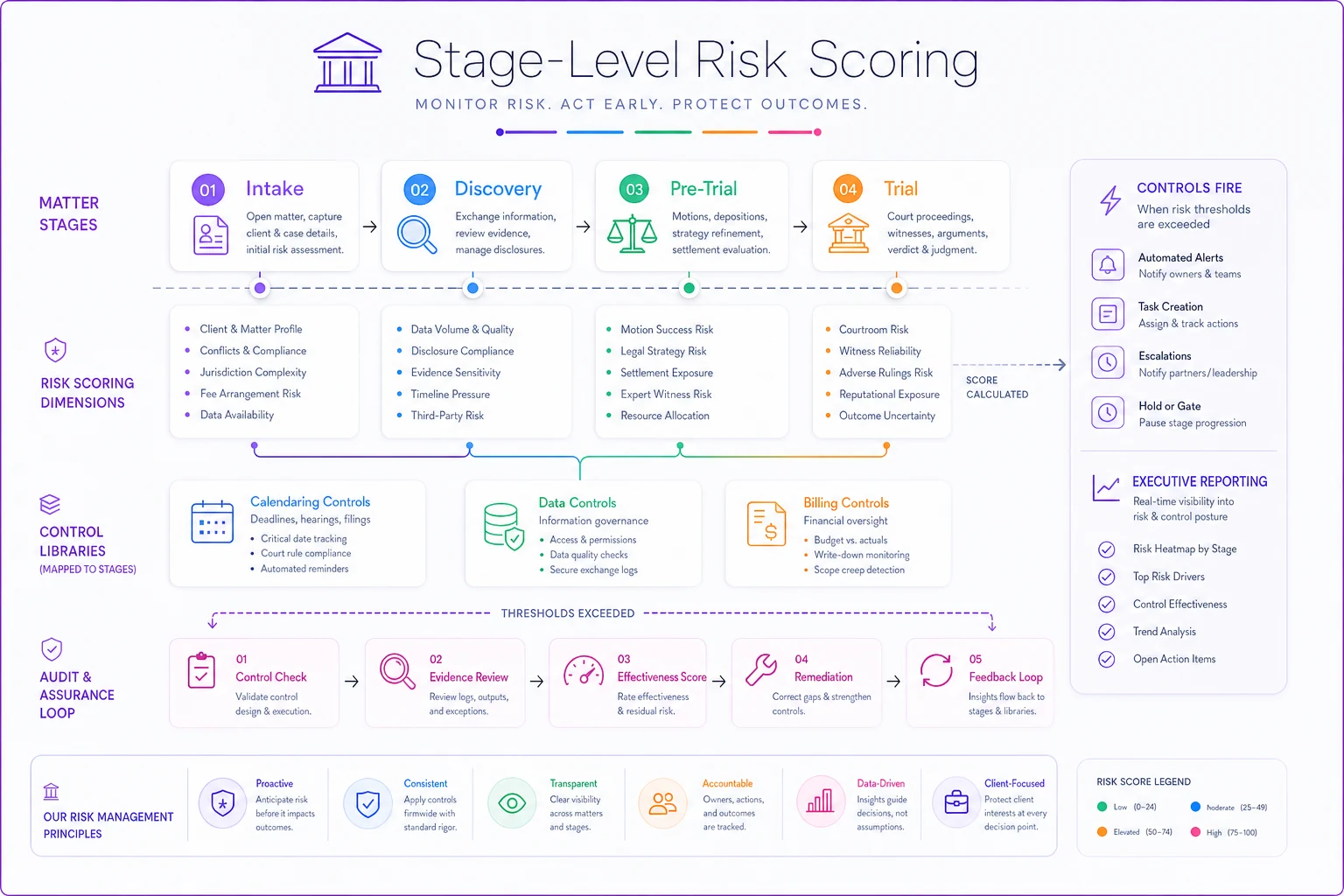
Calendaring controls. These are your highest-consequence, lowest-tolerance controls because a blown deadline is often uninsurable-feeling in the moment. The library should include dual-owner assignment for anything with a court-imposed date, backstop reminders at multiple intervals, and a rule that no hard date gets entered by one person without a second confirmation. The deeper mechanics — dual-owner rules, escalation ladders, and who gets pinged when a date goes unconfirmed — are worth setting up properly, and there's a full treatment of that in the piece on calendaring governance and missed-deadline prevention. For the risk matrix, the key is that these controls should escalate automatically when deadline density hits a 4 or 5.
Data controls. These map to the data-sensitivity dimension. Access reviews when new custodians join, retention tagging at matter open, privilege handling before any production. The mistake firms make is treating data governance as one-and-done at intake, when the real exposure shows up mid-matter — during discovery, during a lateral departure, during a vendor handoff. A stage-aware library re-checks access rights when a matter enters a high-sensitivity stage. If you want the classification, retention, and access-audit backbone that these controls sit on, the matter-focused data-governance matrix covers that in detail.
Billing controls. These catch the slow bleed — write-offs, realization surprises, LEDES rejections, trust-balance problems that turn into bar complaints. The library should include pre-submit validation, retainer-replenishment triggers, and a rule that any matter approaching budget overrun gets partner sign-off before more time accrues. Tying these to the budget structure matters, because a billing control without a budget baseline is just an alert with no threshold. The stage-tied budgeting framework is the reference for setting those thresholds so your billing controls have something concrete to fire against.
One thing worth emphasizing: a control isn't real unless it has an owner, a trigger, and a check. "We review conflicts" is not a control. "Intake lead runs the conflict decision-tree before the engagement letter goes out, and a second reviewer signs off on any hit" is a control. Every entry in your library should read like the second version.
Pro-tip: a control isn't real unless it has an owner, a trigger, and a check.
One thing worth emphasizing: a control isn't real unless it has an owner, a trigger, and a check. "We review conflicts" is not a control. "Intake lead runs the conflict decision-tree before the engagement letter goes out, and a second reviewer signs off on any hit" is a control. Every entry in your library should read like the second version.
Where this breaks as the firm grows
At five attorneys, informal risk sense works fine because one partner has the whole book in their head. They know a matter is heating up because they walked past the associate's desk. The framework exists — it's just undocumented.
The break happens somewhere around 15–25 timekeepers. That's where no single person holds the whole picture anymore, but the firm still runs on the assumption that someone does. New matters open faster than anyone re-scores them. Controls that used to fire because a partner remembered now don't fire because the partner is buried. Handoffs multiply — associate to paralegal to contract attorney — and each handoff is a place where a control silently drops.
A pattern that shows up more than you'd expect: a firm crosses into that mid-size zone, opens significantly more matters year over year, and their risk incidents don't rise proportionally — they rise faster than the matter count. That non-linear jump is the tell that informal risk sense has stopped scaling. The controls didn't get worse; there are just more intersections where weak controls can line up badly.
What actually scales is making the scoring and control-firing something the system does rather than something a person remembers. This is where AI-assisted operational platforms earn their place quietly in the background — re-scoring matters as stage data changes, flagging when a dimension crosses a threshold, routing the right control to the right owner without waiting for a human to notice. The point isn't automation for its own sake. It's that a re-score which used to depend on a partner's memory now happens every time the underlying data moves, so the framework stays live instead of decaying between annual audits.
Audit cadence: what to check and how often
A control library gathers dust if nobody verifies the controls actually fired. Audit cadence is the heartbeat that keeps the framework honest, and it should run at three different tempos because different risks decay at different speeds.
-
Weekly — high-flag matters only. Any matter with a dimension scored 4 or 5 gets a fast eyes-on review. Did the deadline controls fire? Is the trust balance clean? Is the responsible attorney still under their utilization ceiling? This is a 15–20 minute scan, not a deep dive, and it only touches the handful of matters that earned attention.
-
Monthly — control-coverage sweep. Sample across all active matters and confirm the required controls for their current stage are actually present and owned. You're not re-reviewing every matter; you're checking whether the library is being applied consistently. This is where you catch drift — the quiet erosion where controls stop firing because everyone got busy.
-
Quarterly — framework calibration. Look at the incidents and near-misses from the quarter and ask whether your rubric predicted them. If three problems came from a dimension you score low, your rubric is miscalibrated. The scoring model should evolve based on what actually hurt you, not stay frozen from the day you wrote it.
A short checklist for the monthly sweep, since it's the one firms most often skip:
-
Does every active matter have a current stage assigned?
-
Does every high-sensitivity-stage matter have a completed access review?
-
Does every court-deadline matter have two named calendar owners?
-
Are retainer-replenishment triggers set on matters over their threshold?
-
Has any matter changed stage without being re-scored?
-
Are there matters open more than 90 days with no activity and no closure?
This is where you catch drift — the quiet erosion where controls stop firing because everyone got busy.
A real scenario
A litigation-heavy firm of around 18 attorneys had no incidents that made the papers, but there was a pattern: a couple of fee disputes a year, some near-miss deadline scares, and one trust-accounting hiccup that took a stressful week to untangle. Individually, each looked like bad luck. Together they were a framework gap.
They built a stage-level rubric and wired control libraries to it. Nothing exotic — the whole setup lived on their existing matter system plus a scoring layer that re-ran when stage data changed. The first monthly sweep flagged that roughly a third of their court-deadline matters had only one named calendar owner. That single finding probably prevented the next deadline scare.
Over the following year the improvements were undramatic and real: fee disputes dropped significantly, deadline near-misses effectively stopped showing up in quarterly reviews, and the malpractice-renewal questionnaire went from a two-week scramble to something answerable from their reporting templates in an afternoon. No heroic turnaround — just a framework that saw the intersections a single overloaded partner couldn't.
When this framework makes sense — and when it doesn't
When it's worth building: you're past the point where one person holds the whole book, you're opening matters faster than you can informally track them, or your malpractice profile spans very different matter types with very different risk shapes. Firms in that mid-size squeeze get the most out of it because it replaces memory with structure right when memory stops scaling.
When it's overkill: a solo or tight three-person firm where everyone genuinely knows every active matter. Building a six-dimension rubric and a three-tempo audit cadence for eight active matters is process for its own sake. Score informally, keep a lightweight calendaring backstop, and revisit when you grow.
Who should not do this: any firm that will build the rubric, run it for a quarter, and then let it freeze. A miscalibrated framework that nobody recalibrates is worse than honest informality — it gives false confidence. If you're not going to run the quarterly calibration, don't pretend to have a framework. Just keep partners close to the matters.
Executive reporting: make the framework visible to the people who decide
The last piece is what keeps the whole thing funded and alive: reporting that a managing partner actually reads. The template should fit on one page and answer three questions — where is risk concentrated right now, what's trending worse, and what did we catch before it became an incident.
Concentration is a simple heat view: which practice groups or attorneys are carrying the most high-flag matters this month. Trend is the direction of your risk scores quarter over quarter. And the "caught before it broke" line is the one that justifies the entire program — every near-miss the framework surfaced is a claim, a dispute, or a bar complaint that didn't happen.
That last metric matters more than it looks. Risk programs die because their value is invisible — nothing going wrong doesn't feel like a win. Reporting the near-misses makes the invisible visible. It's the difference between leadership seeing the framework as overhead and seeing it as the reason the bad quarters stopped happening.
A matter risk framework isn't a binder or a once-a-year exercise. It's a living map that scores risk where it actually lives — at the stage — attaches specific owned controls to each risk shape, and checks itself on a rhythm that matches how fast each risk decays. Build it that way and it stops being the thing you dread before the audit and starts being the thing that quietly keeps you off the audit's radar in the first place.
Ready to elevate your legal practice management?
Join 500+ law firms using Casioly to optimize case workflows, reduce administrative burden, and improve client satisfaction.