



Matter data governance in most law firms is broken. Not just inefficient or a little outdated—fundamentally broken in ways that create compounding risk across every practice area.
Most firms figure this out at the worst possible moment: when opposing counsel requests production, when a departing partner disputes file ownership, or when state bar auditors want documentation that should exist but doesn't. The scramble that follows burns thousands of billable hours that proper governance would have prevented.
What makes it so frustrating is that firms already have most of what they need. Document management systems, matter tracking databases, retention policies buried somewhere in an operations manual. The problem isn't missing tools—it's that nothing connects to actual matter workflows.
Why traditional document governance fails at the matter level
Traditional document governance treats all firm data like it belongs in the same bucket. Corporate governance documents get the same retention rules as active litigation files. Settlement agreements sit next to marketing materials. Client communications mix with internal memos in shared drives nobody properly maintains.
That approach might have worked when firms handled 50 matters a year. But even mid-sized firms now juggle hundreds of active matters across multiple practice areas, each with distinct regulatory requirements, retention obligations, and access restrictions. A personal injury matter has completely different governance needs than a corporate merger. Most firms still apply the same generic policies to both.
The real damage happens when matters cross practice areas or span multiple jurisdictions. A routine business dispute suddenly picks up employment claims with different retention requirements. A real estate transaction spawns environmental litigation with specialized discovery obligations. Without matter-specific governance frameworks, firms end up either over-retaining everything—unnecessary risk and storage costs—or under-retaining critical documents and creating malpractice exposure.
Classification by risk: the framework that actually works
One approach consistently works better than generic retention policies: classification by risk at the matter level, not the document level.
Never miss a critical deadline again.
Casioly helps legal teams manage cases efficiently and stay on top of critical tasks.
- Centralized case tracking
- Automated deadline reminders
- Secure client communication
No credit card required
Here's what this looks like in practice:
Risk Level 1: Routine Matters
-
Standard commercial contracts
-
Simple estate planning
-
Uncontested divorces
-
Basic corporate formations
These matters follow standard retention periods, typically 5–7 years after matter close. Access stays limited to assigned attorneys and paralegals. Disposal happens automatically unless flagged.
Risk Level 2: Moderate Complexity
-
Multi-party litigation
-
Regulatory filings
-
Complex transactions
-
Employment disputes
These require enhanced governance. Retention extends to 10 years minimum, with automatic holds for related matters. Access controls include audit trails and periodic reviews. Nothing gets deleted without partner approval.
Risk Level 3: High-Stakes Matters
-
Class actions
-
Government investigations
-
Bet-the-company litigation
-
Matters with potential criminal implications
Everything gets preserved indefinitely until someone explicitly authorizes disposal. Access requires documented business purpose. All actions generate alerts to managing partners.
| Risk Level | Examples | Retention/Access/Disposition |
|---|---|---|
| Risk Level 1: Routine Matters | Standard commercial contracts; Simple estate planning; Uncontested divorces; Basic corporate formations | Typically 5–7 years after matter close. Access limited to assigned attorneys and paralegals. Disposal happens automatically unless flagged. |
| Risk Level 2: Moderate Complexity | Multi-party litigation; Regulatory filings; Complex transactions; Employment disputes | Retention extends to 10 years minimum, with automatic holds for related matters. Access controls include audit trails and periodic reviews. Nothing gets deleted without partner approval. |
| Risk Level 3: High-Stakes Matters | Class actions; Government investigations; Bet-the-company litigation; Matters with potential criminal implications | Everything gets preserved indefinitely until someone explicitly authorizes disposal. Access requires documented business purpose. All actions generate alerts to managing partners. |
Classification happens during intake, not months later when someone remembers to update the matter type. A simple three-question decision tree determines the risk level:
-
Could this matter spawn related litigation?
-
Does this involve regulatory compliance or government entities?
-
Are damages or transaction values over $1 million?
Any "yes" bumps the classification up one level.
Retention triggers that map to matter metadata
Generic retention schedules assume matters have clean end dates. They don't. A case might settle but generate fee disputes two years later. A transaction closes but warranty claims surface three years down the road. A criminal matter ends and expungement proceedings begin five years after that.
Smart retention frameworks tie to matter metadata that actually lives in your practice management system:
-
Last time entry
-
Last client communication
-
Last court filing
-
Last payment received
-
Related matter activity
Instead of "7 years from matter close," the rule becomes "7 years from last client activity on this matter or any related matter." That prevents the nightmare where you destroy files for Matter A and then discover Matter B—still open—needed those exact documents.
The metadata approach also catches matters that never officially close. Roughly 15% of matters in most firms exist in perpetual limbo—not active enough to bill, not finished enough to close. Traditional retention policies ignore these entirely. Metadata-driven triggers catch them automatically when client communication stops for a year or more.
Access review checklists that prevent permission creep
Permission creep is a slow-moving problem that creates serious exposure. It starts innocently enough: an associate needs temporary access to research a similar case, a paralegal covers for someone on vacation, a partner wants their assistant to pull some old documents. Six months later, 40-plus people have access to matters they haven't touched in months.
Annual access reviews don't fix this because they treat all permissions the same. The originating partner gets the same scrutiny as the temp who scanned documents once.
Monthly Reviews:
-
Contract attorneys
-
Temporary staff
-
Vendors with system access
-
Recently departed employees
Quarterly Reviews:
-
Paralegals
-
Associates
-
Staff attorneys
-
Administrative personnel
Annual Reviews:
-
Partners
-
Of counsel
-
Long-term administrators
Each review follows a specific checklist:
-
Has this person billed time to this matter in the review period?
-
Does their current role require continued access?
-
Are they still employed or contracted with the firm?
-
Have they accessed the matter files in the last 30 days?
Any "no" triggers automatic revocation unless explicitly overridden with documented justification.
This might feel like overkill until you realize a 50-attorney firm can easily have over 10,000 individual matter-permission combinations. Without systematic reviews, you're trusting that someone manually removes permissions every time an employee changes roles, leaves the firm, or wraps up their matter work. That never happens consistently.
Building your incident handoff templates
When data incidents hit—and they will—the first 48 hours determine whether you're managing a minor headache or a malpractice claim. Most firms have no structured handoff process between whoever discovers the issue and the team that needs to respond.
Here's what typically happens: a paralegal notices unusual access patterns on a sensitive matter. They mention it to their supervising attorney, who's in trial and forgets. Three weeks later, opposing counsel files a motion about improperly accessed privileged documents. Now everyone scrambles to reconstruct what happened, when, and who knew what.
Discovery Phase (First 2 hours):
-
Who discovered the issue
-
What exactly was observed
-
When it was first noticed
-
Which matters are affected
-
Screenshots or system logs captured
Initial Assessment (Hours 2–6):
-
Scope of potential exposure
-
Client notification requirements
-
Regulatory reporting obligations
-
Immediate containment steps taken
-
Partners and stakeholders notified
Response Coordination (Hours 6–48):
-
Legal team assigned
-
IT forensics initiated
-
Client communications drafted
-
Insurance carrier notified
-
Remediation plan developed
Here's a simple visual of the incident handoff workflow.
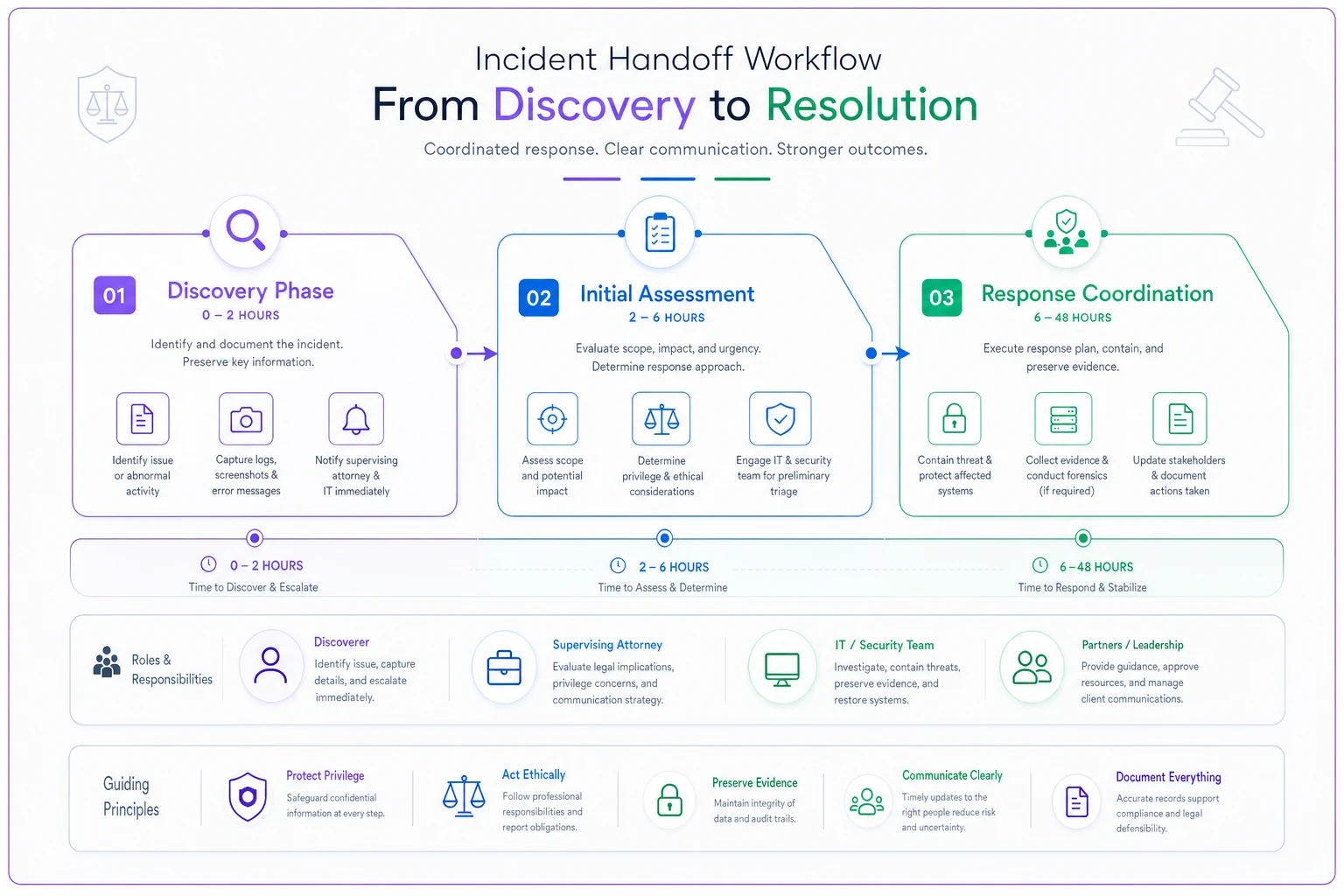
The template forces everyone to capture information while it's fresh, not three weeks later when memories have faded and logs have been overwritten.
Connecting to your e-discovery and permissions infrastructure
Matter data governance can't function in isolation from your e-discovery processes or permissions management systems. They're three legs of the same stool.
When e-discovery requests arrive, your matter classification should automatically trigger appropriate preservation holds. Risk Level 3 matters get immediate litigation holds across all systems. Risk Level 2 matters require partner approval before any data destruction. Risk Level 1 matters follow standard preservation protocols.
Classification also drives collection scope. High-risk matters trigger expanded collection including email archives, chat logs, and personal devices if BYOD policies apply. Routine matters stick to core matter documents unless specifically requested.
Permissions need the same integration. New team members on high-risk matters require enhanced background checks and specific confidentiality agreements. Their access gets logged differently, with detailed audit trails instead of simple login records. When they leave the matter or the firm, access revocation follows accelerated timelines with confirmed verification.
Without this integration, you get the common scenario where e-discovery preservation happens but nobody tells the document management team, so files keep getting modified. Or permissions get granted for discovery review and nobody removes them after production ends.
Common pitfalls in matter-scoped governance
Over-engineering the classification system
Some firms build 15 risk levels with dozens of sub-categories. It feels sophisticated but kills adoption. Attorneys won't memorize complex taxonomies, and support staff won't consistently apply nuanced rules. Three levels work. Five might work if you have dedicated governance staff. Anything beyond that becomes a theoretical exercise, not operational reality.
Ignoring state-specific requirements
A California employment matter has different retention requirements than a Texas employment matter. A New York divorce has different confidentiality rules than a Florida divorce. Firms operating across state lines need jurisdiction-specific variants, not blanket policies.
Treating all matter data the same
Not every document in a matter needs identical governance. Publicly filed pleadings have different retention needs than attorney work product. Client communications require different access controls than legal research. Practical frameworks distinguish between:
-
Core matter documents (pleadings, contracts, correspondence)
-
Supporting materials (research, drafts, notes)
-
Administrative records (invoices, time entries, conflicts checks)
-
Client-provided materials (original documents, business records)
Each category gets appropriate governance without overcomplicating the system.
Automating too much too fast
Full automation sounds great until it deletes the wrong files or locks out the managing partner. Start with automated alerts and recommendations, not automated actions. Let humans verify the system works correctly before trusting it with irreversible decisions.
Implementing classification matrices without disrupting operations
New governance frameworks almost always trigger firm-wide resistance. Partners don't want to change their workflows. Associates don't want extra administrative tasks. Staff doesn't want another system to learn.
Start with new matters only. Don't try to retroactively classify thousands of existing matters. Begin with matters opened after a specific date. This limits disruption while proving the system works.
Start with new matters only.
Pick one practice area for the initial rollout. Corporate transactions or estate planning work well because they have predictable patterns and clear endpoints. Litigation is harder—matters drag on for years with unpredictable twists.
Build classification into existing intake workflows. If someone already fills out a new matter form, add three classification questions to that form. Don't create a separate governance intake process that people will skip.
Make the benefits visible quickly. When attorneys can instantly see which matters require special handling, when paralegals know exactly what retention rules apply, when IT can automate permission reviews—adoption accelerates on its own.
Measuring governance effectiveness with matter-level metrics
Most firms measure document governance by counting policies written or training sessions completed. These metrics tell you nothing about operational effectiveness.
Better metrics tie directly to matter outcomes:
Response Time Metrics:
-
Hours to compile production for discovery requests
-
Days to complete conflict checks across historical matters
-
Time to restore archived matter files when needed
Risk Reduction Metrics:
-
Number of matters with undefined retention status
-
Percentage of matters with active permission reviews
-
Count of incidents caught by access monitoring
Efficiency Metrics:
-
Storage costs per matter by risk classification
-
Hours spent on manual permission management
-
Attorney time lost to document searching
Track these monthly by practice area and you'll spot problems before they become crises. If employment matters suddenly show ten times more permission exceptions than corporate matters, something's wrong with your classification or your workflows.
Building matter-level accountability without micromanagement
The biggest governance failures happen when nobody owns the outcome. IT owns the systems but not the legal requirements. Attorneys own the matters but not the technical infrastructure. Administrators own the processes but not the decision authority.
Matter-level accountability means one person—usually the originating attorney—owns governance decisions for that specific matter. They decide the classification level. They approve retention extensions. They authorize access changes.
This doesn't turn attorneys into IT administrators. The framework makes decisions based on matter metadata. They verify the automation got it right and handle exceptions.
Simple escalation paths for common scenarios:
-
Client requests immediate file destruction → Managing partner approval required
-
Departing attorney claims file ownership → Executive committee review
-
Third party subpoenas matter records → General counsel notification
-
System recommends disposal of 7-year-old files → Originating attorney confirmation
Clear ownership plus defined escalation prevents both governance paralysis and rogue decisions.
The hidden costs of poor matter data governance
Firms rarely calculate the true cost of broken governance until something catastrophic happens. But the daily drain is measurable if you know where to look.
A midsized firm with 500 active matters and no proper classification probably loses around 3 hours per matter per year to searching for misfiled documents, verifying retention compliance, and managing permissions manually. That's roughly 1,500 hours annually—somewhere around $450,000 in lost billable time depending on your rates.
Add storage costs for over-retained documents (typically 30–40% more than necessary), cyber insurance premiums inflated by poor access controls, and staff time on manual reviews. The total often clears $600,000 annually for a 30-attorney firm.
The catastrophic costs are worse. One malpractice claim from destroyed documents can mean $2–3 million in damages and defense costs. One data breach from excessive permissions can easily run $500,000 in notification costs alone, before you factor in reputational damage.
Compare that to proper governance infrastructure: roughly $50,000–75,000 to implement, then $20,000–30,000 annually to maintain. The math isn't complicated—but only if you're actually measuring the right things.
What this looks like with modern operational software
Modern operational platforms move matter data governance from manual checklists to automated workflows. Instead of attorneys trying to remember to classify matters, the system proposes classifications based on matter type, client industry, and jurisdiction. Instead of paralegals manually reviewing permissions every quarter, the platform monitors access patterns continuously and flags anomalies.
AI automation strengthens these workflows by learning from firm-specific patterns. If employment matters from certain clients consistently escalate to Risk Level 3, the system starts suggesting higher classification by default. When attorneys regularly extend retention for specific matter types, default timelines adjust accordingly.
The real value comes from integration. Matter classification flows automatically to your document management system, e-discovery platform, billing software, and client portal. Change the risk level in one place and retention rules, access permissions, and billing rates update everywhere.
This isn't about replacing attorney judgment—it's about making sure that judgment gets applied consistently. Partners still make the big calls, but they make them once, in a structured way, instead of repeatedly in ad-hoc fashion across different matters and different staff.
Moving forward with matter data governance
Start small but think systematically. Pick your highest-risk practice area and build a classification matrix for new matters. Document retention triggers based on actual metadata you already track. Create access review checklists that fit your firm's real roles.
Don't wait for the perfect system. Basic classification beats no classification. Manual reviews beat no reviews. Simple templates beat scrambling during an incident.
The firms that get matter data governance right aren't necessarily the largest or most technically sophisticated. They're the ones treating it as an operational discipline rather than a compliance checkbox—building frameworks that match how attorneys actually work, not how policy manuals say they should.
Every matter that enters your firm creates data governance obligations that last years beyond final billing. Without proper frameworks, you're essentially betting that nothing goes wrong during that entire retention window. With the right classification matrices, retention triggers, and review protocols, you convert that bet into manageable operational risk.
The question isn't whether you need better matter data governance—it's whether you implement it before something forces your hand or after.
Ready to elevate your legal practice management?
Join 500+ law firms using Casioly to optimize case workflows, reduce administrative burden, and improve client satisfaction.