



Matter management governance breaks in predictable ways. Small firms survive on personal relationships and informal controls. Massive firms have dedicated teams and enterprise systems. The breakdown happens in that dangerous middle zone—typically around 15-25 attorneys—when informal controls stop working but formal governance still feels unnecessary.
A boutique litigation firm I worked with grew from 8 to 22 attorneys over three years. Their matter creation process? Any attorney could open matters in their practice management system. No approval workflow. No standardized naming. No conflict checks beyond memory. The managing partner discovered they had 47 duplicate matters across different practice areas—same client, different naming conventions, zero coordination. Their malpractice insurance audit flagged it as critical risk.
The duplicates weren't the real problem. They revealed something worse: zero visibility into who was doing what work, which matters were actually profitable, and whether retention policies were being followed. They were operating completely blind.
Why permission matrices become political nightmares
Creating matter management governance sounds straightforward until you try implementing it. The technical setup takes maybe a week. Getting partners to agree on who can create matters, who approves them, and what metadata is required? That negotiation drags for months.
The resistance patterns are remarkably consistent. Senior partners want complete autonomy—they've been opening matters their way for decades. Associates need enough access to work efficiently but not enough to create liability. Paralegals require specific permissions that vary by practice area. Administrative staff need visibility without modification rights.
Most firms default to giving everyone too much access because restriction creates friction. Then something goes wrong—a matter gets opened without conflict checking, sensitive documents end up in the wrong hands, or someone accidentally modifies billing rates—and suddenly governance becomes urgent.
A 35-attorney firm in Chicago took a different approach. Instead of designing perfect permissions upfront, they started with three simple tiers: matter creators (partners only initially), matter managers (senior associates and paralegals), and matter viewers (everyone else). They logged every permission exception request for 90 days, then used that data to refine their matrix. By mapping actual workflow needs rather than theoretical ones, they avoided both over-restriction and under-governance.
Their permission matrix evolved into something more sophisticated but manageable:
| Role | Create New Matter | Modify Matter Details | Add Documents | View Financial Data | Delete/Archive |
|---|---|---|---|---|---|
| Managing Partner | Yes | All matters | All matters | All matters | Yes |
| Practice Group Leads | Yes (own group) | Own group matters | Own group matters | Own group matters | No |
| Senior Associates | Request only | Assigned matters | Assigned matters | Assigned matters only | No |
| Junior Associates | No | Limited fields | Assigned matters | No | No |
| Paralegals | No | Task fields only | Assigned matters | No | No |
| Billing Staff | No | Billing fields only | No | All matters | No |
What made this work wasn't the specific permissions—it was that they mapped directly to how people actually worked. Senior associates could manage their cases without constantly asking partners for permission. Billing staff could access financial data without seeing privileged documents. Paralegals could update task status without changing billing rates.
The audit trail nobody builds until after the lawsuit
Most firms think about audit trails after something goes wrong. A client complains about overbilling. A document goes missing. A former employee claims they were excluded from a profitable matter. Suddenly everyone wants to know who did what, when.
Never miss a critical deadline again.
Casioly helps legal teams manage cases efficiently and stay on top of critical tasks.
- Centralized case tracking
- Automated deadline reminders
- Secure client communication
No credit card required
Building audit trails retroactively is nearly impossible. You need to capture actions as they happen, not reconstruct them months later. But audit trails aren't just about compliance or covering your liability. They're operational intelligence.
A properly structured audit trail tells you how work actually flows through your firm. Who typically initiates matters in each practice area? How long does matter creation to active work take? Which attorneys consistently bypass approval workflows? Where do matters stall?
One firm discovered through their audit logs that their average matter sat dormant for 11 days between creation and first billable activity. The cause? Their matter creation process required three approvals, but partners only checked their approval queues weekly. Daily notification reduced that lag to 2 days and accelerated cash flow by roughly $200k annually.
Your audit trail needs to capture these events:
Matter Creation Events
-
Who initiated the request
-
Timestamp of creation
-
Initial matter type and practice area designation
-
Conflict check completion (who performed, when, results)
-
Approval chain (each approver, timestamp, any conditions)
-
Initial team assignments
Modification Events
-
Every field change (what changed, previous value, new value)
-
Who made the change and when
-
Whether change required approval
-
Billing rate modifications especially
-
Client contact updates
-
Matter status transitions
Access Events
-
Document views and downloads
-
Financial data access
-
Report generation
-
External sharing activities
-
Unusual access patterns (off-hours, high volume)
Retention and Disposal
-
When retention period begins
-
Automatic holds placed
-
Manual retention overrides
-
Disposal authorization
-
Actual disposal confirmation
The key insight: every action gets logged automatically. No one remembers to document manually, but systems can track everything without human intervention.
Building retention SOPs that attorneys will actually follow
Retention policies fail because they're written by compliance teams for compliance teams. A 47-page retention manual might satisfy regulatory requirements, but no practicing attorney will ever reference it. They need simple, matter-specific guidance embedded in their actual workflow.
The breakthrough happens when you tie retention rules directly to matter metadata. Instead of expecting attorneys to remember that employment discrimination matters require 7-year retention while contract disputes need 10 years, you encode these rules in the matter type itself.
Start with matter categorization that maps to retention requirements. Don't create 200 categories—attorneys won't classify accurately. Most firms operate with 15-20 matter types covering 95% of their work. Each type gets clear retention rules:
-
Automatic retention period calculation based on matter close date
-
Hold triggers for litigation, regulatory inquiry, or client request
-
Escalation workflows for matters approaching disposal dates
-
Client notification requirements before any destruction
-
Exception handling for matters with special circumstances
A firm handling corporate transactions and litigation built their retention SOP around four key triggers:
Matter Close Trigger: System automatically calculates retention period based on matter type. Corporate formation = 7 years from dissolution. M&A = 10 years from close. Litigation = 7 years from final judgment. Clock starts automatically, no manual intervention.
Annual Review Trigger: Every January, system generates list of matters eligible for disposal. Responsible attorney gets 30 days to review and either approve disposal or extend retention with documented reason.
Client Departure Trigger: When a client relationship ends, all their matters get flagged for retention review. Departed client matters often have different retention requirements than active ones.
Regulatory Change Trigger: When retention laws change, system flags affected matters for manual review rather than applying new rules blindly.
Tie retention rules to matter type and automate holds so attorneys don't need to remember retention durations.
The enforcement piece is where most firms stumble. You can't rely on manual compliance checks. The system needs to prevent non-compliant actions automatically. Attorney tries to delete documents from a matter under legal hold? Blocked with explanation. Someone attempts to modify closed matter data? Requires managing partner approval.
The metadata framework that prevents operational chaos
Matter metadata seems boring until you realize it determines whether you can actually run your firm or just react to whatever's happening. The firms struggling with profitability, where partners have no idea which matters make money? They all have garbage metadata.
The temptation is to track everything. One firm showed me their matter creation form—73 required fields. Their attorneys were entering gibberish to get through it. "Client Industry: Other. Matter Value: TBD. Opposing Counsel: Various." Completely useless.
Effective metadata serves three purposes: operational management, financial analysis, and risk mitigation. Everything else is noise.
Core Operational Metadata (Required at creation)
-
Client identifier (linked to conflicts system)
-
Matter type (drives retention, workflows, billing)
-
Responsible attorney (single point of accountability)
-
Originating attorney (credit allocation)
-
Practice area (resource planning)
-
Status (active, dormant, closed)
Financial Metadata (Required before first bill)
-
Billing arrangement (hourly, flat, contingency, hybrid)
-
Rate structure or fee amount
-
Budget estimate (even if rough)
-
Billing frequency
-
Payment terms
Risk Metadata (Assessed within first week)
-
Conflict check status and date
-
Malpractice risk level (standard, elevated, high)
-
Special retention requirements
-
Insurance coverage confirmation
-
Engagement letter status
Performance Metadata (System-generated, not manual)
-
Actual hours vs budget
-
Realization rate
-
Collection velocity
-
Matter profitability
-
Client satisfaction scores
Metadata must be tied to consequences. If entering wrong metadata has no impact, accuracy drops to zero. When matter type determines billing rules, workflow routing, and retention periods, attorneys suddenly care about getting it right.
Permission inheritance patterns that scale without IT intervention
Most firms handle permissions matter by matter, manually setting access for each new case. This works for your first 50 matters. By matter 500, it's unmanageable. By matter 5,000, you've got security holes everywhere because nobody can track who has access to what.
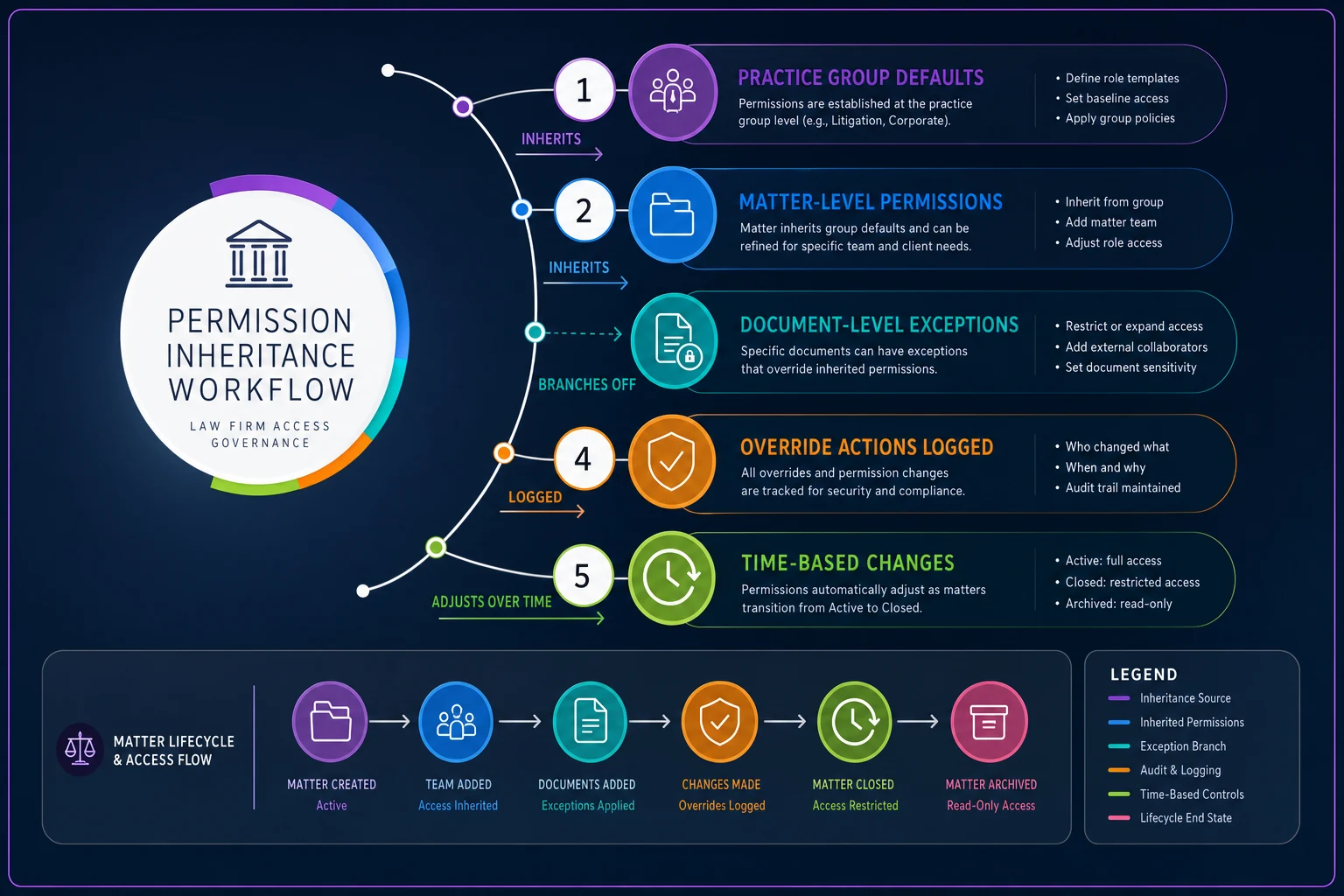
Smart permission systems use inheritance patterns. Permissions flow from practice groups to matters to documents, with override capabilities at each level. This sounds complex but actually simplifies management dramatically.
Level 1 - Practice Group Defaults: Corporate group members automatically get access to new corporate matters. Litigation team sees litigation matters. Family law stays completely isolated. New team members inherit their group's permissions immediately.
Level 2 - Matter-Specific Adjustments: High-stakes litigation matter needs tighter control? Override group defaults to limit access to core team only. Pro bono matter requiring volunteer attorney help? Add specific external users without changing group permissions.
Level 3 - Document Exceptions: Most documents inherit matter permissions. But that expert witness report? Lock it down to partners only. The client's financials? Restrict to attorneys, exclude paralegals. Each exception is logged and reviewed quarterly.
Level 4 - Time-Based Evolution: Permissions change over matter lifecycle. During active litigation, whole team has access. Post-settlement, access restricts to partners and billing. After retention period, read-only for everyone except records management.
This structure means adding a new attorney takes minutes, not hours. They join their practice group, inherit standard permissions, get explicitly added to specific matters as needed. When they leave, one removal cascades through the entire system.
The real power comes from permission templates. Instead of building from scratch, you select "Complex Litigation Template" and get pre-configured access patterns: core team full access, experts limited to their materials, local counsel specific folder access, client portal visibility for defined documents. Modifications are logged as variances for review.
The workflow below shows how permissions inherit and where overrides apply.
Modifications are logged as variances for review.
Why "matter owner" is the worst governance model
The "matter owner" model seems logical—one person owns each matter, controls access, makes all decisions. It's also why firms end up with governance disasters when that owner leaves, gets sick, or just gets too busy to manage permissions properly.
Senior partner has exclusive control over 200+ matters. Has a heart attack. Nobody can access critical client documents for three days while IT scrambles to break into the system. Client fires the firm.
Better model: distributed governance with clear escalation paths. Every matter needs:
-
Primary Attorney (legal responsibility, strategic decisions)
-
Matter Manager (often senior paralegal, handles day-to-day permissions and workflow)
-
Billing Supervisor (approves rates, reviews write-offs)
-
Risk Reviewer (quarterly check on compliance, conflicts)
No single person can lock others out. No single absence cripples operations. But accountability remains clear—primary attorney can't claim ignorance because someone else managed permissions.
This distributed model requires clear escalation rules:
-
Permission disputes go to practice group leader
-
Billing conflicts escalate to managing partner
-
Compliance issues trigger automatic legal administrator review
-
Client complaints override all internal permissions—management gets immediate access
The key is building redundancy without losing accountability. Multiple people can access everything, but specific roles own specific decisions.
Connecting governance to profitability metrics
Most firms miss this connection: proper matter management governance directly impacts profitability, but nobody measures it. They track billable hours, realization rates, collection speeds. They don't track how governance failures eat profits.
Consider what poor governance actually costs:
-
Duplicate matter creation
Average of 3.5 hours wasted per duplicate across team members discovering and merging work. At $400/hour, that's $1,400 per incident.
-
Permission delays
Waiting for access approval averages 4.2 hours per request. Multiply by dozens of requests monthly.
-
Incorrect billing setup
Wrong rates on matters average $8,500 in write-offs before discovery and correction.
-
Missing retention deadlines
One spoliation claim can cost millions.
-
Audit preparation
Firms with poor governance spend 10x longer preparing for malpractice audits.
When you implement proper governance, these costs disappear. More importantly, you gain capabilities: accurate matter-level profitability analysis, predictive budgeting based on historical metadata, automated conflict checking, instant audit responses.
One firm tracked their ROI carefully. Their governance implementation cost roughly $75,000 in software and setup time. Within six months, they'd prevented $340,000 in write-offs just from catching billing setup errors. Their malpractice insurance premium dropped $50,000 annually due to improved risk rating. Collection speed increased 15% because billing data was accurate from day one.
The math is compelling once you measure it. The challenge is that most firms never calculate these costs because they're distributed across dozens of small inefficiencies rather than one big disaster.
Building governance that survives partner politics
The technical side of matter management governance is straightforward. The political side destroys most implementations. Partners who've practiced for 30 years don't want some system telling them they can't create matters their way.
Successful governance requires political engineering as much as technical design. Start with voluntary adoption by forward-thinking partners. Let them demonstrate value through better matter profitability and fewer administrative headaches. Success stories spread naturally.
Never frame governance as restriction. Position it as operational intelligence. "This lets you see which matters are actually profitable" resonates. "This restricts your matter creation privileges" causes rebellion.
Build escape valves into the system. Partners need emergency overrides for urgent client needs. But make overrides visible—managing partner gets notified, usage gets tracked, patterns get discussed at partner meetings. Most firms find override usage drops 90% just from visibility alone.
The most effective approach: one firm created a "governance dividend." Money saved from prevented write-offs, faster collections, and reduced malpractice premiums got distributed to partners who followed governance protocols. Partners who consistently bypassed governance didn't participate in the dividend. Compliance hit 95% within three months.
The technology stack that makes governance automatic
Manual governance fails. Always. You need technology that enforces rules automatically, but most firms cobble together incompatible systems that create more problems than they solve.
Your core governance stack needs five integrated components:
-
Practice Management System - The foundation where matters live. Must support custom metadata, permission inheritance, and API access for integration.
-
Document Management Platform - Linked to matter permissions, automatic retention rules, audit trails on every action.
-
Billing System - Pulls metadata from matters, enforces rate rules, prevents unauthorized changes.
-
Conflict Checking - Triggered automatically on matter creation, blocks progress until cleared.
-
Reporting Dashboard - Real-time governance metrics, exception alerts, compliance scores.
The integration points matter more than individual systems. When an attorney creates a matter in practice management, it should automatically create the document structure, establish billing rules, trigger conflict checks, and start retention timers. No manual steps, no data entry duplication, no synchronization delays.
Modern platforms handle this through APIs and webhooks, but plenty of firms still rely on overnight batch synchronization. That's where governance breaks—someone creates a matter at 9am, starts work immediately, but billing doesn't know about it until the next day's sync. By then, they've already logged time at the wrong rates.
The best implementations use what I call "governance as code"—rules encoded in the system itself, not policy documents. Matter type determines permission template. Client category triggers enhanced conflict checking. Practice area sets billing defaults. Geographic location enables specific retention rules. The system enforces governance through configuration, not discipline.
Integration isn't optional anymore. Firms operating with disconnected systems are essentially running blind, hoping manual processes catch errors before they become expensive problems.
From reactive chaos to predictive control
Matter management governance isn't about control for control's sake. It's about transforming your firm from reactive chaos to predictive operations. When every matter follows consistent patterns, when permissions align with responsibilities, when audit trails capture everything automatically, when retention happens without manual intervention—that's when firms stop fighting fires and start building strategically.
The firms thriving right now aren't necessarily the biggest or most prestigious. They're the ones with operational discipline. They know exactly which matters generate profits, which clients create risks, which attorneys need support. That knowledge comes from governance—boring, critical governance that most firms ignore until crisis hits.
Start small if you need to. Pick one practice group, implement basic permission matrices, establish simple audit trails, enforce standardized metadata. Prove the value, then expand. Within a year, you'll wonder how you ever operated without proper governance.
The alternative is continuing to operate blind, hoping nothing goes wrong, scrambling when it inevitably does. In a profession built on risk management for clients, it's remarkable how many firms refuse to manage their own operational risks.
Build the governance framework before you need it, because by the time you need it, it's usually too late.
Ready to elevate your legal practice management?
Join 500+ law firms using Casioly to optimize case workflows, reduce administrative burden, and improve client satisfaction.