


Missed deadlines in law firms rarely happen because someone forgot. They happen because the calendaring system lacks proper structure.
I've built operational software for dozens of small and mid-sized law firms, and the pattern is always the same. Partners assume associates are tracking dates. Associates assume paralegals have it covered. Paralegals think the case management system handles everything automatically. Then a motion deadline passes, or worse, a statute of limitations expires.
The problem isn't memory or workload. Most firms treat calendaring like a single-person responsibility instead of building redundancy into the process.
Why single-owner calendaring breaks down
Traditional calendaring assigns one person to track each deadline. Maybe it's whoever opened the matter, the lead attorney, or the paralegal on the case. This works fine until that person gets sick, quits, goes on vacation, or just gets buried during a busy period.
What happens more often though is jurisdiction confusion. A firm handling cases across multiple states calculates California deadlines using New York rules. Someone enters a federal court date without checking local rules that require earlier filing. These aren't careless mistakes—they're systematic failures.
The financial impact adds up fast. Beyond malpractice exposure, there's the immediate cost of emergency motions, rushed filings, and damaged client relationships. One mid-sized litigation firm calculated they were spending about $45,000 annually just on overtime and express filing fees from last-minute deadline panic.
Building dual-owner accountability into every deadline
Effective calendaring starts with eliminating single points of failure. Every critical deadline needs two owners: a primary responsible party and a backup reviewer. But most firms assign these roles randomly instead of creating systematic rules.
Never miss a critical deadline again.
Casioly helps legal teams manage cases efficiently and stay on top of critical tasks.
- Centralized case tracking
- Automated deadline reminders
- Secure client communication
No credit card required
The primary owner should be whoever knows the matter best—usually the associate or senior paralegal working it daily. The backup reviewer needs enough context to spot problems but enough distance to provide fresh eyes. Often that's a supervising attorney or dedicated calendaring coordinator.
The backup reviewer doesn't re-enter dates or duplicate work. They perform spot checks at defined intervals—weekly for active litigation, monthly for slower matters. They verify jurisdiction rules were applied correctly, confirm calculation methods match court requirements, ensure nothing got lost when team members change.
Assign backups automatically based on matter type to avoid manual selection errors.
Here's a simple visual of the dual-owner workflow.
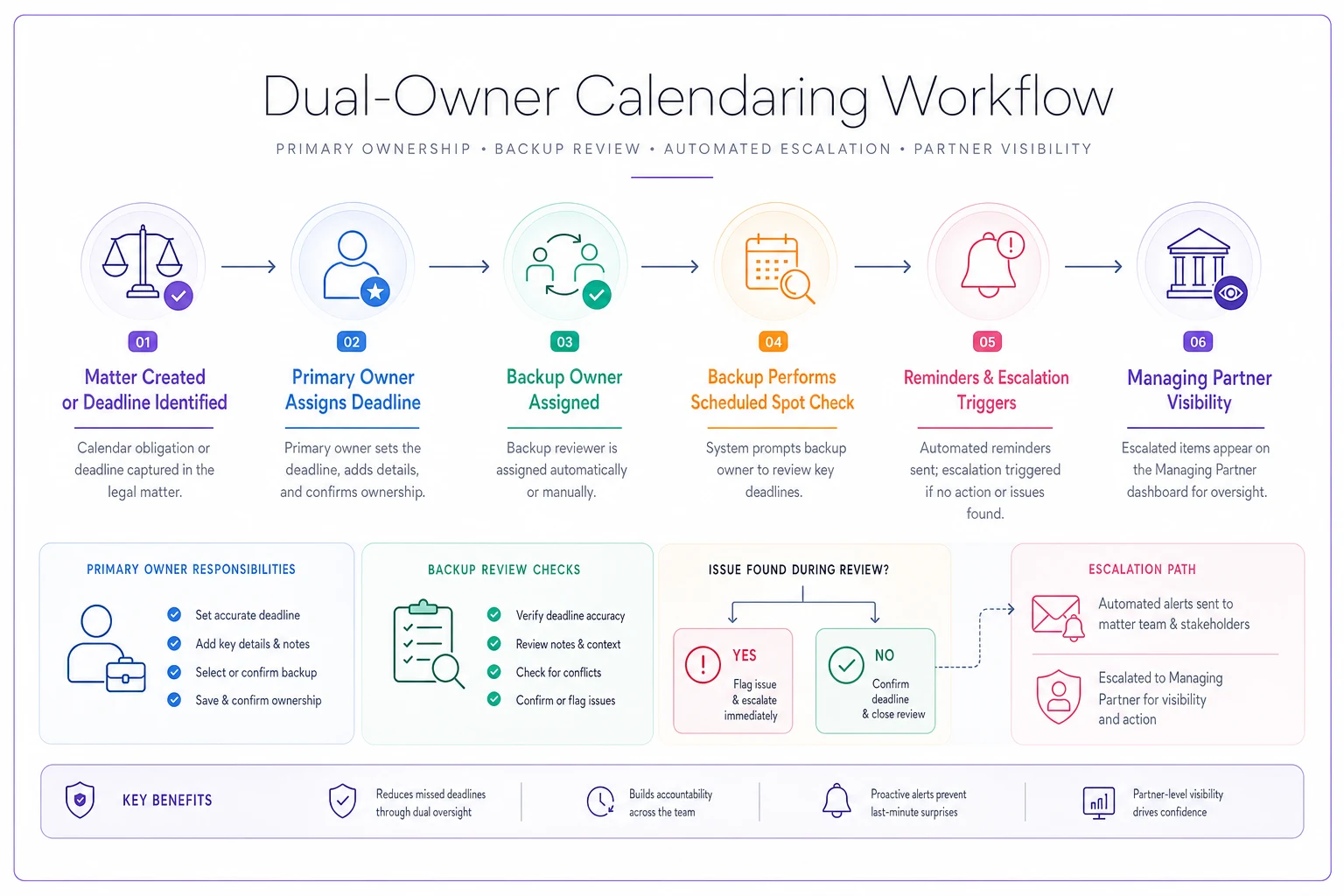
Make these assignments automatic based on matter type, not manual decisions. Patent litigation gets attorney-paralegal pairing. Simple contract disputes might pair two paralegals. Immigration matters require someone familiar with USCIS processing times as backup.
Jurisdiction rules that actually prevent calculation errors
Most calendar systems let you pick a jurisdiction, but few firms build comprehensive rule libraries that account for local variations. You end up with technically correct dates that miss crucial details.
Discovery deadlines are a perfect example. Federal rules give you 30 days to respond to interrogatories. But the Eastern District of Texas local rules can modify timing for certain motions. California state courts have different rules for unlimited versus limited civil cases. New York courts distinguish between commercial division and regular civil parts.
Building proper jurisdiction capture means documenting:
-
Court-specific modifications
Which deadlines differ from standard state or federal rules
-
Service method impacts
How electronic filing versus mail service affects timing
-
Holiday calendars
Which courts observe different holidays or closure dates
-
Motion practice variations
When informal conferences or pre-motion letters affect deadlines
A small insurance defense firm handling cases across three states discovered they were miscalculating removal deadlines in about 15% of their federal cases. Not because they didn't know the 30-day rule—they weren't accounting for how service method affected the calculation start date in different jurisdictions.
The fix isn't just entering these rules once. Build a review process where someone validates rule updates quarterly, especially after local rule amendments. One person can't track every jurisdiction's changes, but a structured review process with assigned jurisdictions per team member makes it manageable.
Redundancy rules that match matter complexity
Not every deadline needs the same level of protection. A routine status conference doesn't require the same safeguards as a summary judgment motion deadline. Most firms either over-engineer everything or under-protect critical dates.
Effective redundancy scales with consequence. Statute of limitations, appeal deadlines, and claim filing dates get maximum protection: dual owners, multiple reminder intervals, escalation triggers. Routine scheduling orders might only need single ownership with standard reminders.
Here's a practical redundancy framework:
| Deadline Type | Primary Owner | Backup Reviewer | Check Frequency | Escalation Trigger |
|---|---|---|---|---|
| Statute/Appeal | Lead Attorney | Managing Partner | Weekly from 60 days out | 30 days before deadline |
| Dispositive Motions | Assigned Associate | Supervising Partner | Bi-weekly from filing | 14 days before deadline |
| Discovery Deadlines | Case Paralegal | Lead Attorney | Weekly during period | 7 days before deadline |
| Status Conferences | Any Team Member | None required | Once at 7 days | 3 days if no confirmation |
| Administrative Filings | Paralegal | Calendaring Coordinator | Monthly | 5 days before deadline |
The escalation trigger is what most firms miss. It's not enough to have a backup person—you need defined points where oversight automatically increases. A statute of limitations deadline that's 30 days away should trigger managing partner visibility, whether the primary owner seems to have it handled or not.
Escalation templates that actually get attention
Generic reminder emails get ignored. Escalation needs to convey urgency without crying wolf on routine matters.
Most calendar systems can send notifications, but few firms customize them effectively. A reminder that says "Deadline in 7 days" gets lost in the inbox. An escalation that says "UNCONFIRMED: Summary Judgment Opposition due in 7 days - No draft on file" gets attention.
The difference is context. Escalation templates should include:
-
Current status verification (draft complete, filed, pending review)
-
Required actions remaining (client approval, co-counsel coordination, filing logistics)
-
Specific person responsible for next step
-
Consequence if missed (non-refundable motion, jurisdictional bar, malpractice exposure)
One firm built escalation templates that automatically CC'd additional people based on time remaining and deadline type. Thirty days out, just the assigned team. Fourteen days out, the supervising attorney gets copied. Seven days out for critical deadlines, managing partner visibility kicks in. Three days out with no completion confirmation triggers an all-hands meeting invite.
This graduated escalation prevents both deadline misses and unnecessary panic. People know that increasing visibility means a real issue, not just automatic spam.
Preventing transition gaps when attorneys leave
The highest risk period for missed deadlines is staff transition. An associate leaves for another firm. A paralegal goes on maternity leave. A partner takes a sabbatical. Institutional knowledge walks out the door and deadlines get orphaned.
Most handoff processes focus on case status and client relationships but neglect calendar ownership transfer. The departing person might mention upcoming deadlines, but rarely transfers the full context of calculation methods, related deadlines, and coordination requirements.
Deadline audit: Every deadline the departing person owns gets reviewed with their replacement, including calculation basis and special circumstances
Jurisdiction verification: Confirm the replacement understands any non-standard rules affecting inherited matters
Escalation reset: Update all escalation rules to include the new owner and verify backup reviewers are still appropriate
Historical review: Look back at recently passed deadlines to ensure nothing was missed in transition
Future projection: Run a 90-day forecast of all inherited deadlines to identify potential conflicts or capacity issues
The audit seems tedious, but takes less time than fixing one missed deadline. A litigation boutique in Chicago implemented this after an associate departure led to a missed expert disclosure deadline. The few hours spent on transition audits saved them from another near-miss six months later.
Technology integration without abandoning human oversight
AI-powered operational software can strengthen calendaring governance without replacing human judgment. Use automation for pattern recognition and error detection while keeping humans in control of decisions.
Modern platforms can scan docket entries and automatically flag potential deadlines. They can compare calculated dates across similar matters to identify outliers. They can track which team members consistently miss calendar entries and flag matters that might need additional oversight.
But the technology shouldn't make decisions autonomously. A system that automatically enters dates without human review creates new risks. AI agents work best as a verification layer—comparing human-entered dates against court rules, flagging calculation inconsistencies, identifying patterns that suggest systematic errors.
For instance, one platform monitors how different team members calculate the same types of deadlines. When it detects variation (Attorney A always adds three days for service, Attorney B doesn't), it flags for review. This catches both individual errors and training gaps.
The real value comes from centralizing deadline information across matters. Instead of each case existing in isolation, the system can identify patterns: "You have seven summary judgment deadlines in the next 30 days" or "This jurisdiction typically schedules hearings 45 days from motion filing."
Building your governance framework
Start with your highest-risk deadlines. Don't try to implement dual ownership and escalation for everything at once.
Pick five critical deadline types—probably statute of limitations, notice of appeal, summary judgment, class certification, and whatever your practice area requires. Build out the full governance structure for just these five: dual ownership rules, jurisdiction capture, redundancy requirements, escalation templates.
Run this limited system for 60 days. Track what works, what feels like overkill, and what gaps remain. The patterns will show you how to expand the framework without creating unnecessary bureaucracy.
Assign someone to own the governance system itself. Not to enter dates or review individual matters, but to monitor whether dual-ownership assignments are happening, whether escalations are triggering properly, and whether the system is preventing misses or just creating more emails.
Making governance stick
The hardest part isn't building the system—it's maintaining discipline when everything seems under control. Three months without a missed deadline and people start skipping backup reviews. Six months and escalation emails get filtered to folders.
Firms that succeed treat calendaring governance like malpractice insurance—a necessary investment that pays for itself by preventing catastrophe. They build review of the governance system into quarterly operations meetings. They track near-misses, not just actual failures. They celebrate catches, not just clean records.
One firm created a simple monthly metric: percentage of critical deadlines with confirmed dual ownership. Not whether deadlines were met, but whether the governance structure was being followed. This predicted problems before they happened.
The real cost of calendar failure
Beyond malpractice claims and client anger, missed deadlines destroy team morale and operational efficiency. Associates panic about whether they've calculated something correctly. Partners lose sleep wondering what's falling through cracks. Paralegals spend time triple-checking work that should be systematic.
Strong calendaring governance eliminates this anxiety. When everyone knows there's a backup reviewer, that escalation will trigger if needed, and that jurisdiction rules are properly captured, they can focus on practicing law instead of constantly worrying about what might be missed.
The investment in building proper governance—probably 40-60 hours to design and implement for a small firm—pays back immediately. Not just in prevented disasters, but in daily operational efficiency of teams that trust their systems.
Calendaring governance isn't about adding bureaucracy. It's about building systematic safeguards that let your team work confidently, knowing that critical deadlines have multiple fail-safes while routine matters flow efficiently. Firms that get this right don't just avoid malpractice—they deliver better client service with less stress and lower operational cost.
Calendaring governance isn't about adding bureaucracy. It's about building systematic safeguards that let your team work confidently, knowing that critical deadlines have multiple fail-safes while routine matters flow efficiently. Firms that get this right don't just avoid malpractice—they deliver better client service with less stress and lower operational cost.
Ready to elevate your legal practice management?
Join 500+ law firms using Casioly to optimize case workflows, reduce administrative burden, and improve client satisfaction.