

Most firms think they have a business-continuity plan. What they actually have is a PDF someone drafted during a compliance push a few years back, sitting on a server that would be completely inaccessible during the exact event it's supposed to address. Nobody has read it recently. The phone tree lists people who left two years ago. And the "recovery time objective," if it exists at all, is one number applied uniformly across every matter in the firm — as if a statute-of-limitations filing due Friday and a routine contract review are remotely the same problem.
That last part is the real failure. Matter operational resilience isn't about having a plan — it's about having one that recognizes your matters aren't interchangeable. A litigation matter with a hearing in 48 hours cannot tolerate the same downtime as an estate-planning file that's been dormant for six weeks. When your continuity framework treats them the same, you either over-invest in protecting everything (expensive, and nobody maintains it) or you under-protect the matters that will actually get you sued.
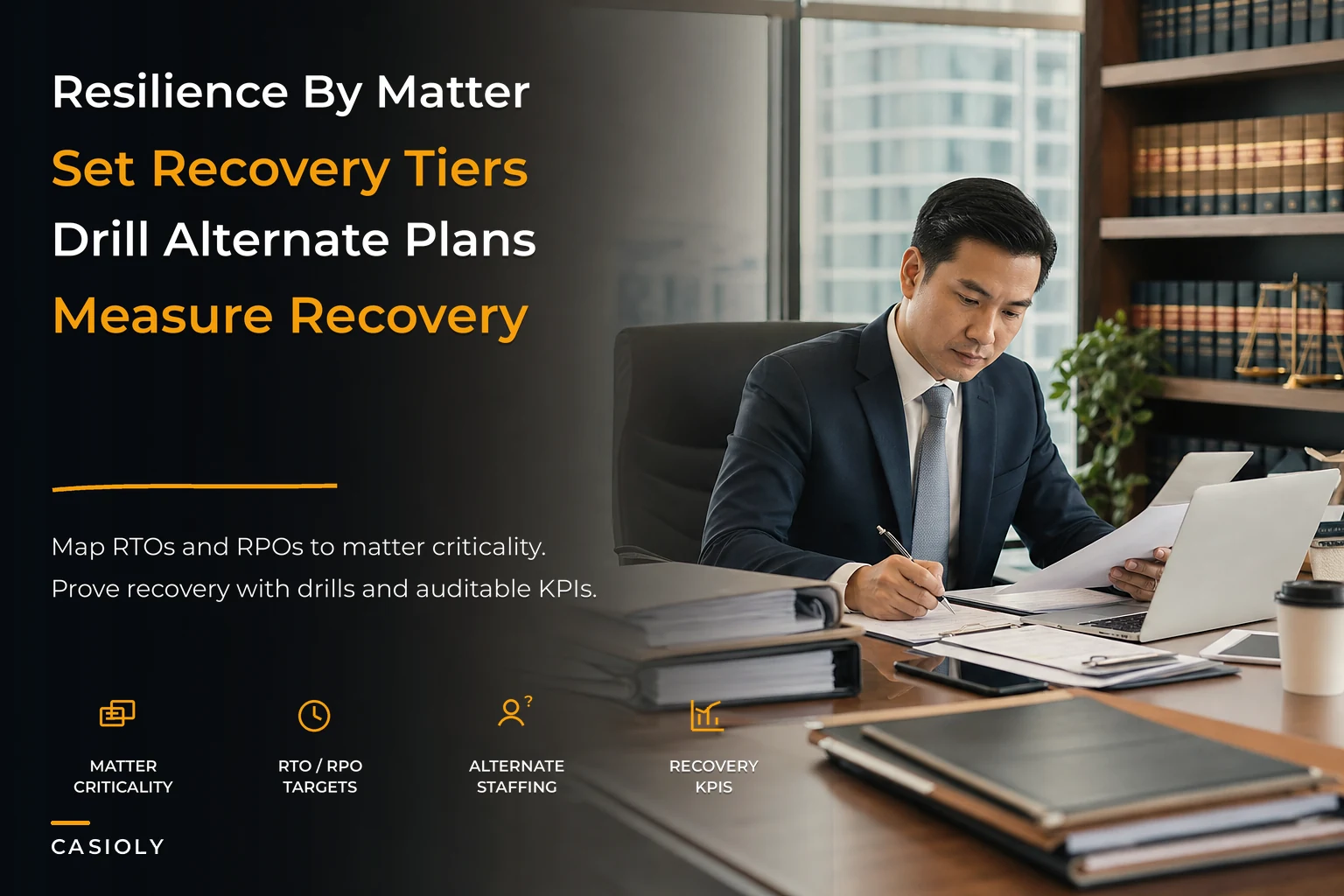
This piece walks through how to build resilience that actually works: tiered by matter criticality, mapped to real recovery targets, tested with drills, and backed by staffing fallbacks and KPIs partners will actually look at more than once a year.
Why continuity planning quietly fails in firms
The pattern is pretty consistent. A firm buys decent software, sets up backups, maybe even gets cyber insurance with a continuity rider. On paper, resilient. Then something ordinary happens — not a hurricane, just a cloud provider outage, a ransomware hit at a vendor, or a key paralegal out sick during a filing crunch — and the whole thing falls apart.
Recovery targets aren't tied to anything real. "We will restore systems within 24 hours" sounds reasonable until you ask: which systems? The document management platform and the billing software have very different consequences when they go down. And neither question matters as much as which matters are mid-deadline right now.
Knowledge lives in individuals, not systems. The attorney who knows where the Henderson engagement letter is filed, how opposing counsel operates, and what the client is anxious about — none of that is written anywhere. When she's unreachable, the matter isn't just delayed. It's frozen. This is probably the most underrated continuity risk in small and mid-size firms.
Nobody tests anything. A continuity plan that's never been drilled is a hypothesis. Discovering your backup restores take nine hours instead of two is not a moment you want during an actual incident.
What operationally mature firms tend to share is that resilience stops being a document and becomes a set of practiced reflexes — tiered responses tied to matters whose criticality was defined before anything went wrong.
Start with matter criticality tiers, not technology
Before anyone talks about servers or RTOs, there's a harder question: which matters, if disrupted, actually hurt? Most firms have never formally scored this, which is why their recovery plans default to protecting everything equally.
Never miss a critical deadline again.
Casioly helps legal teams manage cases efficiently and stay on top of critical tasks.
- Centralized case tracking
- Automated deadline reminders
- Secure client communication
No credit card required
| Tier | Definition | Example matters | Tolerance for disruption |
|---|---|---|---|
| Tier 1 — Critical | Hard deadline within 72 hours; irreversible consequences if missed | Pending filings, hearings, TROs, closing dates, SOL deadlines | Near-zero. Hours, not days. |
| Tier 2 — Time-sensitive | Active matters with deadlines in the 1–3 week window | Discovery responses, negotiated deals in progress, regulatory submissions | Low. ~1 business day. |
| Tier 3 — Active, flexible | Ongoing work, no imminent deadline | Routine drafting, early-stage matters, advisory work | Moderate. 2–3 days. |
| Tier 4 — Dormant/closed | No active work; archival or reference only | Closed files in retention, paused matters | High. Recovery can wait. |
The key move here is that tiering is dynamic. A Tier 3 matter becomes Tier 1 the moment a court sets a hearing. Firms that assign a static criticality label at intake and never revisit it end up protecting the wrong things. Your matter management system should carry a criticality field that updates as deadlines approach — your continuity response should key off that field, not a frozen spreadsheet.
Worth noting: Tier 1 at any given moment is usually a smaller slice than people expect — often under 10% of open matters. That's actually good news. Real resilience doesn't require heroically protecting your entire caseload. It requires knowing exactly which matters can't tolerate downtime, and having a tight plan for those specifically.
Mapping RTOs and RPOs to each tier
Once matters are tiered, recovery targets stop being arbitrary. Two numbers drive everything:
-
RTO (Recovery Time Objective) how fast you need to be functional again on a given matter after a disruption.
-
RPO (Recovery Point Objective) how much data loss you can actually tolerate — meaning how recent your last good backup needs to be.
Mapped to tiers, this gets concrete:
| Tier | RTO target | RPO target | What it demands operationally |
|---|---|---|---|
| Tier 1 | 2–4 hours | ≤ 15 min | Hot access to matter docs, alternate attorney briefed, offline copies of imminent filings |
| Tier 2 | 1 business day | ≤ 1 hour | Reliable cloud failover, cross-trained backup staff |
| Tier 3 | 2–3 days | ≤ 4 hours | Standard backup restore acceptable |
| Tier 4 | 1 week+ | ≤ 24 hours | Archive-grade recovery, no urgency |
What most firms miss: your RPO is often worse than you think. If your document system auto-saves but matter notes live in someone's local Word files, or billing entries only sync overnight, your real recovery point for those items could be a full day — nowhere close to the 15-minute target a Tier 1 matter actually needs. Resilience planning forces you to audit where data actually lives and how frequently it's genuinely protected. Honestly, that audit is where most of the value is. It surfaces gaps nobody knew existed.
For Tier 1 matters specifically, a smart habit is keeping an offline go-bag: printed or locally-stored copies of anything due within 72 hours, plus critical contacts and deadline details. Low-tech, but it's saved filings when systems were down.
Here's a simple workflow that ties intake to drills and KPIs.
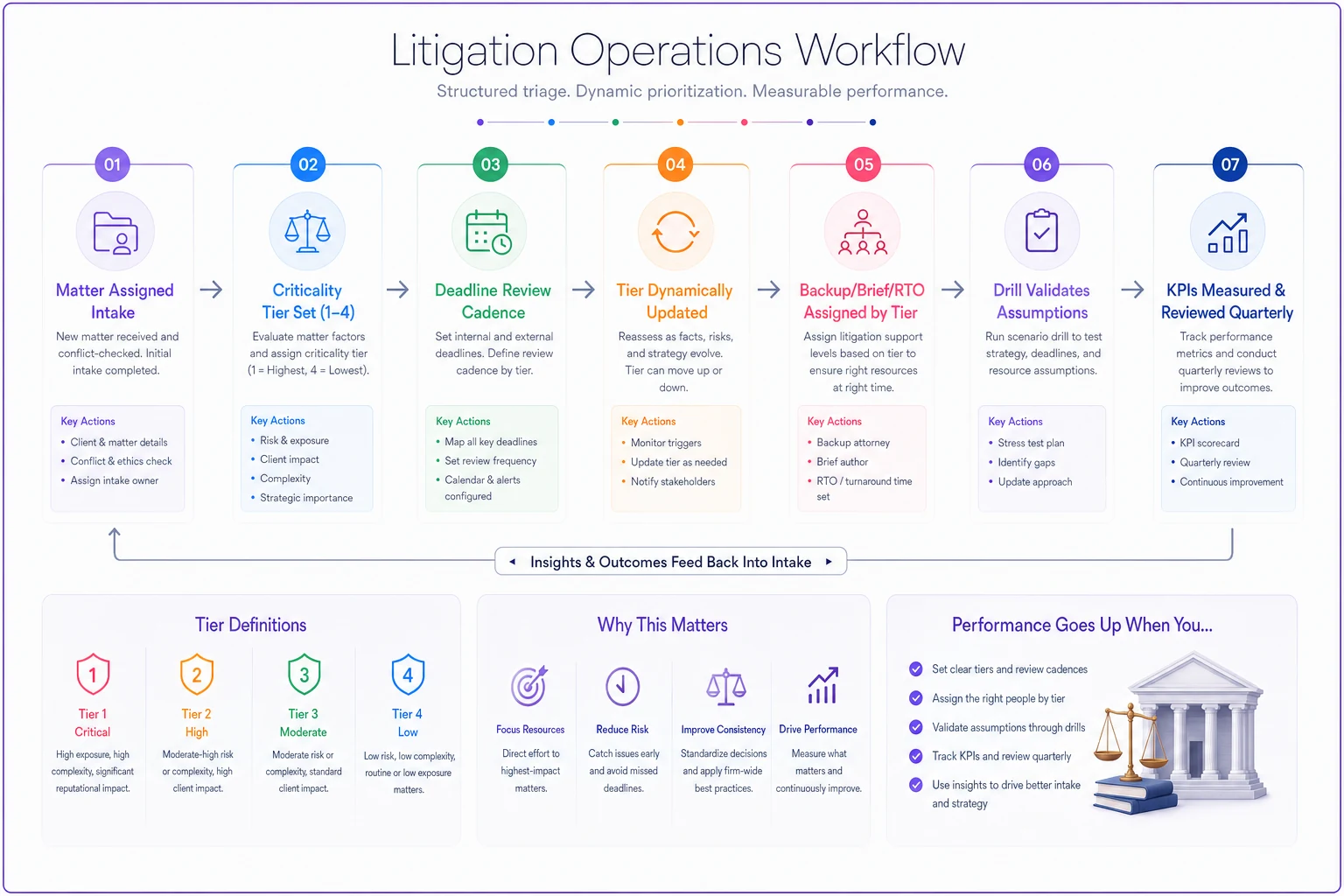
The graphic above represents how matter intake should feed dynamic tiering, leading to assigned recovery targets and drills that validate assumptions.
Alternate staffing and cold-open procedures
Technology recovery gets most of the attention. Staffing resilience is what actually breaks first.
-
Designate a named backup for every Tier 1 and Tier 2 matter. Not "the team" — a specific person.
-
Maintain a one-page matter brief for critical matters
current status, next deadline, opposing counsel, key document locations, client sensitivities. This is what a cold-open actually depends on.
-
Require the brief to be current as a condition of the matter staying in Tier 1 — tie it to your deadline review cadence.
-
Run periodic handoff tests where the backup has to state the matter's status using only the brief and system records, with no help from the primary.
That fourth step is where firms find out whether their continuity is real. A brief that looks complete often turns out to be missing exactly the context a stranger would need. Firms that already maintain malpractice-ready advice logs and audit checklists find cold-opens dramatically easier, because the matter's history is already documented rather than carried around in someone's memory.
Maintain the one-page matter brief in a shared, access-controlled folder so the named backup can find it quickly during a cold-open.
When deep cross-training makes sense — and when it doesn't
Full cross-training on every matter is a bad idea for most firms. It's expensive, it dilutes focus, and the knowledge decays faster than you can refresh it. Reserve serious backup coverage for Tier 1 and Tier 2 matters. For Tier 3 and 4, a documented brief and system access is enough — you're not staffing a crisis response for a dormant file. Firms that try to cross-train on everything usually end up with everyone vaguely informed and nobody genuinely responsible. That's not resilience, it's diffused accountability.
Test drills: scripts that reveal the gaps
A plan you haven't drilled is a guess. Drills don't need to be elaborate — they need to be uncomfortable enough to surface real failures. The goal isn't to pass. It's to find what breaks while the stakes are low.
Drill 1 — The vendor outage. Scenario: your practice management cloud is unreachable for the next six hours. How do you identify every Tier 1 matter with a deadline in the next 72 hours, and how do you continue work on each? Run it live. Time it. Most firms discover they can't quickly produce a filtered list of imminent-deadline matters without the system that's supposedly down — which tells you to maintain that list exported somewhere independent.
Drill 2 — The key-person vanish. Scenario: your most loaded litigation attorney is unreachable for a week, effective immediately. Hand their three most critical matters to backups. Can the backups state current status, next actions, and deadlines within 30 minutes using only documentation? This one almost always exposes thin matter briefs.
Drill 3 — The data-recovery timing test. Scenario: a file set was corrupted at 2 p.m. Actually perform a restore from backup. Measure the real RTO and RPO — not the assumed ones. Firms are regularly surprised to find their "hourly" backups were silently failing, or that restores take far longer than the vendor suggested.
Run Tier 1 drills at least twice a year, and once after any major system change. Keep them short — a couple of hours is plenty. Always close with a written list of what broke and who owns the fix.
Recovery KPIs you can actually audit
Resilience that isn't measured drifts back toward theater within a year. These KPIs aren't about dashboards for their own sake — they give partners auditable evidence the program works, and they catch decay before a real incident does.
-
Tier 1 coverage rate % of Tier 1 matters with a named, briefed backup and a current one-page brief. Target: 100%. Anything less is a live gap.
-
Measured RTO vs. target from your last drill, actual recovery time per tier against the objective.
-
Measured RPO vs. target actual data-loss window observed in restore tests.
-
Brief freshness % of critical-matter briefs updated within the last review cycle.
-
Drill completion drills run vs. scheduled, plus % of identified issues closed within 30 days.
-
Backup verification rate % of backup jobs confirmed by actual restore test, not just "job completed" status.
That last one deserves a separate mention. A backup that reports success but has never been restored is Schrödinger's backup — you won't know whether it works until you need it, which is the worst possible time to find out. Build a recurring restore-verification habit into your operations the same way you'd treat a month-end trust reconciliation: a non-negotiable control with a clear owner and a red flag when it slips.
These KPIs also fold naturally into broader operational review. If you already run a quarterly matter health-check with audit scripts, adding resilience checks to that cadence means you're not building a separate program nobody maintains — you're extending something that already has momentum.
Tiered recovery playbooks: what actually happens when something goes wrong
The playbook is the thing people open during an incident. It should be short, tier-specific, and action-oriented. Nobody reads a 40-page manual when something is actively on fire.
Tier 1 playbook (critical, deadline within 72 hours):
-
Pull the current list of Tier 1 matters and their deadlines from your independent export.
-
For each, confirm whether the primary owner is available; if not, activate the named backup.
-
Verify access to each matter's imminent documents — fall back to offline copies if systems are down.
-
Notify affected clients and, where needed, request deadline extensions proactively rather than at the wire.
-
Assign a single incident coordinator to track every Tier 1 matter until resolved.
Tier 2 playbook (time-sensitive): confirm failover access, reassign to backups as needed, communicate realistic timelines to clients, and re-tier anything whose deadline has moved inside 72 hours.
Tier 3 and 4 playbook: document the disruption, queue for recovery once critical tiers are stable, and don't let non-urgent work pull attention from Tier 1. The discipline of not reacting to low-priority matters during a crisis is as important as the response to high-priority ones.
The thread running through all of it: your playbook keys off matter criticality, and that criticality data has to be live and trustworthy. Firms whose matter metadata is clean and current have a real advantage here. If criticality tiers are maintained as an actual field — updated as deadlines shift, visible firm-wide, exportable independently — your continuity response becomes almost mechanical. If that data is scattered across people's memories and stale spreadsheets, no playbook saves you.
A real scenario
A roughly 14-attorney litigation firm got hit with a ransomware incident at their document-hosting vendor — not their own systems, a third party. Access was gone for most of two days.
Before they'd built a tiered resilience program, their continuity "plan" was a flat backup policy and good intentions. During the first few hours of the outage, they couldn't answer the basic question: which of our open matters have a deadline this week? They spent most of day one reconstructing that list from memory and email, and nearly missed a discovery response because the owning associate was on vacation and unreachable.
Afterward, they rebuilt around criticality tiers. They tagged every matter, maintained an independent weekly export of Tier 1 and Tier 2 deadlines, assigned named backups to critical matters, and started running the key-person drill twice a year. When a shorter outage hit about eight months later, the difference was obvious: within the first hour they had the full list of at-risk matters, backups were briefed off current one-pagers, and they proactively requested two extensions they might not have even needed. No missed deadlines. The partners' comment afterward was that the event felt "almost boring" — which is exactly what operational resilience is supposed to feel like.
When this level of rigor makes sense — and when it's overkill
This makes sense when: you carry active matters with hard, irreversible deadlines — litigation, transactional, regulatory — when knowledge is concentrated in a few people, or when a multi-day outage could realistically expose you to malpractice risk.
This is probably overkill when: you're a solo or very small practice with a handful of flexible-deadline matters, where the backup plan is genuinely just the principal attorney and recovery can wait a few days without consequence. In that case, maintain simple backups, keep offline copies of anything imminently due, and skip the tiered machinery.
Who should not do this: firms that will build the tiers, write the playbooks, run one drill, and then let the whole thing calcify. A half-maintained resilience program creates false confidence, which is arguably worse than knowing you're exposed. If you can't commit to the review cadence and the drills, skip the elaborate version — just verify your backups and keep an offline go-bag for critical matters.
The bottom line
Operational resilience in a law firm isn't a document or something you buy — it's the discipline of knowing, at any given moment, which matters can't tolerate downtime, and having practiced what you'll do about them. The firms that handle disruption calmly aren't the ones with the thickest continuity manuals. They're the ones that tiered their matters honestly, mapped recovery targets to that criticality, stress-tested their assumptions with uncomfortable drills, and built staffing fallbacks before they needed them.
Start small. Tier your matters this quarter. Identify the Tier 1 slice — it's smaller than you expect. Run one drill, and let it embarrass you a little. The gaps it surfaces are the whole point, and finding them now is infinitely cheaper than finding them when it actually matters.
Operational resilience in a law firm isn't a document or something you buy — it's the discipline of knowing, at any given moment, which matters can't tolerate downtime, and having practiced what you'll do about them. The firms that handle disruption calmly aren't the ones with the thickest continuity manuals. They're the ones that tiered their matters honestly, mapped recovery targets to that criticality, stress-tested their assumptions with uncomfortable drills, and built staffing fallbacks before they needed them.
Start small. Tier your matters this quarter. Identify the Tier 1 slice — it's smaller than you expect. Run one drill, and let it embarrass you a little. The gaps it surfaces are the whole point, and finding them now is infinitely cheaper than finding them when it actually matters.
Ready to elevate your legal practice management?
Join 500+ law firms using Casioly to optimize case workflows, reduce administrative burden, and improve client satisfaction.