

The advice that gets firms into trouble is rarely the formal opinion letter. It's the fifteen-second hallway answer. The "yeah, you're probably fine to sign that" over the phone. The associate's quick reply to a client email at 6:40 PM on a Friday. None of it gets documented, and eighteen months later, when the client says you never told me about that risk, there's nothing to point to except memory.
That's the actual failure mode in most malpractice claims at small and mid-sized firms — not bad advice, but undocumented advice. The lawyer usually gave the right guidance. They just can't prove it. In a fee dispute, a bar grievance, or a coverage conversation with the carrier, "I definitely told them" carries almost no weight against a client's contemporaneous email saying the opposite.
This post is narrow on purpose. It's about building a lightweight advice log that captures the right fields at the right matter stages, with clear sign-off rules, so everyday advice stays defensible without turning your lawyers into full-time scribes.
Why advice goes uncaptured (it's not laziness)
The instinct is to blame discipline. Tell everyone to "document their advice" and assume the problem is willpower. That almost never works, and it misreads why the gap exists.
Advice goes uncaptured because the moments advice happens are the moments logging is most inconvenient. Nobody opens the DMS and drafts a memo-to-file after a two-minute phone call. The friction is completely out of proportion to the interaction. So the log stays empty for exactly the small, fast, high-frequency advice that generates the most exposure.
Firms that do try to log everything usually overcorrect — a mandatory 12-field form for every client touch. Within a month, lawyers either ignore it or fill it with garbage ("discussed matter, advised accordingly"). A log that's too heavy fails the same way a log that doesn't exist fails. You end up with defensibility theater: fields filled in, but nothing that would actually hold up when it matters.
The goal isn't to capture everything. It's to capture the material advice — the guidance a client could plausibly claim they never received — with enough context to reconstruct what was said and why.
What actually makes an advice entry defensible
Defensibility isn't about volume. A three-sentence entry written the same day beats a two-page memo written after the complaint arrives. What a reviewer, carrier, or opposing counsel looks for is narrower than most people assume:
Never miss a critical deadline again.
Casioly helps legal teams manage cases efficiently and stay on top of critical tasks.
- Centralized case tracking
- Automated deadline reminders
- Secure client communication
No credit card required
-
Contemporaneity — was it recorded at or near the time of the advice?
-
Specificity — does it name the actual question, the actual advice, and the risk disclosed?
-
Attribution — who gave it, and who reviewed it if anyone?
-
Client acknowledgment — is there any sign the client received and understood it?
A typical weak entry: "Call with client re: contract. Advised." Useless. It proves a call happened, nothing more.
A defensible version of the same interaction: "Client asked whether he could sign the vendor MSA before we finished reviewing the indemnity clause. Advised NOT to sign until review complete; flagged uncapped indemnity as material risk. Client acknowledged, agreed to hold. Follow-up email sent 3:15 PM."
Required capture fields by matter stage
The fields you need shift depending on where the matter is. Advice during intake carries different risk than advice at closing. Below is a lightweight field set mapped to stage — no single stage needs all of it, so the burden at any one moment stays low.
| Matter stage | Core required fields | Why it matters here |
|---|---|---|
| Intake / scoping | Scope stated, out-of-scope items flagged, conflicts noted | Most "you should have told me" claims trace back to unclear scope |
| Active advisory | Question asked, advice given, risk disclosed, client response | Highest-frequency, highest-exposure advice happens here |
| Decision points | Options presented, recommendation, client's chosen path | Client "instructed against advice" needs documenting cleanly |
| Pre-closing / signing | Final risk disclosures, sign-off given, deadlines confirmed | Irreversible moments — this is where uncaptured advice hurts most |
| Post-matter / wind-down | Final advice, retained obligations, matters expressly excluded | Prevents scope creep claims after the matter "ends" |
Worth noticing: the active advisory row is where most firms have nothing, and it's where most claims originate. If you only tighten one stage, tighten that one.
This field structure also lines up with how matters already move through defined phases. If your firm has mapped its stages and required data — worth doing regardless — you can attach these advice fields to existing stage definitions rather than building a parallel system. Our law firm case lifecycle framework walks through that stage-and-data mapping in detail.
Approver sign-off rules: keep them boring and few
Sign-off is where good intentions turn into bureaucracy. If every logged piece of advice needs partner review, nobody logs anything. The goal is a small set of triggers where sign-off is genuinely worth the friction, and default to no sign-off everywhere else.
-
Advice that reverses a prior position — if the firm previously advised X and now advises not-X, a supervising attorney signs off. Reversals show up disproportionately in claims.
-
Advice against the client's stated wish — when you're telling a client not to do the thing they want to do, that entry gets a second set of eyes, because that's exactly the scenario that produces angry clients later.
-
Advice at irreversible points — signing, filing, waiving a right, missing an optional deadline. Sign-off here is cheap insurance.
-
Everything else — logged by the responsible lawyer, no sign-off required.
Four rules. Three trigger sign-off; one covers the vast majority of daily advice with none. If a first-year can't recite the triggers from memory, they're too complicated.
One pattern worth flagging: firms sometimes make sign-off a blocking step — advice can't go out until approved. For irreversible-point advice, fine. For everything else, that guarantees the log gets bypassed in real time. Better to allow the advice, require the log entry within the same day, and route the sign-off asynchronously.
The workflow, in plain terms
A lawyer finishes a client call. Inside the matter, they open a quick advice entry — a short form pinned to that matter, not a blank document. They pick the stage (usually pre-filled from where the matter already sits), type two or three sentences covering what did they ask, what did I advise, what risk did I flag, and note whether the client acknowledged.
If the entry hits a sign-off trigger — say it's advice against the client's wishes — it flags for the supervising attorney and lands in a short review queue. The reviewer reads it and either signs off or adds a note. Nothing blocks the advice that already went out. The log just catches up within hours.
A quick visual of that workflow can make it easier to design the capture form and review queue.
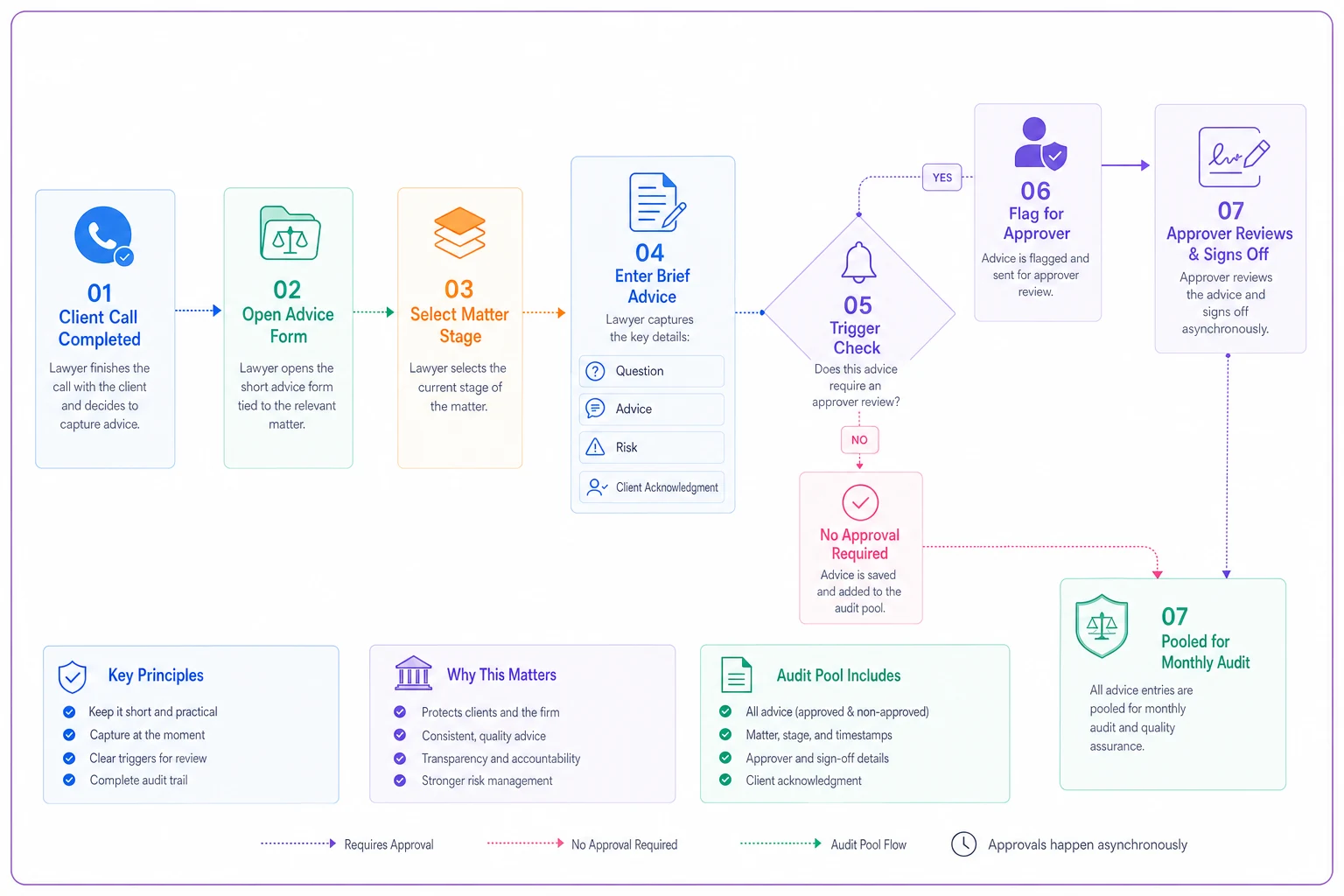
At month-end, someone runs a five-minute audit: pull all advice entries from the period, spot-check for empty or junk entries, confirm sign-off items were actually signed. This is where operational software earns its place — not by writing the advice, but by making the capture form frictionless, auto-tagging entries to the right matter and stage, and surfacing the ones that need review. When the logging step lives one click from where the lawyer already works, the log gets filled. When it lives in a separate system, it dies.
The same discipline applies to how you handle privilege on these logs, since advice entries are exactly the kind of sensitive internal record you don't want mishandled in production — worth reading alongside a tighter privilege-log and redaction workflow if that's a concern at your firm.
Quick audit checklist
Run this monthly. It takes under ten minutes on a normally-sized matter portfolio and it's the highest-leverage habit for keeping the log defensible rather than decorative.
Prioritize sampling matters with recent client contact first; they're likeliest to reveal missing active-advisory entries.
-
- [ ] Are there advice entries for every matter with client contact this period? (A matter with meetings but zero logged advice is a red flag.)
-
- [ ] Do active-advisory entries name a specific question and specific advice — not "advised accordingly"?
-
- [ ] Is risk disclosure present on any advice touching irreversible actions?
-
- [ ] Did every sign-off-trigger entry actually get signed off?
-
- [ ] Are entries dated at or near the interaction, not backfilled in a cluster?
-
- [ ] Is client acknowledgment noted where the advice was material?
-
- [ ] Any advice-against-wishes entries missing the client's response?
The dated-vs-backfilled check matters more than it looks. A pile of entries all created on the 30th tells a reviewer they were reconstructed after the fact, which quietly undermines the whole log's credibility. Contemporaneous imperfect notes beat polished retroactive ones every time.
When this makes sense — and when it doesn't
This kind of structured advice log is worth building for transactional, advisory, and regulatory practices where clients make consequential decisions based on your guidance and where "you never told me" is a live risk. Corporate, real estate, employment, estate planning, tax — anywhere the advice is essentially the product.
It's less useful, and can be overkill, in high-volume commodity work where advice barely varies matter to matter, or in pure litigation where the docket and filings already create a heavy contemporaneous record of your positions. In those settings a lighter version — just the intake and decision-point fields — is usually enough.
Who should not roll this out firm-wide on day one: any firm without buy-in from the lawyers doing the logging. Mandate it top-down with no lightweight tooling and you'll get compliance for two weeks and empty fields by month three. Start with one practice group, one stage (active advisory), and prove the log is fast before you expand it.
A short real scenario
A six-attorney business firm kept running into the same pattern: clients would call with quick contract questions, get advice, act on it, and later dispute both the bill and the guidance. Two matters in a single year escalated to the point where the malpractice carrier got involved — not because the advice was wrong, but because there was no record of it beyond the lawyer's recollection.
They put in a stage-based advice log with the four-rule sign-off set. Nothing fancy — a short form tied to each matter, filled in same-day, spot-audited monthly. The lawyers grumbled for about three weeks, then stopped, because entries took under a minute.
The results over the following year weren't dramatic in a headline sense, but they were the right kind of boring. The two-per-year escalations dropped to zero. When one client did raise a "you never advised me" complaint, the partner pulled up a dated entry naming the exact risk disclosed and the client's acknowledgment — and the complaint evaporated in one email. The carrier conversation at renewal went noticeably smoother too. The log paid for itself the first time it was actually needed.
The point
Malpractice evidence capture isn't about writing more or documenting defensively out of fear. It's about catching the small, fast advice that already happens — the calls, the quick replies, the hallway answers — in a form light enough that lawyers will actually use it and specific enough that it holds up when someone challenges it. Keep the fields few, tie them to the stage the matter's already in, reserve sign-off for the handful of moments that genuinely warrant it, and audit briefly every month. Do that, and the day a client says you never told me, you won't be reaching for your memory. You'll be reaching for the entry.
Ready to elevate your legal practice management?
Join 500+ law firms using Casioly to optimize case workflows, reduce administrative burden, and improve client satisfaction.