



I've helped dozens of law firms untangle their operational messes, and one pattern keeps showing up: firms try to manage complex matters without defining clear stages, handoff rules, or service expectations. Partners wonder why associates miss deadlines. Associates don't know what data they need before moving forward. Clients get frustrated when nobody can tell them where their matter stands.
The real problem isn't that lawyers can't manage cases—it's that most firms never build a proper case lifecycle framework that everyone actually follows.
Last month, a litigation boutique called us because their matters kept stalling. They had talented attorneys, decent technology, but no systematic way to move cases through their lifecycle. Discovery would drag for months. Document production happened in bursts of panic. Client updates were random.
What they needed wasn't more project management software or another case tracking spreadsheet. They needed an operational framework that defined exactly what happens at each stage, what data moves forward, and who's responsible for what.
Why Most Firms Never Build Real Operational Frameworks
Here's what typically happens: a firm starts small, partners handle everything personally, and cases move through sheer force of will. As the firm grows to 15, 20, 30 attorneys, that personal oversight breaks down. Partners can't watch everything. Associates don't know the unwritten rules. Paralegals guess at priorities.
The firm tries to fix this with technology—practice management software, document systems, time tracking. But software without process just digitizes the chaos. You end up with matters scattered across systems, data trapped in silos, and nobody really knowing the operational status of anything.
The litigation boutique I mentioned? They had three different case tracking systems running simultaneously. Partners used one, associates used another, paralegals had their own spreadsheets. Each system told a different story about the same matters. Client deadlines would appear in one system but not others. Discovery cutoffs lived in individual calendars. Motion practice schedules existed only in email threads.
When we mapped their actual matter flow, we found 47 different paths a case could take through their firm. Not 47 types of matters—47 different operational paths for the same type of litigation. Some partners required formal intake memos. Others started work on verbal agreements. Some matters got conflict checks, others didn't. Some had engagement letters before work started, others got them weeks later.
This isn't unusual. Most small and midsize firms operate this way, relying on individual expertise rather than systematic processes. It works until it doesn't—usually when you hit around 25-30 active matters per attorney.
The Five-Stage Framework That Actually Works
After building operational systems for firms ranging from solo practices to 200-attorney operations, we've found that almost every legal matter can be managed through five discrete stages. Not every matter uses all five, but having them defined creates consistency across practice areas.
Never miss a critical deadline again.
Casioly helps legal teams manage cases efficiently and stay on top of critical tasks.
- Centralized case tracking
- Automated deadline reminders
- Secure client communication
No credit card required
Stage 1: Intake and Validation
-
Client entity structure and authorization
-
Conflict check results with timestamp
-
Matter type and estimated complexity score
-
Initial scope boundaries
-
Budget parameters or fee structure
-
Key dates already known
-
Opposing parties identified
-
Venue/jurisdiction confirmation
A medical malpractice firm we worked with discovered they were losing roughly $180,000 annually just from incomplete intake. Cases would be halfway through discovery before someone realized they didn't have proper plaintiff authorization. Or they'd find out the statute of limitations was closer than anyone thought. Or the client's insurance coverage wasn't what they assumed.
The handoff rule from intake to active matter: ALL required fields must be populated, conflict check must be dated within 72 hours, and engagement letter must be fully executed. No exceptions. The partner trying to "just get started" while paperwork catches up is exactly how operational disasters begin.
Stage 2: Active Matter Development
-
Defined workstreams with owners
-
Task dependencies mapped
-
Internal deadlines (not just court deadlines)
-
Budget burn tracking
-
Document generation requirements
-
Client communication cadence
We typically see firms break this into substages based on practice area. Litigation might have: Pleadings → Discovery → Motion Practice → Trial Prep. Corporate might have: Due Diligence → Documentation → Negotiation → Closing.
Each substage needs its own data requirements and handoff rules. Discovery doesn't start until initial disclosures are complete. Document review doesn't begin until privilege log framework is established. These aren't suggestions—they're operational requirements.
Stage 3: Review and Quality Control
-
Substantive legal review checklist
-
Technical accuracy verification
-
Client communication approval
-
Budget variance analysis
-
Deadline confirmation
-
Deliverable completeness check
The handoff from active work to review must include all work product, time entries through current date, and notation of any issues or uncertainties. The reviewer needs full context, not just the final document.
Stage 4: Delivery and Confirmation
-
Transmittal documentation
-
Receipt confirmation method
-
Understanding verification (for complex matters)
-
Next steps communication
-
Final billing preparation
-
Outcome documentation
A trust and estates practice learned this lesson expensively when a client claimed they never received final estate planning documents. The firm had sent them, but had no delivery confirmation protocol. They ended up writing off $34,000 in fees to avoid the relationship damage.
Stage 5: Matter Closure and Archive
-
Final billing and collection
-
Client property return protocol
-
Document retention classification
-
Conflict database update
-
Knowledge capture for similar matters
-
Formal closure communication
The handoff to closed status must be explicit, documented, and irreversible without partner approval. Otherwise, matters drift back into active status whenever a client calls with a question.
Sample SLA Matrices by Practice Area
Service level agreements aren't just for client expectations—they're operational guardrails that keep matters moving. Here's what actually works:
Litigation SLA Matrix
| Stage | Task | Standard Timeline | Escalation Trigger |
|---|---|---|---|
| Intake | Conflict check | 24 hours | 48 hours |
| Intake | Engagement letter | 72 hours | 5 business days |
| Active | Initial pleading | 5 business days from retention | 7 business days |
| Active | Discovery responses | 20 days from receipt | 25 days |
| Active | Motion response | 10 days from service | 14 days |
| Review | Document review | 48 hours for <50 pages | 72 hours |
| Delivery | Client communication | Every 2 weeks | 3 weeks |
| Closure | Final billing | 15 days from resolution | 30 days |
Corporate Transaction SLA Matrix
| Stage | Task | Standard Timeline | Escalation Trigger |
|---|---|---|---|
| Intake | Deal structure memo | 48 hours | 72 hours |
| Intake | Fee estimate | 24 hours | 48 hours |
| Active | Due diligence list | 3 business days | 5 business days |
| Active | Initial draft documents | 5 business days | 7 business days |
| Active | Revision turnaround | 24-48 hours | 72 hours |
| Review | Partner review | 24 hours | 48 hours |
| Delivery | Closing documents | Same day as closing | Next business day |
| Closure | Post-closing cleanup | 30 days | 45 days |
The enforcement mechanism matters more than the timeline. We've seen firms create elaborate SLA matrices that nobody follows because there's no systematic tracking. The boutique litigation firm now has automated alerts when any matter approaches an SLA deadline. Associates get notified at 50% of timeline consumed. Partners get escalation alerts at the trigger point.
Required Data Specifications for Each Stage
Data requirements aren't just about having information—it's about having the RIGHT information in a USABLE format at the RIGHT time.
Intake Data Architecture
-
Client identifier (not just name—unique ID that links across systems)
-
Matter type code (standardized, not free text)
-
Responsible attorney (with backup designation)
-
Billing arrangement (hourly, flat, contingency, hybrid)
-
Preliminary scope (even if it changes later)
-
Initial deadline capture
-
Resource requirements estimate
A regulatory compliance practice discovered they were losing 12-15 hours per matter just hunting for basic information that should have been captured at intake. Their associates would spend hours reconstructing client corporate structures that should have been documented on day one.
Active Matter Data Requirements
-
Time entries linked to specific tasks
-
Document version control with matter association
-
Communication logs with response requirements
-
Budget consumption percentage
-
Deadline chains with dependencies
-
Resource allocation adjustments
Knowing you've spent 47.3 hours on a matter doesn't help if you can't break down what tasks consumed that time and what's still remaining. Data must be structured for operational use, not just billing.
Review Stage Data Capture
-
Common issues encountered
-
Successful strategies employed
-
Client preferences discovered
-
Opposing counsel tactics noted
-
Judicial preferences observed
-
Template improvements identified
This data becomes your firm's operational intelligence. The next similar matter benefits from everything learned on this one.
Handoff Rules That Prevent Matter Stagnation
The space between stages is where matters die. Clear handoff rules eliminate the ambiguity that causes operational paralysis.
The Three-Component Handoff
-
Explicit trigger (what causes the handoff)
-
Required deliverables (what must be complete)
-
Acceptance criteria (how the recipient confirms readiness)
Example: Moving from Intake to Active Matter
-
Trigger
Engagement letter executed and retainer received
-
Deliverables
Complete intake form, conflict check dated within 72 hours, preliminary case assessment, initial client communication plan
-
Acceptance
Assigned attorney confirms receipt of all deliverables and accepts matter within 24 hours
Without all three components, handoffs become suggestions rather than operational requirements.
Rejection Protocols
-
Specific deficiency identified
-
Remediation requirement stated
-
Timeline for correction set
-
Escalation path defined
An employment law firm implemented rejection protocols and saw their matter cycle time improve by roughly 22%. Associates stopped accepting incomplete handoffs from partners. Paralegals stopped processing documents with missing information. The initial friction forced better upstream preparation.
Building Your Implementation Artifacts
Theory without artifacts remains theory. Here's what you actually need to build:
The Matter Stage Tracking Dashboard
Create a simple visual showing every active matter's current stage, time in stage, and next expected milestone. This isn't complex—a basic kanban board works. But it must be:
-
Updated in real-time
-
Visible to all team members
-
Linked to your SLA triggers
-
Sortable by multiple factors
Keep it simple and focused on stage motion rather than every minor task.
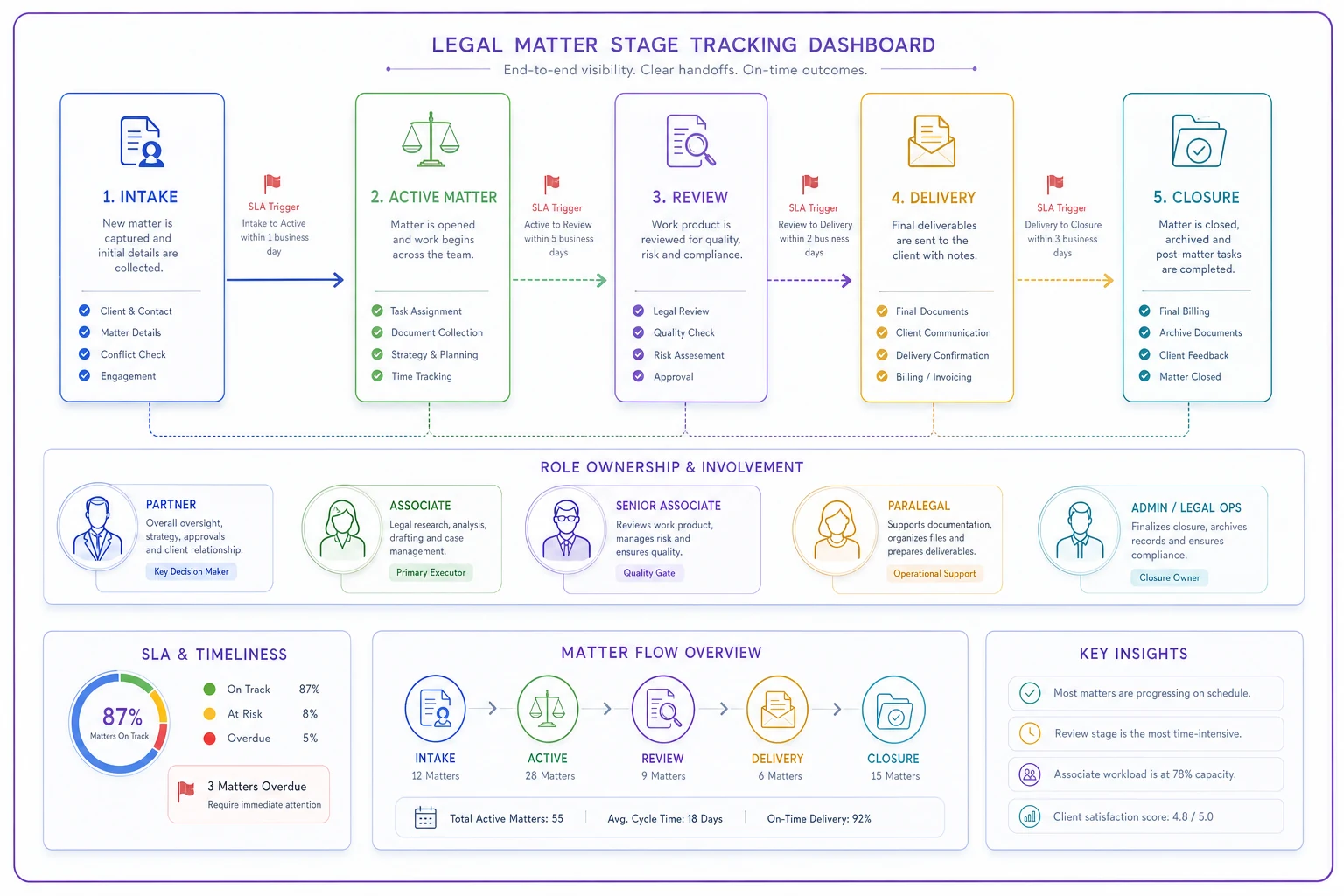
This shows the basic flow and who gets alerted at each point.
Tie your kanban board to automated SLA alerts so the dashboard reflects both status and urgency.
The Data Requirement Checklist System
For each stage, build an actual checklist that someone must complete and timestamp. Not a mental checklist, not a general guide—a specific list with checkboxes and signature requirements.
-
- [ ] Client entity verification complete
-
- [ ] Conflict check run (date
_)
-
- [ ] Matter type selected from standard list
-
- [ ] Scope boundaries documented
-
- [ ] Initial budget discussed and documented
-
- [ ] Key dates entered in case management system
-
- [ ] Opposing parties identified and recorded
-
- [ ] Venue/jurisdiction confirmed
-
- [ ] Engagement letter sent (date
_)
-
- [ ] Engagement letter executed (date
_)
-
- [ ] Retainer received (amount
_)
-
- [ ] Matter formally opened in system
-
- [ ] Team members assigned and notified
Completed by: Date: Verified by: Date:
The SLA Monitoring Matrix
Build a simple table that tracks every matter against its SLA requirements:
| Matter | Current Stage | Time in Stage | SLA Target | Status | Alert Triggered |
|---|---|---|---|---|---|
| Smith v. Jones | Discovery | 47 days | 60 days | Green | No |
| ABC Corp Deal | Due Diligence | 12 days | 10 days | Red | Yes |
| Estate of Johnson | Review | 3 days | 5 days | Yellow | No |
This becomes your early warning system for operational breakdowns.
The Automation Opportunity Most Firms Miss
The framework itself is operational discipline, but tracking it manually becomes its own burden. This is where thoughtful automation transforms a good framework into sustainable operations.
Smart firms are using AI-powered platforms to automatically track matter progression, flag SLA violations, and route handoffs without manual oversight. The system watches for stage triggers, validates data requirements, and alerts the right people at the right time.
We helped a workers' compensation firm implement automated stage tracking that reduced their matter cycle time by around 30%. Not because the lawyers worked faster, but because matters stopped sitting in limbo between stages. The system automatically detected when intake requirements were met and pushed matters to the assigned attorney's active queue. It flagged when discovery responses were approaching deadlines. It prevented matters from closing until all required documentation was uploaded.
The automation doesn't replace judgment—it enforces the framework consistently. Partners still make strategic decisions. Associates still do legal analysis. But the operational backbone runs itself.
Making This Actually Work in Your Firm
Building a case lifecycle framework isn't a weekend project, but it doesn't require months of planning either. Start with one practice area, define the five stages, and track ten matters through the framework manually. You'll quickly discover what data you're missing, which handoffs break down, and where your SLAs are unrealistic.
The litigation boutique started with their employment disputes—their most predictable matter type. Within six weeks, they had a working framework. Within three months, they'd expanded it to all litigation. Their realization rate improved by roughly 14% just from better operational visibility.
The framework forces operational discipline that most small firms have never experienced. It's uncomfortable at first—partners don't like being told they can't skip steps, associates don't like rejection protocols, everyone complains about "additional documentation."
But then matters stop falling through cracks. Clients stop calling to ask for status updates. Bills get paid faster because the work is better documented. The entire operation runs smoother because everyone knows what's supposed to happen next.
The choice is straightforward: continue managing matters through individual heroics and hope nothing falls apart, or build an operational framework that scales with your practice. The firms choosing frameworks are the ones growing sustainably. The ones relying on individual expertise are the ones calling us when everything breaks down.
Ready to elevate your legal practice management?
Join 500+ law firms using Casioly to optimize case workflows, reduce administrative burden, and improve client satisfaction.