


Most trust reconciliation problems don't show up as a giant, obvious hole. They show up as a $412 difference nobody can explain, sitting on the three-way reconciliation for two months while the bookkeeper keeps writing "timing" in the notes column. Then a client asks for their retainer balance, the number on the invoice doesn't match the number in the trust ledger, and suddenly a partner is spending a Saturday reverse-engineering six weeks of transactions.
The root cause is almost always the same: money moves at the bank and account level, but the firm's obligations live at the matter level. When those two layers aren't tightly linked, reconciliation turns into detective work instead of a checklist.
This piece is narrow on purpose. It's about matter-linked trust reconciliation specifically — how to structure your ledger-to-matter mappings, what your month-end checklist should actually contain, the red-flag rules that catch problems before the bar does, and where automation genuinely reduces manual error (and where it doesn't).
The core problem: bank-level reconciliation hides matter-level chaos
A standard three-way reconciliation checks that three numbers agree at month-end:
-
The trust bank statement balance
-
The trust ledger (book) balance
-
The sum of all individual client/matter ledger balances
Here's the trap. You can get all three to tie out to the penny and still have a compliance problem. The classic version: Matter A is overdrawn by $600 and Matter B is over-funded by $600. Nets to zero. Passes the three-way. But you've just used one client's money to cover another client's disbursement — which is exactly the thing trust accounting rules exist to prevent.
That's why the reconciliation that matters isn't "does the total tie out" — it's "does every individual matter balance reconcile, and is any single one negative or unexplained." Bank-level reconciliation is necessary but nowhere near sufficient.
In real operations, the overdraft-then-net-to-zero pattern usually happens when a disbursement gets posted to the wrong matter, or when a check clears before the corresponding deposit is coded, or when someone pays a filing fee out of trust "temporarily" meaning to bill it later. None of those are fraud. All of them are exactly what an auditor circles first.
Why the ledger-to-matter link breaks down
Before the checklist, it helps to know where the links actually snap. Across small and mid-size firms, the breakpoints cluster in a few predictable spots:
Never miss a critical deadline again.
Casioly helps legal teams manage cases efficiently and stay on top of critical tasks.
- Centralized case tracking
- Automated deadline reminders
- Secure client communication
No credit card required
-
Bank feeds don't carry matter numbers. The bank knows you deposited $5,000. It has no idea that $3,000 belongs to the Hendricks matter and $2,000 belongs to Okafor. That mapping is manual, and manual means occasionally wrong.
-
Split deposits. One check, multiple matters. This is the single most common source of misposted trust funds. A $5,000 wire gets dropped entirely onto one matter because splitting it took an extra ninety seconds nobody had.
-
Fee transfers with no matter reference. When earned fees move from trust to operating, the transfer often gets recorded against the operating account cleanly but sloppily against the specific matter ledger.
-
Voided and re-issued checks. A trust check gets voided and reissued. The void hits one matter; the reissue accidentally hits another, or hits the right matter twice.
-
Stale client ledgers. Matter is closed, work is done, but $37 in unearned fees is still sitting in trust because nobody got around to refunding it. Small numbers, but they accumulate into a reconciliation you can't cleanly close.
The common thread: every one of these is a coding failure at the moment of transaction, not a math failure at month-end. Which is why "recheck the math" never fixes anything. You have to fix the mapping at the point of entry.
The ledger-to-matter mapping structure
The mapping is the backbone. Get this right and the checklist becomes mechanical. Every single trust transaction needs to carry these fields, no exceptions:
| Field | Why it exists | Common failure if missing |
|---|---|---|
| Matter ID | Ties the transaction to a specific client obligation | Money lands in a "suspense" bucket nobody reviews |
| Transaction type | Deposit / disbursement / fee transfer / refund / bank fee | Fee transfers get miscounted as disbursements |
| Related invoice or authorization ref | Proves the movement was authorized | Disbursements with no paper trail |
| Cleared/uncleared flag | Separates timing differences from real differences | Every outstanding check looks like an error |
| Source document link | Check image, wire confirmation, settlement statement | Audit takes four times longer to substantiate |
The rule that prevents most disasters: no trust transaction posts without a Matter ID. If a deposit comes in and you don't yet know the matter, it goes to a clearly labeled unidentified-funds holding ledger — not dumped onto a convenient matter to make the day's entry balance. Unidentified funds are a known, reviewable state. Misallocated funds are a hidden liability.
Make Matter ID a required field at entry to remove the "I'll fix it later" gap.
One pattern worth flagging: firms that let staff post directly to a general "trust" account and then allocate to matters later almost always accumulate a drift problem. The allocation step gets skipped under deadline pressure. Requiring the Matter ID as a hard field at entry removes the "I'll fix it later" gap where errors live.
The month-end reconciliation checklist
This is the part most firms already do — badly, or inconsistently, or differently depending on who's running it that month. The value is in doing it the same way every time and in the same order, so nothing depends on one person's memory.
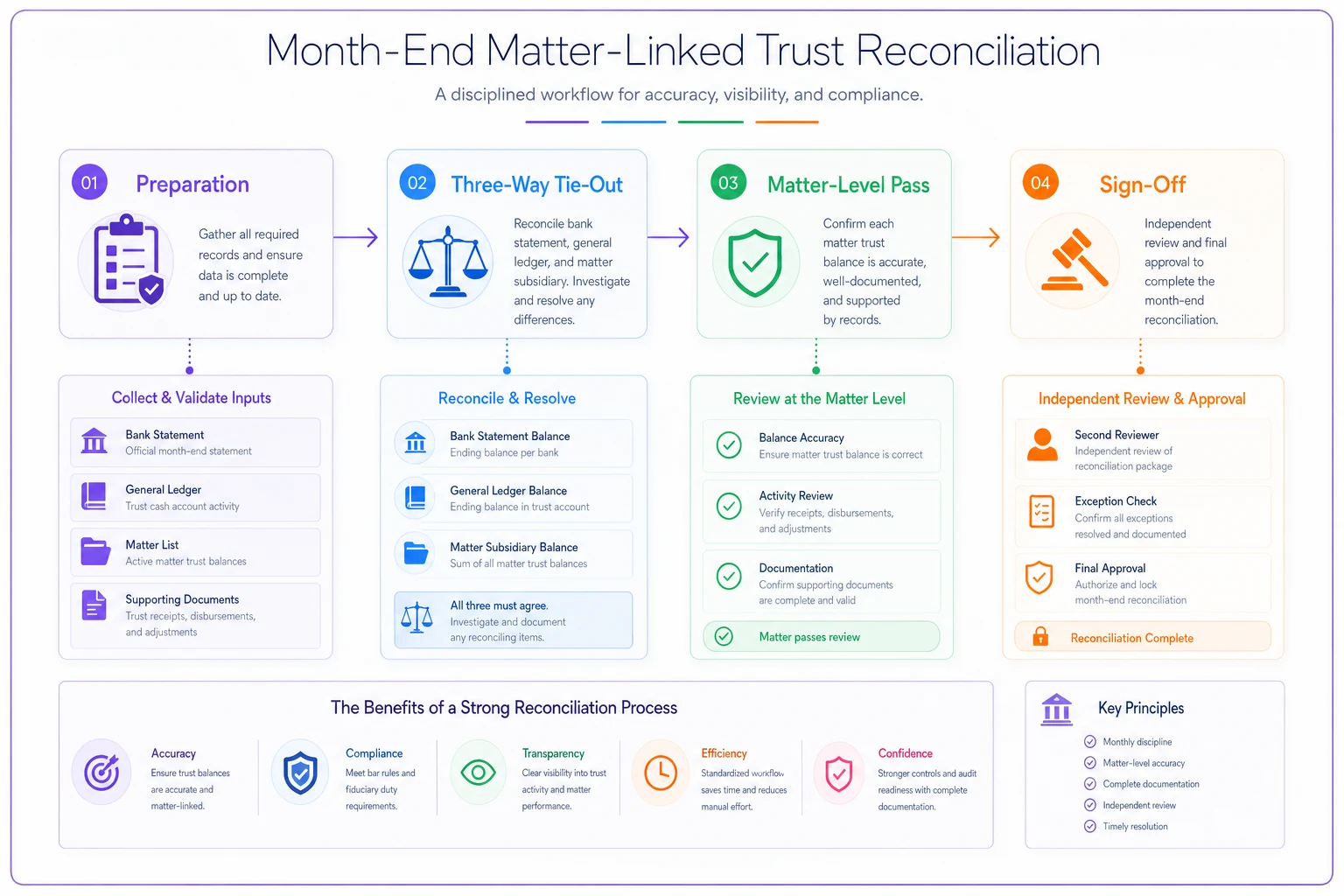
Preparation (before you touch the numbers)
-
- [ ] Confirm all trust deposits for the month are recorded and matter-coded
-
- [ ] Confirm all trust checks written are recorded, including any voided/reissued
-
- [ ] Confirm all fee transfers to operating are recorded against the correct matter
-
- [ ] Confirm any bank fees, wire fees, or interest (IOLTA) are posted
-
- [ ] Pull the trust bank statement and confirm the closing date matches your ledger cutoff
The three-way tie-out
-
- [ ] Reconcile bank statement balance to adjusted book balance (list outstanding checks and deposits in transit)
-
- [ ] Confirm the trust ledger book balance equals the sum of all individual matter ledger balances
-
- [ ] Confirm all three numbers agree
The matter-level pass (the part everyone skips)
-
- [ ] Review every individual matter ledger for a negative balance — zero tolerance, investigate before closing
-
- [ ] Flag any matter with activity but no supporting invoice or authorization
-
- [ ] Flag any matter holding funds for a closed matter
-
- [ ] Flag any deposit still sitting in the unidentified-funds ledger
-
- [ ] Flag any outstanding check older than 90 days (stale-dated)
Sign-off
-
- [ ] Preparer signs and dates
-
- [ ] A second person — not the preparer — reviews and signs
-
- [ ] Reconciliation and supporting statement archived to the trust file
The two-person sign-off is not bureaucratic theater. The single most reliable predictor of a clean trust account over time is that the person who records transactions is not the only person who reviews the reconciliation. Segregation of duties matters more than any software feature.
Here's a quick visual to keep the month-end sequence clear.
The two-person sign-off is not bureaucratic theater. The single most reliable predictor of a clean trust account over time is that the person who records transactions is not the only person who reviews the reconciliation. Segregation of duties matters more than any software feature.
Red-flag rules: what to catch, and the threshold that triggers action
A red-flag rule is only useful if it has a threshold and a required action. "Watch for problems" is not a rule. Here's a working set:
-
Any negative individual matter balance. Threshold
$0.01. Action: stop and investigate before the reconciliation is signed. A negative matter balance means one client's funds covered another's — full stop.
-
Book vs. bank difference that persists two consecutive months. Threshold
same unexplained amount appearing twice. Action: escalate to the responsible partner. A one-month timing difference is normal; the same difference twice is a coding error hiding in plain sight.
-
Fee transfer without a corresponding issued invoice. Threshold
any. Action: reverse or document immediately. You cannot pull earned fees from trust without an invoice that earned them.
-
Funds held on a closed matter beyond 30 days. Threshold
$0 remaining obligation. Action: refund the client or move to the appropriate account.
-
Unidentified-funds ledger holding anything beyond 15 days. Action
escalate to identify the client. Stale unidentified funds are a red flag for both compliance and your own recordkeeping.
-
A single deposit split across more than three matters. Not necessarily wrong, but it's the highest-error transaction type. Action: second-set-of-eyes verification.
-
Round-number disbursements with no source document. Action
verify. Legitimate disbursements usually have a specific dollar-and-cents amount and a document behind them.
The point of red flags is to catch the $600-and-negative-$600 net-to-zero problem in the same month it happens, while the transactions are fresh and the people who made them still remember what happened — not during an annual audit when nobody can reconstruct anything.
A short real scenario
A four-attorney plaintiff-side firm handling personal injury and some family law. Trust account carried settlement funds regularly — sometimes six figures sitting in trust for a single matter while liens got resolved.
Their reconciliation was monthly and "always tied out." The problem surfaced when a client called about a $2,100 balance the firm's invoice showed but the client's own records disputed. Pulling the matter ledger, the bookkeeper found a disbursement for a medical lien that had been coded to the wrong matter about five weeks earlier. The bank balance had been correct the whole time. Two matters were off by the same amount, netting to zero, and it had passed two consecutive three-way reconciliations without anyone looking at individual balances.
Cleanup took most of two days — pulling check images, tracing the lien payment, re-coding, re-running the affected months. The dollar amount was fully recoverable. The real cost was the time, plus a partner's genuine discomfort about how long a misallocation could sit completely undetected.
The fix wasn't more math. They added the matter-level pass to the checklist — the negative-balance review specifically — required a Matter ID on every entry, and moved to a two-person sign-off. Over the following quarter the same class of error got caught within the month twice, both times a misposted disbursement flagged by the negative-balance rule before month-end closed. Instead of a two-day forensic exercise, each was a ten-minute correction.
Where automation actually reduces error — and where it doesn't
Reconciliation is one of the few areas where the right operational tooling genuinely cuts manual mistakes, because the errors are mechanical and repetitive. But it's worth being honest about which parts automation helps and which parts still need a human.
Automation touchpoints that pay off:
-
- Hard-required matter coding at entry. A workflow that won't let a trust transaction save without a Matter ID removes the largest single error source outright. This is a rules-based control, not something you should rely on memory for.
-
- Bank feed matching with matter suggestions. Pulling transactions directly from the bank and proposing the likely matter based on payee and amount removes a lot of manual keying — though a human still confirms the match.
-
- Continuous negative-balance monitoring. Rather than discovering a negative matter balance at month-end, a system that flags it the moment a disbursement pushes a matter below zero turns a month-long problem into a same-day one.
-
- Automated stale-check and stale-funds alerts. The 90-day-check and closed-matter-funds rules are perfect for automated reminders. Nobody reliably remembers to check these manually.
-
- Reconciliation packet assembly. Auto-generating the outstanding-check list, deposits-in-transit list, and matter-balance detail so the preparer is reviewing rather than assembling.
Where automation doesn't help — and can hurt:
-
- Judgment on ambiguous transactions. A split settlement, a disputed lien, a fee transfer timing question — these need a person who understands the matter.
-
- The second sign-off. Automating away the second human reviewer defeats the entire control. Segregation of duties is the point.
-
- Reconciling a mess. Automation applied on top of bad historical coding just produces confidently wrong output faster. You have to clean the base data first.
The right mental model: let the software enforce the boring, mechanical rules relentlessly — required fields, threshold flags, stale-date reminders — and reserve human attention for ambiguous transactions and the review sign-off. That split is where firms actually cut manual reconciliation errors, without pretending a tool can carry the compliance responsibility. It can't. The attorney does.
When a lighter approach is fine — and when it isn't
Not every firm needs the full apparatus.
A lighter, mostly-manual approach makes sense when you have a low volume of trust transactions, funds pass through quickly rather than sitting, and one trusted person handles bookkeeping with a partner reviewing. A transactional real estate closing practice with clean in-and-out flows can run a disciplined manual checklist just fine.
You need the tighter controls when you hold large balances for extended periods — settlement funds, ongoing retainers — multiple people touch the trust account, you handle split deposits regularly, or you've already had one unexplained difference persist across months. That last one is the clearest signal. A difference that survived two reconciliations means your process has a blind spot the checklist above is designed to close.
The situation where shortcuts are most dangerous: any firm where trust volume has grown faster than the reconciliation process. Firms grow into trouble here quietly. The reconciliation that worked at 15 matters starts buckling somewhere around 60, and the person running it usually senses it's getting harder before they can articulate why.
Closing thought
The firms that never have a trust scare aren't the ones with the fanciest accounting software — they're the ones who reconcile at the matter level every single month, in the same order, with a second person signing off, and who treat any negative individual balance as a stop-everything event.
Bank-level reconciliation tells you the money is there. Matter-linked trust reconciliation tells you it's there for the right people. Those are different questions, and only the second one keeps you out of trouble.
Ready to elevate your legal practice management?
Join 500+ law firms using Casioly to optimize case workflows, reduce administrative burden, and improve client satisfaction.