


Most firms don't have a matter data problem. They have a drift problem. Everything looks fine on the day a matter opens — the calendar entries are there, the retainer's funded, the integrations are syncing, the retention clock is set. Then six months pass. A paralegal leaves. A rule gets renamed in the practice management system. Somebody creates a "temporary" duplicate matter that never gets merged. And now you've got 40 open matters that quietly disagree with each other about what's true.
The quarterly health-check exists to catch that drift on a schedule, before it turns into the kind of surprise nobody wants to explain to a partner or a client. This isn't an annual compliance ritual you dread. Done right, a matter lifecycle audit takes a few hours per quarter and pays for itself the first time it catches a mis-calendared limitation date or a trust ledger that doesn't tie out.
What follows is a reusable SOP: which tests to run, in what order, how to actually query for the problems, and — the part most audit checklists skip — how to prioritize the mess you find so you're not treating a cosmetic naming inconsistency with the same urgency as a missed deadline.
Why quarterly beats "when something breaks"
The reactive model is what most small and mid-sized firms run by default. Something breaks — a client asks where their refund is, an insurer's LEDES file bounces, a court flags a missed filing — and someone scrambles to figure out how it happened. By the time the breakage surfaces, the underlying error is usually months old and has already caused downstream damage.
A missed calendar entry doesn't fail on the day it's entered. It fails on the day the deadline arrives. A retention misclassification doesn't hurt anyone until the day you're supposed to have destroyed a file and didn't, or destroyed one you were supposed to keep. The gap between the error and the consequence is exactly where a quarterly rhythm earns its keep.
There's also a compounding effect people consistently underestimate. A firm that never audits doesn't accumulate errors at a steady rate — bad data begets bad data. One duplicate matter means two calendars, two ledgers, two document sets, and every downstream report now silently double-counts or splits. The cost of cleanup roughly triples for every quarter you let it sit. That's not an exaggeration, it's just what happens when systemic errors have time to branch.
The four control areas — and why they can't be audited separately
The instinct is to hand calendaring to the litigation team, billing to accounting, retention to the records person, and integrations to whoever manages the software. That siloing is exactly why problems slip through. These four controls aren't independent — they're linked through the matter, and failures cross the lines.
Never miss a critical deadline again.
Casioly helps legal teams manage cases efficiently and stay on top of critical tasks.
- Centralized case tracking
- Automated deadline reminders
- Secure client communication
No credit card required
| Control area | What it governs | Where it silently breaks something else |
|---|---|---|
| Calendaring | Deadlines, limitation dates, hearing dates | A closed matter still firing reminders means the close control failed and retention won't trigger |
| Billing | Time capture, invoices, trust, realization | An open matter with zero activity for 90+ days signals a phantom matter that pollutes utilization and WIP reports |
| Retention | Classification, hold status, destruction dates | A matter marked "closed" in billing but "active" in the DMS means the retention clock never started |
| Integrations | Sync between PM, accounting, DMS, e-filing | A field renamed in one system breaks calendar or ledger sync everywhere downstream |
The through-line: a single matter that's inconsistent across systems trips multiple controls at once. So the audit has to be run against the matter, not against each system in isolation. You're checking whether all four systems tell the same story about the same matter.
If your integrations layer is where most of this drift originates — and for most firms it is — the health-check pairs naturally with a standing ownership model like the one in Don't Let Data Drift: Integrations Governance, Ownership Matrices and Reconciliation Rules for Law-Firm Stacks. The health-check finds the drift; the governance matrix keeps it from coming back.
Prioritizing tests before you run them
Not every test matters equally. Before running anything, sort your checks into three tiers based on what a failure actually costs.
Tier 1 — Client harm or malpractice exposure. Missed or mis-calendared deadlines, trust account discrepancies, matters open past a statute clock. A single failure here can end a firm. These run first, every quarter, no exceptions.
Tier 2 — Financial leakage and compliance risk. Unbilled WIP aging past thresholds, retainers below replenishment triggers, retention misclassifications, LEDES/billing guideline mismatches. These bleed money and create audit findings but rarely end careers.
Tier 3 — Data hygiene. Duplicate matters, naming inconsistencies, orphaned documents, stale contacts. Annoying, report-distorting, worth fixing — but never at the expense of Tier 1 or 2.
Run Tier 1 checks before Tier 3 — the piece that says "Reverse it. Always." isn't optional.
The mistake firms make is running the easy Tier 3 tests first because they're satisfying to clean up, then running out of time before touching the deadline and trust checks. Reverse it. Always.
The reusable quarterly SOP
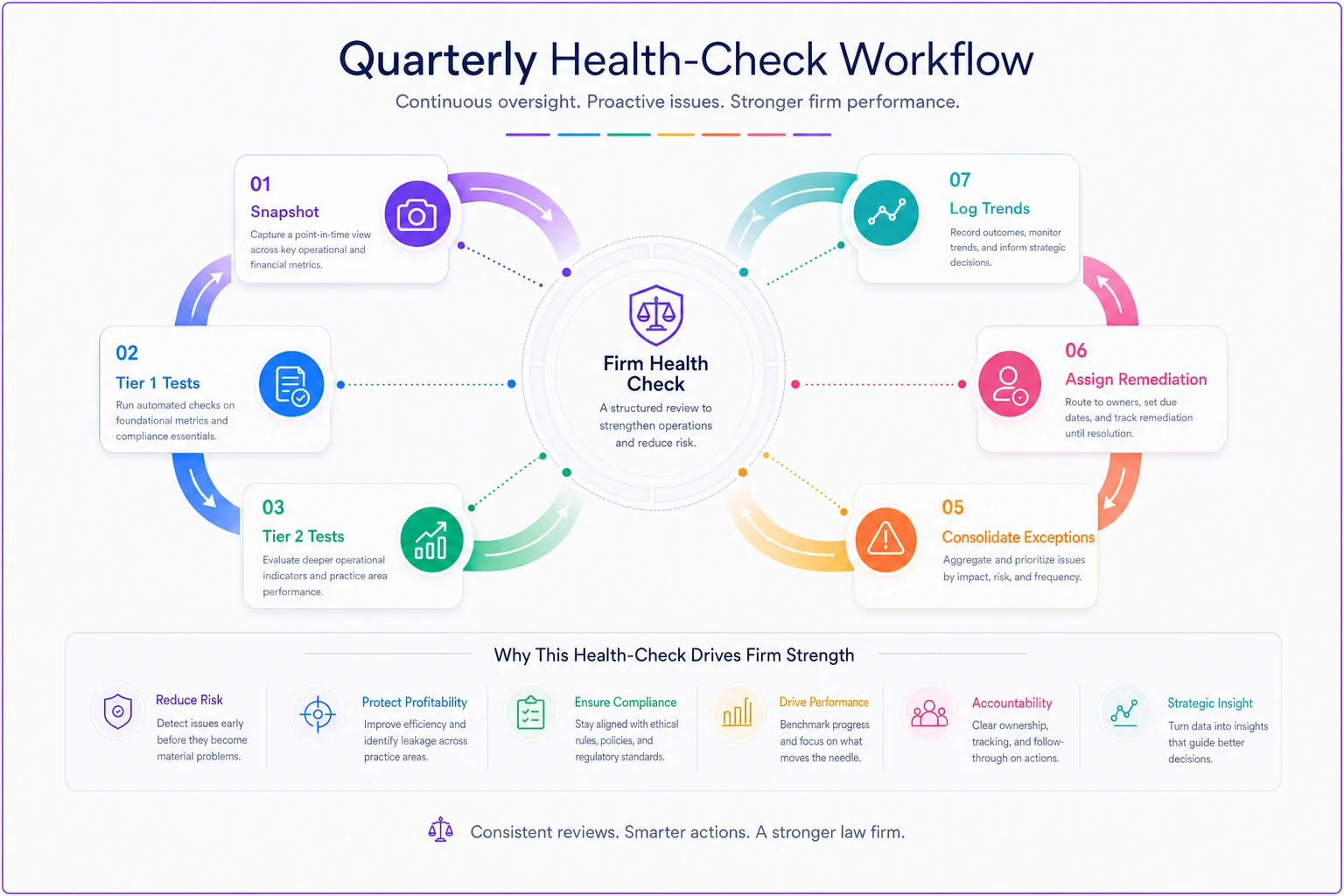
Run it in order. Each step produces a list of exceptions — you don't fix as you go, you collect all exceptions first, then remediate by tier.
-
Freeze a snapshot. Pull matter, calendar, ledger, and DMS status data as of the same timestamp. If you query billing on Monday and the DMS on Thursday, half your "discrepancies" are just timing noise.
-
Run Tier 1 deadline and trust tests. Every open matter with an upcoming deadline gets checked for a live, dual-owned calendar entry. Every trust ledger gets tied to the bank balance.
-
Run Tier 2 financial and retention tests. WIP aging, retainer thresholds, retention classification against close status.
-
Run Tier 3 hygiene tests. Duplicates, orphans, naming.
-
Consolidate exceptions into one list. One spreadsheet, tagged by tier, matter number, control area, and owner.
-
Assign remediation with due dates by tier. Tier 1 within 48 hours. Tier 2 within the quarter. Tier 3 as capacity allows.
-
Log what you found for trend tracking. The same category showing up quarter after quarter isn't a data problem — it's a process problem, and it belongs in a workflow change, not another cleanup task.
This visual shows the workflow and where exceptions feed back into remediation and governance.
The same category showing up quarter after quarter isn't a data problem — it's a process problem, and it belongs in a workflow change, not another cleanup task.
Sample audit queries
You don't need a data scientist for these. Most practice management platforms expose these fields through their reporting or export tools, and the logic translates into filters or SQL depending on your stack. The point isn't the exact syntax — it's the question each query is asking.
Open matters with a deadline but no calendar owner (Tier 1):
> Return every matter where status = open AND a deadline exists within the next 90 days AND the linked calendar entry has fewer than two responsible owners.
Dual ownership on deadlines is non-negotiable at scale.
Trust ledger vs. bank tie-out (Tier 1):
> For each matter with a trust balance, compare the sum of matter-level trust ledger entries to the reconciled bank sub-account. Flag any difference greater than $0.
Yes, $0. Trust is the one place "close enough" doesn't exist.
Phantom or stalled matters (Tier 2):
> Return matters where status = open AND no time entry, no document activity, and no calendar event in the last 90 days.
Retention clock never started (Tier 2):
> Return matters where billingstatus = closed but DMSstatus != closed OR retentiondestroydate is null.
Duplicate matter detection (Tier 3):
> Group by client + matter description + open date within a 30-day window; flag groups with more than one matter number.
The pattern across all of these: you're comparing what two systems say about the same matter and flagging where they disagree.
Mapping findings back to controls and remediation
Finding the exception is the easy part. The value is in routing it to the right fix and the right owner. A missed-deadline exception doesn't get "fixed" by adding the calendar entry — that's treating the symptom. The real remediation is figuring out why it was missing and closing the process gap.
-
Calendar exceptions → re-enter with dual owners, then trace the intake step where the deadline should have been captured. If it's recurring, the intake checklist is broken.
-
Billing exceptions → phantom matters get closed or reactivated with a real reason; retainer shortfalls trigger replenishment; WIP aging gets escalated to the responsible attorney.
-
Retention exceptions → align close status across systems, set the destroy date, confirm no legal hold blocks it.
-
Integration exceptions → these are almost always root causes, not symptoms. A renamed field or broken sync gets fixed at the connector level, and then you re-run the affected tests — because that one break probably created a dozen downstream exceptions.
When you see the same category of exception cluster around the same time period, you're usually looking at a single integration or process change that broke and cascaded. Fixing the individual matters without fixing the source guarantees the same list next quarter.
For firms running matters as structured projects, folding these remediation owners into an existing accountability model keeps things sustainable. The RACI approach in the Legal Project Management Playbook: RACI by Matter Stage, Change-Control Templates and Milestone Acceptance Criteria maps cleanly onto who owns which remediation category.
Where automation actually helps (and where it doesn't)
The manual version of this SOP works fine at around 30–50 open matters. Past that, the snapshot-and-compare step becomes the bottleneck. Pulling data from four systems by hand and lining it up is exactly the kind of tedious cross-referencing that people quietly stop doing when they get busy.
This is where AI-assisted operational software earns its place — not as a replacement for judgment, but for the reconciliation grind. A platform that continuously compares matter state across your PM, accounting, and document systems can surface Tier 1 exceptions the day they appear instead of waiting for the quarterly pull. The automation handles the "which system disagrees with which" comparison; a human still decides what to do about it. The goal isn't to remove the review — it's to make sure the review isn't the first time anyone notices a trust ledger is off.
What it won't do is tell you why the intake checklist keeps failing or which attorney needs a conversation about aging WIP. Those stay human. The tooling just makes sure the exceptions are actually on the table when the conversation happens.
When this SOP makes sense — and when it's overkill
Run the full quarterly version if you have more than roughly 40 open matters, handle client trust funds, work across multiple systems that sync, or carry deadline-sensitive litigation work.
Scale it down if you're a solo or two-attorney shop with a handful of matters and everything lives in one system. A monthly 30-minute Tier 1 check may be all you need — the full four-control audit would be more ceremony than value.
Don't bother trying to run this against a system where you don't trust the underlying data. If your matter records are already a mess, do a one-time remediation first, then start the quarterly rhythm. Running a health-check on garbage data just produces a very long, very demoralizing exception list.
A realistic before-and-after
A litigation boutique — around 60 open matters, three attorneys, two support staff — was running purely reactive. Their trigger for cleanup was almost always a client or opposing counsel catching something first. Over one year they'd eaten a write-off in the low five figures from unbilled WIP that aged past what clients would accept, plus a near-miss on a limitation date that a paralegal caught by luck two days out.
They adopted a version of this SOP, roughly a half-day per quarter. The first run surfaced 11 Tier 1 exceptions — mostly single-owner calendar entries on active deadlines — a handful of phantom matters inflating their WIP reports, and a trust sub-account that was off by a few hundred dollars from a mis-posted entry.
Nothing dramatic changed overnight. By the third quarter, though, the Tier 1 list had dropped to two exceptions, both fixed same-day. Write-offs from aged WIP roughly halved the following year, mostly because stalled matters got flagged while there was still time to bill or close them. The paralegal-catching-it-by-luck situation stopped being a recurring thing, because the deadline check ran on a schedule instead of on adrenaline.
The real win wasn't the numbers. It was that the partners stopped finding out about problems from clients.
The point
A quarterly health-check isn't about being audit-ready for its own sake. It's about shortening the distance between when something breaks and when you find out — because in a law firm, that gap is measured in malpractice exposure and lost fees, not inconvenience.
Build the SOP once, tier your tests so the dangerous stuff runs first, route findings back to the process that caused them, and log the patterns so you're fixing systems instead of symptoms. Do that four times a year and most of the surprises stop.
A quarterly health-check isn't about being audit-ready for its own sake. It's about shortening the distance between when something breaks and when you find out — because in a law firm, that gap is measured in malpractice exposure and lost fees, not inconvenience. Build the SOP once, tier your tests so the dangerous stuff runs first, route findings back to the process that caused them, and log the patterns so you're fixing systems instead of symptoms. Do that four times a year and most of the surprises stop.
Ready to elevate your legal practice management?
Join 500+ law firms using Casioly to optimize case workflows, reduce administrative burden, and improve client satisfaction.