


Legal project management in law firms usually breaks down at the handoffs. Not when someone drops the ball entirely, but in those gray zones between matter stages where everyone assumes someone else owns the next step. You get partners reviewing work that associates haven't finished, paralegals waiting on instructions that never come, and clients wondering why their straightforward merger is running three weeks behind.
The core operational problem isn't getting people to do their jobs. It's creating clarity about who owns what decision at each stage of a matter. Most firms respond with more meetings or tighter deadlines, which just piles on overhead without touching the actual coordination problem.
There's a structural reason this keeps happening. Firms are organized around practice groups, billing hierarchies, and client relationships—not around matter workflows. So when a matter moves from one stage to the next, the accountability structures don't automatically move with it.
The governance gap that derails complex matters
Legal project management in law firms usually breaks down at the handoffs. Not when someone drops the ball entirely, but in those gray zones between matter stages where everyone assumes someone else owns the next step. You get partners reviewing work that associates haven't finished, paralegals waiting on instructions that never come, and clients wondering why their straightforward merger is running three weeks behind.
The core operational problem isn't getting people to do their jobs. It's creating clarity about who owns what decision at each stage of a matter. Most firms respond with more meetings or tighter deadlines, which just piles on overhead without touching the actual coordination problem.
There's a structural reason this keeps happening. Firms are organized around practice groups, billing hierarchies, and client relationships—not around matter workflows. So when a matter moves from one stage to the next, the accountability structures don't automatically move with it.
Why traditional project management fails in legal work
Legal matters don't move like standard business projects. A litigation case might loop back through discovery multiple times. A corporate transaction can sit dormant for weeks waiting on regulatory sign-off, then suddenly need all-hands attention when the deal structure shifts. Your M&A matter that was tracking fine suddenly needs emergency tax restructuring because due diligence surfaced a liability nobody saw coming.
Never miss a critical deadline again.
Casioly helps legal teams manage cases efficiently and stay on top of critical tasks.
- Centralized case tracking
- Automated deadline reminders
- Secure client communication
No credit card required
Standard project management assumes linear progress—complete phase one, move to phase two, get sign-off, continue. Legal work operates more like parallel tracks that occasionally merge, split, and reconnect. Your document review team might be on version twelve while the negotiation team is still debating core terms from version three.
This creates specific operational failures. Associates burn hours on work that gets scrapped because strategy changed upstream. Partners get pulled into decisions that should have been handled two levels down. Clients receive conflicting updates because the litigation team and the settlement team aren't aligned on current strategy.
The irony is that most firms already know this. They've just never built the operational infrastructure to do anything about it consistently.
Building RACI matrices for each matter stage
A functioning legal project management system starts with clear ownership at each stage. Not just "Sarah handles discovery"—but exactly what Sarah can decide independently, what needs partner approval, and when she needs to pull in other practice groups.
-
Initial Case Assessment (Days 1–14) - Responsible: Senior Associate conducts factual investigation, preliminary legal research - Accountable: Partner owns go/no-go decision, initial strategy, fee structure - Consulted: Client provides documents and background; specialist attorneys review specific issues - Informed: Paralegal team, accounting (for conflict checks and billing setup)
-
Pleadings Phase (Days 15–45) - Responsible
Mid-level Associate drafts all pleadings, manages filing deadlines - Accountable: Senior Associate reviews and approves all drafts before partner review - Consulted: Partner provides strategic input on key arguments; client reviews fact sections - Informed: Full team on filing status and opposing counsel responses
-
Discovery Planning (Days 46–75) - Responsible
Paralegal team creates document collection protocols, custodian lists - Accountable: Senior Associate owns discovery strategy, privilege determinations - Consulted: Partner on scope disputes and cost considerations; IT on data collection - Informed: Client on preservation obligations and collection timeline
The key difference from a generic RACI chart is that these are stage-specific and acknowledge that ownership shifts as a matter progresses. The associate who owns document review during discovery might only be in the "informed" column during settlement negotiations. A static org-chart-style RACI misses that entirely.
Change control when matters pivot
Every complex matter hits inflection points where the original plan becomes obsolete. The opposing party files an unexpected motion. The client's business priorities shift. A key witness becomes unavailable. Regulatory guidance changes mid-transaction.
Without change control protocols, these pivots create real operational chaos. Teams spend days working off outdated strategies. Budget overruns happen because nobody tracked when scope expanded. Deadlines get missed because the strategy change didn't reach everyone affected.
A working change control template covers five operational checkpoints:
Trigger identification: What actually constitutes a material change requiring formal review? Not every client email needs a change order, but waiting too long means you're already off track. Most firms draw the line at:
-
Scope changes affecting budget by more than 10%
-
Timeline shifts exceeding two weeks
-
New parties or claims being added
-
Strategy pivots affecting more than two team members' work
Impact assessment: Map what actually changes operationally. Shifting from aggressive litigation to settlement discussions affects your discovery strategy, expert witness timeline, and document production priorities. Each downstream impact needs explicit acknowledgment.
Approval hierarchy: Minor tactical changes—like shifting a deposition date—might only need senior associate sign-off. Strategic pivots like abandoning a key legal theory require partner approval. Client-affecting changes need formal client consent.
Communication cascade: Changes flow through defined channels, not informal hallway conversations. The partner informs the senior associate, who briefs the full team, updates the project plan, and notifies affected support staff. Everyone acknowledges receipt.
Documentation requirements: Every material change gets memorialized—not in lengthy memos, but in structured updates capturing what changed, why, who approved it, and which work streams are affected.
The goal isn't bureaucracy. It's making sure a strategic decision made in one partner's office actually reaches the paralegal pulling documents at 9pm.
Milestone acceptance criteria that actually work
Most firms confuse activity completion with milestone achievement. "Finish document review" isn't a milestone—it's a task. A real milestone represents a strategic checkpoint where the matter could theoretically pause, transfer to another team, or change direction based on what's been learned.
Effective milestone design means defining acceptance criteria that go beyond "work complete" to include quality gates, strategic alignment checks, and client value delivery.
Take deposition preparation. The traditional milestone might be "deposition prep complete." Functional acceptance criteria look different:
-
Witness outline reviewed against case theory
-
All referenced documents assembled and indexed
-
Hostile questioning scenarios prepared
-
Settlement leverage points identified
-
Client updated on expected outcomes
-
Backup examiner briefed on key areas
This prevents the scenario where someone marks deposition prep as done, and the partner finds critical gaps an hour before the deposition starts.
For transactional work, milestone acceptance gets more complex because you're coordinating multiple parallel work streams. Your due diligence milestone isn't just "review complete"—it requires:
-
All material risks identified and quantified
-
Remediation strategies proposed for each risk
-
Deal structure implications analyzed
-
Disclosure schedules updated
-
Client decision memo prepared
-
Specialists' sign-offs obtained
The matter lifecycle stages we've covered before provide the framework, but these acceptance criteria add the operational teeth that prevent matters from drifting forward without real progress.
Building your LPM-to-matter rollout checklist
Implementing legal project management isn't about forcing every matter into the same rigid template. Different matter types need different levels of structure. A routine employment dispute doesn't need the same governance overhead as a billion-dollar merger.
But every matter benefits from baseline operational clarity. Here's a practical rollout approach that scales based on matter complexity:
-
Tier 1 — Simple Matters (under $50k, single-attorney) - Basic RACI: attorney responsible, partner accountable, client informed - Change control via email with client confirmation - Three milestones: intake complete, substantive work done, matter closed - Weekly status updates in matter management system
-
Tier 2 — Standard Matters ($50k–$250k, small team) - Stage-based RACI covering 4–6 matter phases - Formal change control for scope/budget adjustments over 15% - Milestones at each major phase transition - Bi-weekly team syncs, weekly client updates - Simple project tracking in spreadsheet or matter management platform
-
Tier 3 — Complex Matters (over $250k, cross-functional team) - Detailed RACI matrix with decision rights specified - Change control committee with defined approval limits - Acceptance criteria for all major milestones - Daily stand-ups during critical phases - Dedicated project coordinator role - Real-time dashboards for budget and timeline tracking
The mistake most firms make is applying Tier 3 controls to Tier 1 matters. That just creates bureaucracy without value. Start with governance that fits the matter type, then adjust as complexity evolves.
Below is a rough illustration of how governance activity maps to matter stage across these tiers:
This visual shows how RACI, change control, and milestone activity layers increase with matter complexity and across intake, active work, and closeout phases.
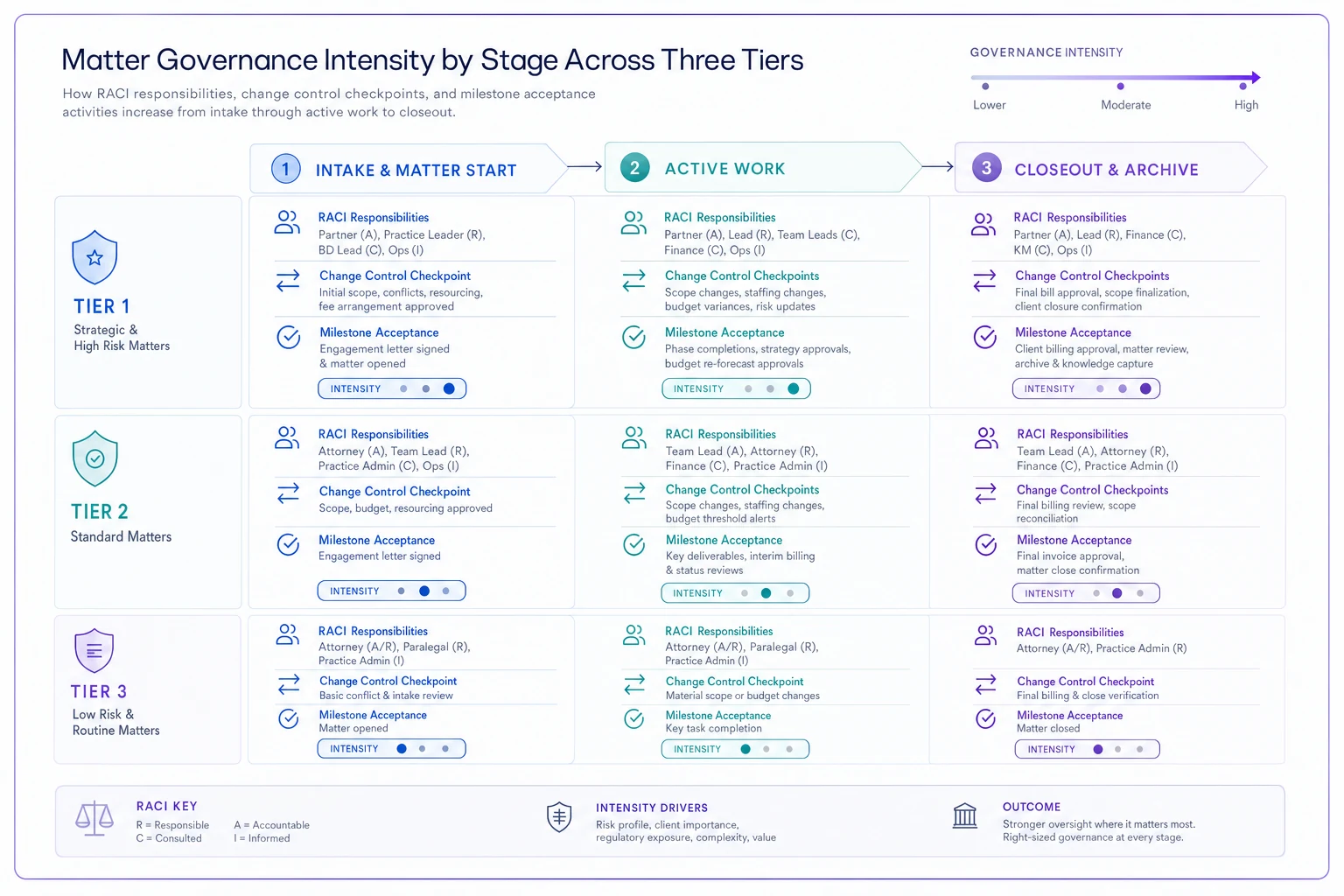
The graph isn't meant to suggest you need complex tooling to manage this. Even a well-maintained spreadsheet can track tier assignments and flag when a matter's scope has outgrown its governance structure.
When handoffs fail: Common breakdown points
The most expensive failures in legal project management happen at the intersections. When corporate hands off to litigation. When discovery transitions to motion practice. When negotiation shifts to documentation. These handoff points account for a significant portion of timeline slippage in complex matters—and it rarely gets tracked until the damage is already done.
Consider a typical M&A-to-integration handoff. The deal team has been running hard for weeks—managing negotiations, coordinating due diligence, drafting agreements. The deal closes and the integration team takes over. But the integration team doesn't know which regulatory approvals are still pending, what employment issues were flagged but unresolved, or why certain contract terms ended up the way they did.
Without structured handoff protocols, you get:
-
Integration attorneys re-doing diligence work
-
Clients receiving contradictory advice from different teams
-
Critical deadlines missed because nobody transferred calendar ownership
-
Budget overruns from duplicate work
Effective handoff protocols include:
-
Structured knowledge transfer sessions—not just document dumps
-
Overlapping team membership during transition periods
-
Clear documentation of open issues and planned resolution paths
-
Formal acceptance of matter ownership
-
Post-handoff check-ins to catch gaps early
The delegation and routing frameworks help with task-level handoffs, but matter-stage transitions need more comprehensive governance than any routing matrix alone can provide.
| Handoff Type | Common Failure | Root Cause |
|---|---|---|
| Corporate → Litigation | Missing context on deal terms | No knowledge transfer session |
| Discovery → Motion Practice | Duplicate document review | No ownership transfer confirmation |
| Negotiation → Documentation | Contradictory client advice | Parallel teams not aligned |
| Deal Team → Integration | Open regulatory items lost | No open issues log maintained |
| Litigation → Settlement | Calendar ownership gaps | Deadlines not formally transferred |
This kind of breakdown happens in firms of every size. It's not a staffing problem or a talent problem—it's a handoff infrastructure problem.
Tracking governance effectiveness
Most firms measure legal project management success through lagging indicators—realization rates, matter profitability, client satisfaction scores. By the time those metrics surface a problem, the operational damage is already done.
Leading indicators focus on process health instead:
RACI clarity: Survey team members quarterly—"Do you know exactly what decisions you own?" Anything below 80% indicates governance gaps worth addressing.
Change control compliance: Track what percentage of material changes go through formal change control versus happening informally. Target 90%+ on complex matters.
Milestone slippage: Measure how often milestones move versus hitting their original dates. Some movement is normal, but consistent slippage points to poor planning or unclear acceptance criteria.
Handoff efficiency: Track hours spent on knowledge transfer and rework after handoffs. Efficient handoffs should account for less than 5% of total matter hours.
Governance overhead: Monitor time spent on project management activities versus substantive legal work. Good governance generally runs 3–7% of matter time depending on complexity.
These aren't hard thresholds—they're directional signals. The point is to measure process health before a matter closes rather than discovering problems in a post-mortem.
The technology reality check
Legal project management software promises to fix coordination problems, but most platforms just digitize existing chaos. You get better visibility into broken processes without actually fixing them.
That said, some operational problems genuinely become harder to solve without technology at scale. Tracking decision rights across multiple active matters. Maintaining updated RACI matrices as team composition shifts mid-matter. Enforcing change control consistently when everyone's billing 60-hour weeks. Managing milestone dependencies across parallel work streams.
AI-assisted operational platforms can help by automatically surfacing governance gaps—flagging matters that proceed without defined ownership, alerting when changes happen outside formal channels, or catching approaching handoffs that haven't triggered preparation activity yet. The value is in using technology to enforce governance, not substitute for it.
These platforms work best when they:
-
Embed governance rules directly into workflow
-
Automatically route approvals based on RACI definitions
-
Track change history with full audit trails
-
Generate handoff checklists based on matter type and stage
-
Surface exceptions before they compound into real problems
But even well-designed legal project management software can't fix fundamental governance gaps. The underlying frameworks have to exist first. Technology scales and enforces them—it doesn't create them.
Making governance stick in real operations
The hardest part of legal project management isn't designing good governance—it's getting busy attorneys to actually follow it. Every firm has tried to implement project management disciplines at some point. Most attempts stall because they add administrative burden without delivering anything immediate to the people doing the work.
Three operational shifts tend to make the difference:
Make governance invisible where possible. Don't require attorneys to build RACI matrices from scratch on every matter. Create standard templates by matter type that apply automatically unless someone actively modifies them. Pre-populate change control forms with standard language. Generate milestone checklists from matter metadata. The less manual effort, the higher the compliance.
Connect governance to problems people already feel. When an associate complains about conflicting instructions from two partners, that's a RACI problem. When a partner keeps getting pulled into minor decisions, that's a delegation protocol problem. Framing governance as the fix for friction people already experience tends to land differently than pitching it as a new administrative requirement.
Start where adoption is easiest. Find one practice group or one matter type where people already recognize the need for better coordination. Get early wins there. Let those results make the case to skeptics. Organic adoption sticks better than firm-wide mandates.
Pre-populate change control forms with standard language and auto-generated fields from matter metadata to minimize manual work and increase compliance.
The firms that actually make legal project management work treat governance as operational infrastructure, not administrative overhead. They embed it into how work naturally flows rather than layering it on top. They measure success by reduced friction and faster resolution—not by governance compliance percentages.
When the balance is right, attorneys spend less time coordinating and more time practicing law. Clients get more predictable outcomes at more predictable costs. And matters stop derailing at the handoff points where nobody's sure who owns the next move.
Ready to elevate your legal practice management?
Join 500+ law firms using Casioly to optimize case workflows, reduce administrative burden, and improve client satisfaction.