



You know that feeling when a partner's inbox becomes the Bermuda Triangle of legal work? Documents go in, nothing comes out for days, and suddenly everyone's scrambling because a filing deadline is tomorrow morning.
Last month I sat with a mid-sized litigation firm that was hemorrhaging money on routine matters. Their senior attorneys were spending 4-6 hours daily on work that paralegals could handle—things like initial discovery reviews, standard motion drafts, and client status updates. The kicker? They were billing these tasks at $450/hour while their paralegals sat idle at 60% utilization.
The problem wasn't competence or willingness to delegate. It was the absence of clear delegation rules law firm matter routing systems need to function properly. Without explicit routing criteria, everything defaults upward to the most expensive resources.
Why Traditional Delegation Breaks Down
Most firms try to delegate through verbal instructions or general policies like "partners handle strategy, associates handle research." But legal work doesn't fit into neat categories. A single matter might involve:
-
Routine administrative tasks (scheduling, file organization)
-
Mid-complexity legal work (standard motions, initial research)
-
High-stakes decisions (settlement strategy, key arguments)
-
Confidential elements (privileged communications, sensitive client data)
When you don't have clear routing rules, everything gets treated as high-stakes by default. Partners review everything "just to be safe." Associates wait for approval on routine decisions. Paralegals avoid taking initiative because they're unsure of boundaries.
The result? A $450/hour attorney spends Tuesday afternoon formatting exhibits while a capable paralegal updates their timesheet for the third time that day.
Building a Complexity-Based Routing Matrix
The firms that successfully push work down the chain use explicit routing matrices based on two dimensions: task complexity and confidentiality level.
Never miss a critical deadline again.
Casioly helps legal teams manage cases efficiently and stay on top of critical tasks.
- Centralized case tracking
- Automated deadline reminders
- Secure client communication
No credit card required
Complexity Levels:
-
Level 1
Routine/procedural (filing documents, scheduling, standard correspondence)
-
Level 2
Template-based with modifications (standard motions, routine discovery responses)
-
Level 3
Analysis required (legal research, strategic recommendations)
-
Level 4
Critical decisions (settlement authority, trial strategy, client advisory)
Confidentiality Tiers:
-
Tier A
Public or general matter information
-
Tier B
Standard attorney-client privileged
-
Tier C
Highly sensitive (merger details, criminal defense strategy, board-level issues)
The magic happens when you create explicit routing rules for each combination. A Level 1/Tier A task (like filing a public document) goes straight to your legal assistant. A Level 3/Tier C task (analyzing sensitive merger terms) stays with senior counsel.
The Routing Decision Tree That Actually Gets Used
Theory is great, but people need something they can reference in 10 seconds when work hits their desk. This decision tree works:
-
First Question
Is immediate action required?
-
If yes → Check SLA timer (more on this below)
-
If no → Continue to routing
-
Second Question
Does this require legal judgment?
-
If no → Route to admin/paralegal
-
If yes → Continue
-
Third Question
Is there precedent or a template?
-
If yes → Junior attorney/senior paralegal with review
-
If no → Continue
-
Fourth Question
Could an error cause malpractice liability?
-
If yes → Senior attorney primary, junior attorney assist
-
If no → Junior attorney primary, partner review
-
Fifth Question
Does this involve board-level or criminal exposure?
-
If yes → Partner only
-
If no → Senior attorney with defined escalation
Below is a simple visual of this decision tree.
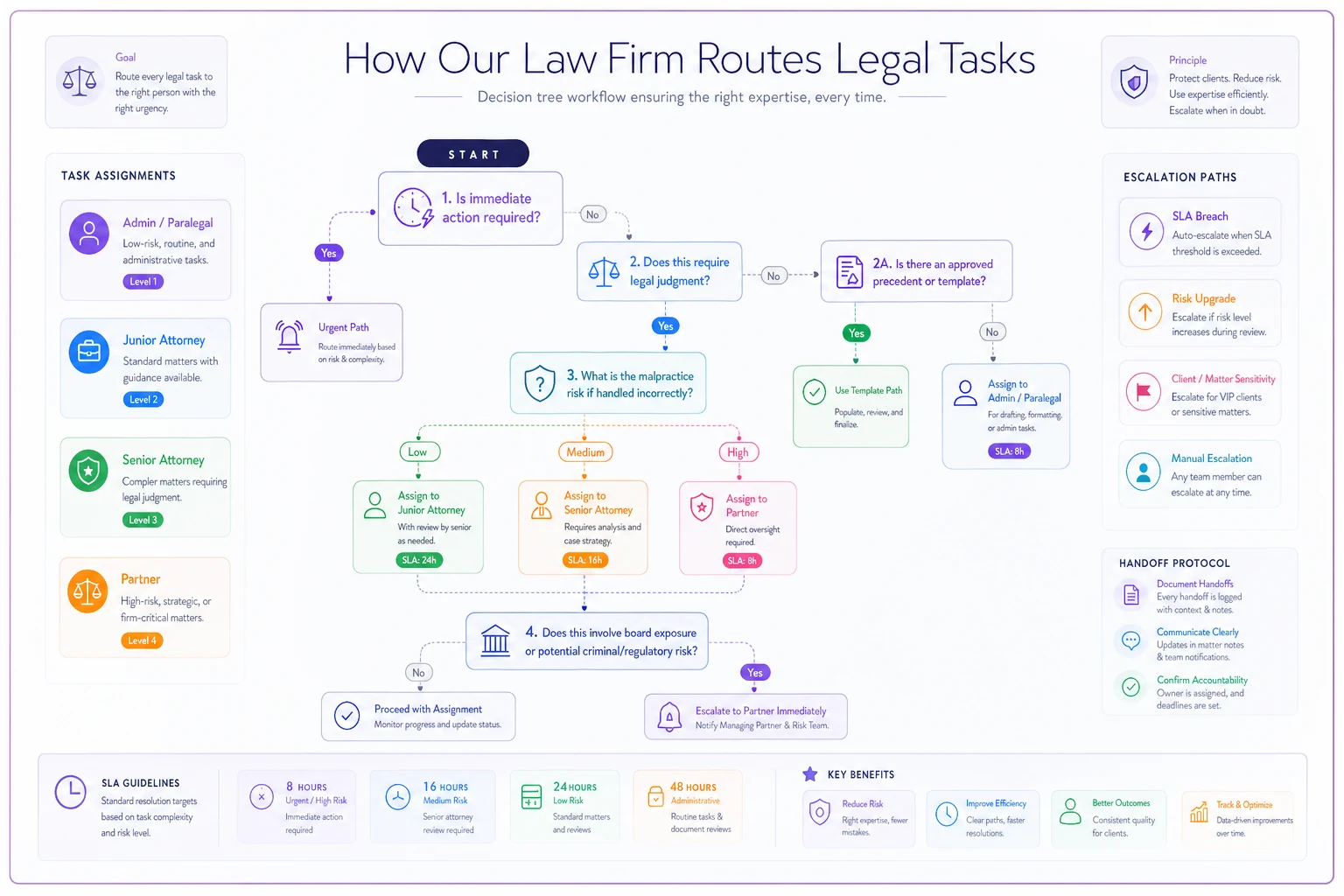
One employment firm implemented this exact tree and saw senior attorney utilization on routine work drop from 35% to 12% within six weeks. They didn't hire anyone new—they just started routing intelligently.
SLA Targets That Prevent Bottlenecks
Routing rules mean nothing if work sits in someone's queue for days. You need Service Level Agreements that create urgency without causing panic.
| Task Type | Initial Response SLA | Completion SLA | Escalation Trigger |
|---|---|---|---|
| Filing/Court Deadlines | 2 hours | Per court rules minus 24hr | 50% time elapsed |
| Client Communications | 4 hours | 24 hours | 6 hours |
| Internal Review Requests | 1 business day | 3 business days | 2 days |
| Research Assignments | 1 business day | Agreed deadline | 1 day past deadline |
| Document Production | 4 hours | Per discovery schedule | 20% schedule consumed |
Include handoff time in SLA calculations so reviews don't hide delays.
SLAs must account for handoff time. If a paralegal needs partner approval, the SLA clock includes both work time and review time. Otherwise you're just moving bottlenecks around.
Sample Automation Rules That Actually Work
Manual routing fails because humans make inconsistent decisions when they're busy. Here are automation rules that firms actually use to shift work off senior attorneys:
Rule 1: Auto-Route by Document Type
-
Correspondence from opposing counsel → Associate for initial review
-
Court notices → Paralegal for calendaring, then attorney
-
Client emails with "urgent" → Partner notification, associate response draft
-
Invoices or billing questions → Billing coordinator
Rule 2: Complexity Scoring
-
New matter intake under $50k → Associate-led with partner oversight
-
Routine motions (continuance, extension) → Paralegal draft, associate review
-
Any filing due within 48 hours → Direct to responsible attorney plus backup
Rule 3: Workload Balancing
-
If primary attorney has 5+ items in review queue → Route to designated backup
-
If paralegal utilization under 70% → Route eligible Level 1-2 tasks automatically
-
If matter inactive for 30+ days → Route to junior for status check
Rule 4: Escalation Triggers
-
Any task at 75% of SLA → Add secondary assignee
-
Client follow-up needed for 5+ days → Escalate to relationship partner
-
Review pending for 2+ days → Copy department head
A boutique IP firm implemented these four rules and reduced their average matter cycle time from 31 days to 19 days. They didn't work faster—they just stopped letting things sit.
The Hidden Cost of Senior Attorney Bottlenecks
When a partner sits on a document review for three days, here's the cascade:
-
The associate waiting for feedback starts another matter (context switching cost)
-
The paralegal can't move forward with filing prep (idle time cost)
-
The client doesn't get their status update (relationship cost)
-
The billing on that matter gets delayed (cash flow cost)
-
Other matters queue up behind this one (opportunity cost)
One litigation firm tracked this and found that each day of partner delay created roughly $3,400 in downstream inefficiency. Not lost revenue—pure inefficiency from people waiting, switching contexts, and duplicating effort.
Common Routing Mistakes That Destroy Delegation
The "Important Client" Override Every important client's work goes straight to partners, regardless of complexity. Result: Partners spend Thursday formatting PowerPoints for board presentations while associates twiddle their thumbs.
The Undefined Escalation Path "Escalate anything unusual" without defining "unusual." Everything gets escalated because nobody wants to be wrong.
The Responsibility Without Authority Problem Associates are responsible for matter outcomes but can't make routine decisions. Result: Constant approval-seeking for minor issues.
The All-or-Nothing Delegation Either the partner handles everything or delegates everything. Result: Quality issues on complex work, senior attorney burnout on simple work.
Building Your Firm's Routing Matrix
Start with your five most common matter types. For each one, list every task from intake to close. Now categorize:
-
Must be partner Maybe 10-15% of tasks (strategy, key client communication, final approval)
-
Should be senior attorney Another 20-25% (complex research, significant motions)
-
Can be junior attorney About 35-40% (routine filings, standard research, first drafts)
-
Should be paralegal The remaining 30-35% (scheduling, document management, routine correspondence)
Now add your confidentiality overlay. Highly sensitive matters might shift everything up one level, but they shouldn't shift everything to the top.
Most firms discover partners are doing 40-50% of all work, regardless of complexity. That's where the opportunity lives.
Technology That Enables Smart Routing
Manual routing through email forwards and verbal instructions fails predictably. The firms getting this right use operational platforms that embed routing logic directly into their workflows.
The key capabilities that matter:
-
Automatic task classification based on matter type and document content
-
Real-time workload visibility across all team members
-
SLA tracking with automatic escalation
-
Delegation audit trails for accountability
When routing rules live in software instead of someone's head, they actually get followed. A small insurance defense firm built their routing matrix into their practice management platform and saw partner hours on routine work drop by 60% in two months.
The platform tracked every delegation decision, creating accountability. Associates knew exactly what they were authorized to handle. Paralegals could take initiative within defined bounds. Partners could actually focus on high-value work.
Measuring Whether Your Routing Works
Track these metrics monthly:
Utilization by Level:
-
Partner time on Level 1-2 complexity work (target
under 15%)
-
Associate time on Level 1 work (target
under 25%)
-
Paralegal utilization rate (target
75-85%)
SLA Performance:
-
Percentage of tasks meeting initial response SLA
-
Average time from assignment to completion
-
Number of escalations triggered
Matter Velocity:
-
Average days from intake to resolution
-
Number of handoffs per matter
-
Percentage of matters with bottleneck delays
Quality Metrics:
-
Client complaints about responsiveness
-
Internal rework required
-
Malpractice near-misses
If partners are still doing 30%+ routine work after three months, your routing rules aren't being followed. Usually it's because the rules are too complex or the escalation triggers are too aggressive.
When Smart Routing Makes Sense (And When It Doesn't)
This approach works when:
-
You have at least 3-4 attorneys and 2-3 support staff
-
Work is somewhat predictable and repeatable
-
Senior attorneys are genuinely overwhelmed
-
There's willingness to let go of control
This approach fails when:
-
Every matter is genuinely unique and complex
-
You don't have junior resources to route work to
-
Partners insist on personal involvement in everything
-
There's no technology to support the routing logic
A solo practitioner with one paralegal doesn't need a complex routing matrix. But a 10-attorney firm where partners review every comma in every document? That's organizational malpractice.
The Path Forward
The difference between firms that successfully implement delegation rules law firm matter routing and those that don't isn't about having perfect rules. It's about having explicit rules that everyone understands and systems that enforce them.
Start small. Pick your highest-volume matter type and build routing rules for just that. Track what percentage of work actually follows the rules. Adjust based on what you learn. Then expand.
Most firms discover that 70% of their work could be handled by someone more junior than who's currently doing it. That's not an indictment of current practices—it's an opportunity to dramatically improve profitability and actually let senior attorneys practice law instead of managing logistics.
The firms winning in this environment aren't the ones working harder. They're the ones routing smarter, using clear complexity frameworks and SLA targets to ensure work flows to the right level automatically. When delegation rules become operational reality instead of theoretical policy, everything changes.
Your senior attorneys stop drowning in routine work. Your associates develop faster through meaningful responsibility. Your paralegals actually use their skills. And your clients get better service because the right person is handling their work at the right level of attention.
The bottleneck isn't your people. It's your routing.
The difference between firms that successfully implement delegation rules law firm matter routing and those that don't isn't about having perfect rules. It's about having explicit rules that everyone understands and systems that enforce them.
Start small. Pick your highest-volume matter type and build routing rules for just that. Track what percentage of work actually follows the rules. Adjust based on what you learn. Then expand.
Most firms discover that 70% of their work could be handled by someone more junior than who's currently doing it. That's not an indictment of current practices—it's an opportunity to dramatically improve profitability and actually let senior attorneys practice law instead of managing logistics.
The bottleneck isn't your people. It's your routing.
Ready to elevate your legal practice management?
Join 500+ law firms using Casioly to optimize case workflows, reduce administrative burden, and improve client satisfaction.