


Most firms treat client experience as a feeling. Partners talk about "being responsive," associates get told to "keep clients updated," and the marketing team runs a satisfaction survey once a year that nobody acts on. None of that is an operating model. It's a hope.
The firms that actually deliver a consistent client experience across 40, 60, 200 matters at once don't do it through good intentions. They've built a client experience operating model — a system that ties each stage of a matter to a defined service level, routes communication through the right channel, measures whether clients are actually using the tools you give them, and triggers business development follow-up at moments that matter. When those pieces connect, the experience feels seamless. When they don't, you get the firm everyone's seen: brilliant legal work wrapped in a frustrating, inconsistent, slow-feeling delivery.
This is a systems article. The goal isn't to give you ten tips for being nicer to clients. It's to map how the whole thing fits together, where it breaks as you grow, and what a governed version actually looks like.
Why client experience fragments as a firm grows
At five lawyers, client experience is basically one person's personality. The founding partner answers the phone, remembers the client's kids' names, sends an update when something happens because they personally know it happened. No system needed — the system is a brain.
That doesn't survive growth, and it doesn't fail gracefully. It fails in pieces.
The first thing to break is consistency across matter owners. One partner replies within an hour. Another takes four days. The client with the slow partner doesn't know they're getting a different service — they just think the firm is slow. You've now got two completely different client experiences under one brand, and nobody's measuring the gap.
The second break is channel chaos. Early on, everything runs through email or a phone call. As you add a portal, a billing system, a document-sharing tool, and a few associates who prefer text, the same client starts getting updates through five different channels with no logic behind which one is used when. Important things get buried. A deadline notice goes out through the portal to a client who hasn't logged in since onboarding.
The third break is the one firms almost never see coming: business development dies inside delivery. When a matter wraps up well, that's the best possible moment to expand the relationship. But at scale, the person who did the work is already deep in the next thing. The moment passes. Nobody owns the handoff from "great delivery" to "next engagement," so the firm leaves relationship value on the table every single month.
These aren't separate problems. They're symptoms of the same missing structure.
Mapping matter stages to an SLA taxonomy
The foundation of this whole model is connecting where a matter is to what the client should experience there. Not every stage deserves the same service level, and pretending they do is how firms burn resources being hyper-responsive during low-stakes periods while going quiet at the moments that actually shape perception.
Never miss a critical deadline again.
Casioly helps legal teams manage cases efficiently and stay on top of critical tasks.
- Centralized case tracking
- Automated deadline reminders
- Secure client communication
No credit card required
If you've already defined your stages properly — and if you haven't, the Law Firm Case Lifecycle Framework is the place to start — the next step is overlaying a client SLA taxonomy on top of them.
| Matter stage | Client-facing SLA | Response target | Proactive update cadence |
|---|---|---|---|
| Intake & onboarding | First human contact after inquiry | Same business day | Within 48 hrs of engagement |
| Active work — high intensity | Substantive question response | 1 business day | Weekly status |
| Active work — steady state | Substantive question response | 2 business days | Biweekly status |
| Waiting on third party | Acknowledgment of client messages | Same day | At each external milestone |
| Closing | Final deliverable + next steps | 1 business day | Close-out summary |
The insight most firms miss: the "waiting on third party" stage is where client trust quietly erodes. Nothing is happening, so nobody updates the client, so the client assumes nothing is being done. A firm that sends a two-line "still waiting on opposing counsel, we're chasing it" note during dead periods will out-feel a faster firm that just goes silent. The SLA for that stage isn't about speed — it's about not disappearing.
You also need segmentation. A one-off consumer matter and a retained institutional client don't get the same SLA, and that's fine — as long as it's deliberate. The failure mode is accidental segmentation, where your best client ends up with worse service because their matter landed with a busy associate. Deliberate tiers you can staff and measure. Accidental tiers just make you look unreliable.
The delivery-channel decision matrix
Once you know what the client should experience at each stage, you have to figure out how that experience reaches them. This is where most firms have no system at all — channel choice is pure habit.
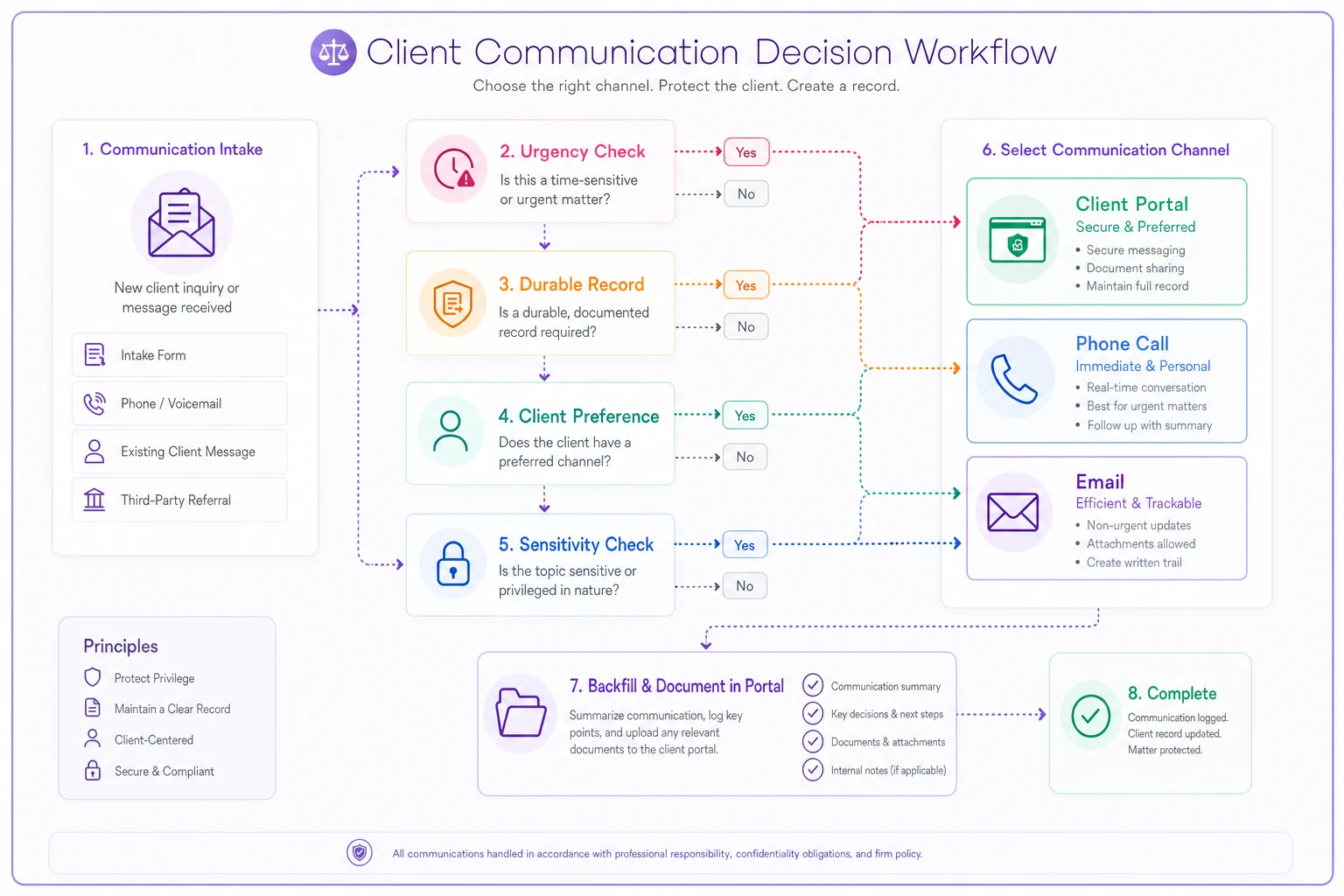
A delivery-channel decision matrix answers one question for every type of client communication: which channel, and why? The variables that actually matter are urgency, whether a durable record is needed, client preference, and sensitivity.
-
Urgent + needs record → portal message with email notification. The record lives in one place; the email makes sure it's seen.
-
Urgent + no record needed → phone, followed by a one-line portal note documenting the call.
-
Routine status update → portal, on a scheduled cadence so clients learn to expect it there.
-
Sensitive or bad news → phone first, always. Never let a client learn something difficult from a portal notification.
-
Document delivery → portal only, never email attachments, for both security and version control.
The pattern worth internalizing: the channel decision isn't about the firm's convenience, it's about the client's attention and the matter's risk. A firm that defaults every message to email because it's easy will eventually email a confidential document to the wrong thread. A firm that pushes everything into the portal will lose clients who never check it.
Document phone calls with a one-line portal note so the portal remains the authoritative record while preserving the immediacy of a call.
There's a coordination cost here that grows with size. When you have one lawyer, channel choice is intuitive. When you have thirty people communicating with clients, you need the matrix written down and built into how your systems prompt people — otherwise everyone reverts to their personal default and the experience fragments right back to where it started.
Portal adoption is a KPI, not a feature
Firms fall into this trap constantly: they buy a client portal, announce it, and assume adoption follows. Six months later, half their clients have never logged in, and lawyers are back to emailing everything because "the client doesn't use the portal anyway."
The portal isn't the point. Client adoption of the portal is the point, and it has to be measured like any other operational metric. If adoption is low, your entire delivery-channel matrix collapses, because half of it assumes clients are actually in the system.
-
Activation rate — percentage of new clients who log in at least once within 14 days of onboarding.
-
Active usage rate — percentage of clients with an active matter who've logged in within the last 30 days.
-
Channel deflection — percentage of routine status requests handled through the portal versus phone or email.
-
Document retrieval rate — are clients actually pulling documents from the portal, or still asking staff to email them?
-
Message response time (client side) — how long clients take to respond to portal messages, which tells you whether they're even seeing them.
A realistic pattern: a firm rolls out a portal and sees activation around 40% in the first quarter. That's not a software problem — it's an onboarding problem. The firms that get activation into the 75–85% range do one thing differently: they make portal activation part of the onboarding workflow itself, not an optional extra. The client's first meaningful interaction — signing the engagement letter, uploading their first document — happens in the portal, so there's no separate "adoption" step to fail at.
Low adoption almost always traces back to intake. Which is why this KPI is really a diagnostic for whether your onboarding workflow is doing its job.
BD handoff triggers: catching the moments that create revenue
This is the part of the operating model that firms consistently under-build, and often the most valuable. Business development and delivery get treated as separate worlds — one owned by marketing or the managing partner, the other by whoever's doing the work. The handoff between them is where relationship value gets lost.
A BD handoff trigger is a defined event in the matter lifecycle that flags a business development action. Not "someone should think about this eventually" — a specific signal that routes to a specific person.
-
Clean matter close with high client satisfaction → trigger relationship review: is there adjacent work? Should this client move to a retained arrangement?
-
Client refers a new inquiry → trigger a thank-you plus a deeper conversation. A referring client is telling you they're happy; that's a BD moment, not just an intake event.
-
Matter expands in scope mid-stream → trigger a check on whether pricing and the relationship structure still fit.
-
A dormant client's matter reactivates → trigger re-engagement, because you've just been handed a reason to be back in contact.
-
Repeated on-time, on-budget delivery across multiple matters → trigger an institutional-relationship conversation.
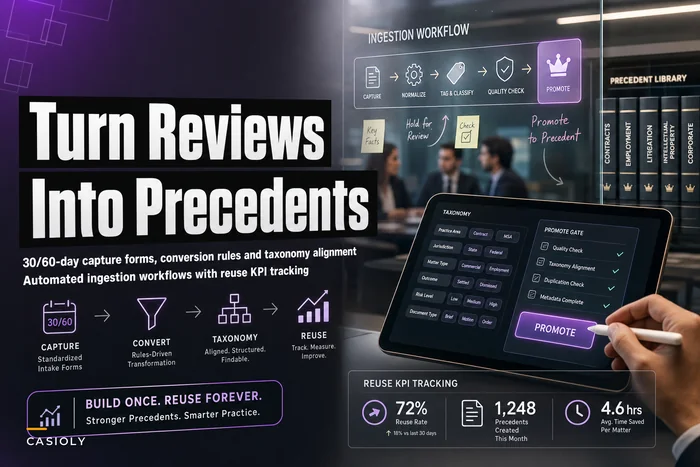
The connection most firms miss: your BD triggers depend entirely on your matter data being clean and your stages being accurate. You can't trigger "clean matter close" if nobody actually closes matters properly in the system. This is why BD and operations aren't separate initiatives — the quality of your delivery data determines whether your BD engine has anything to fire on. Firms that run disciplined post-matter processes, like the ones described in turning post-matter reviews into reusable precedents, end up with a far richer set of BD signals because they're already capturing what went well and why.
Governance: who owns the model and how it stays alive
An operating model that nobody owns decays within a quarter. The governance layer is what keeps SLAs, channels, KPIs, and triggers from drifting back into personal habit.
A workable governance structure has three roles:
-
A model owner (usually a legal-ops lead or operations-minded partner) who owns the SLA taxonomy, the channel matrix, and the KPI definitions. When something changes, they change it in one place.
-
Stage owners who are accountable for SLA compliance within their matters — this maps cleanly to the accountability structure in a legal project management RACI by matter stage, so you're not building a parallel org chart from scratch.
-
A review cadence — a monthly look at the KPIs that actually drive decisions, not a vanity dashboard.
The governance playbook should include an SLA template that's simple enough to apply to any new matter quickly. Something like: matter type → client segment → applicable SLA tier → responsible stage owner → escalation path if breached. If it takes more than a minute to fill out, people won't do it, and ungoverned matters are exactly where the experience breaks.
Staffing is part of governance too. SLAs you can't staff are fiction. You need trigger rules that flag when SLA compliance is slipping because of capacity — when a stage owner's active-matter count crosses a threshold and response times start creeping past target. That's the signal to redistribute work before clients feel it, not after the complaint arrives.
A real scenario
A mid-size firm — around 35 lawyers, mostly commercial and employment work — had a client-retention problem they couldn't explain. Work quality was strong. Win rates were fine. But roughly a third of one-time clients never came back, and nobody could say why.
When they mapped their actual client experience against their matter stages, the pattern was obvious. Response times ranged from under an hour to over a week depending entirely on which lawyer held the matter. There was no update cadence during waiting periods, so clients went dark for weeks at a time. The portal existed but sat at roughly 35% activation. And there was no BD handoff at all — matters closed and that was the last the client heard from the firm.
They didn't fix this with new software or a hiring spree. They built the operating model. Three SLA tiers mapped to matter stages, a one-page channel matrix, portal activation moved into onboarding (activation climbed into the high 70s within two quarters), and four BD triggers with a named owner for each.
The outcomes over the following year weren't dramatic on paper, but they compounded. Repeat engagement from existing clients rose noticeably — the BD triggers alone surfaced a handful of expansions worth more than the entire cost of building the model. Client complaints about responsiveness dropped off, mostly because the "waiting on third party" updates killed the silence that used to breed frustration. Partners stopped getting surprised by clients who'd quietly drifted away.
When this makes sense — and when it doesn't
This level of structure is worth building once you're past the point where one person can personally hold every client relationship across every active matter. For most firms that's somewhere around 10–15 fee earners, or whenever you notice two clients getting visibly different experiences for no deliberate reason.
When it's a bad idea: if you're a three-person firm where everything runs through one partner's head, building a formal SLA taxonomy and channel matrix is premature overhead. You'll spend more time maintaining the model than it saves.
Who should not do this yet: firms whose matter data is a mess. If your stages aren't accurate and matters don't close cleanly in your system, the triggers and KPIs will fire on garbage. Fix the data discipline first — the operating model sits on top of clean matter data, and it amplifies whatever quality is underneath it.
The firms that get this right stop thinking about client experience as something partners are either naturally good or bad at. They treat it as a system with defined inputs, measurable outputs, and clear ownership — which is the only version that actually survives growth. Good intentions don't scale. A model does.
Ready to elevate your legal practice management?
Join 500+ law firms using Casioly to optimize case workflows, reduce administrative burden, and improve client satisfaction.