

Most firms treat the matter close like the finish line. The invoice goes out, the file gets archived, someone updates the CRM, and everyone moves on to the next fire. What almost nobody does — consistently — is capture what the matter actually taught the firm before the details evaporate.
And they do evaporate. Two months after close, the associate who negotiated the tricky indemnity carve-out can't remember why she landed where she did. The clever discovery objection that saved a client three weeks is buried in an email thread nobody will ever search. The one paragraph of settlement language that both sides finally agreed to at 11pm is gone unless someone thought to pull it out on purpose.
That's the gap this article is about. Not a broad "knowledge management" lecture — a tight, repeatable way to run short post-matter reviews that actually produce artifacts your post-matter review precedent library can reuse. Fast enough that busy people will do them, structured enough that the output is precedent-ready.
The real reason post-matter reviews don't happen
It's not that lawyers don't see the value. Ask any partner whether reusable precedents save money and they'll say yes immediately. The problem is timing and format.
The traditional post-mortem is a meeting. It gets scheduled for "after the crunch," which never fully ends, so it slides. When it does happen, it's a freeform discussion with no forced output. People talk, nod, agree it was a learning experience, and produce nothing filable. The knowledge stays in the room.
The other failure mode is the opposite: a bloated debrief form with 40 fields that takes 90 minutes to complete. Nobody fills those out honestly. They either skip it or type "N/A" down the whole column just to close the task.
What works sits in the middle — a short capture form with a hard deadline and a small number of high-value fields tied directly to how the knowledge gets reused later. The trick is that the review isn't really for the person filling it out. It's for the next associate who catches a similar matter eight months from now.
Two capture windows: 30 days and 60 days
A single review at close is the wrong instinct. Some things are only clear right after signature; others only reveal themselves once the dust settles. So we split capture into two lightweight passes.
Never miss a critical deadline again.
Casioly helps legal teams manage cases efficiently and stay on top of critical tasks.
- Centralized case tracking
- Automated deadline reminders
- Secure client communication
No credit card required
The 30-day form runs while memory is still hot. This is where you grab the tactical stuff — the specific clauses, arguments, objections, filings, and negotiation moves that worked or backfired. The person who did the work fills it out, and it should take under 15 minutes.
| Field | 30-Day Form | 60-Day Form |
|---|---|---|
| Reusable artifacts identified (clause, brief section, motion) | ✅ Primary focus | Review/confirm |
| Novel argument or negotiation move | ✅ | — |
| What went wrong tactically | ✅ | — |
| Budget vs. actual variance | Rough note | ✅ Full detail |
| Client satisfaction signal | — | ✅ |
| Did the outcome hold up? | — | ✅ |
| Recommended tag(s) for the library | ✅ Draft | ✅ Finalize |
| Reuse recommendation (yes/no/with edits) | ✅ | Confirm |
The two-window split matters more than it looks. A matter that felt like a clean win at day 30 sometimes looks different at day 60 when the client disputes the bill or the deal renegotiates. If you only capture once, you bake the early optimism into your precedent library and reuse work that didn't actually age well.
Conversion rules: from messy matter to clean precedent
A capture form full of notes isn't a precedent. The gap between "here's what happened" and "here's a reusable artifact" is where most firms stall out. You need explicit conversion rules so the person doing the review knows exactly what gets promoted into the library and what stays as a private note.
-
Extract, don't reference. If the reviewer flags a clause or brief section as reusable, the actual text gets pulled into the library — not a link to the matter file. Links rot. Files get access-restricted. The artifact has to stand on its own.
-
Strip and mark client-specific content. Names, deal values, and matter-specific facts get replaced with clear placeholders. This is non-negotiable and it's where a lot of homegrown precedent banks quietly create confidentiality risk.
-
Attach the "why." Every promoted artifact carries a one- or two-sentence note on why it worked and when to use it. A clause with no context gets misapplied.
-
Assign a confidence level. "Battle-tested" (used and held up), "used once," or "drafted but untested." Reusers deserve to know what they're pulling.
-
Route anything ambiguous to a reviewer. If the person filling the form isn't sure whether something should be promoted, it goes to a named senior lawyer for a yes/no — not into limbo.
Route ambiguous items to a named senior lawyer for a yes/no.
That last rule is the one people skip, and it's the reason libraries fill up with mediocre content. Without a promotion gate, every enthusiastic associate dumps their work in, quality drops, and eventually nobody trusts the library enough to search it. A precedent bank people don't trust is worse than no bank at all, because it creates false confidence.
If you've already built a drafting-side precedent system, this connects directly to it. The capture forms feed the same shelf described in the lightweight precedent library workflow with version labels and reuse KPIs — post-matter review is essentially the intake pipeline for that library.
Getting the tagging taxonomy to actually line up
A quiet killer: your post-matter review tags don't match the tags your precedent library uses, so nothing is findable. The reviewer tags a clause "IP indemnity" and the library expects "Indemnification — IP." That artifact is now effectively invisible to anyone searching the standard way.
Taxonomy misalignment is boring and it's the single most common reason a precedent library gets built and then abandoned. People build the capture side and the retrieval side separately, with different vocabularies, and the two never reconcile.
-
Matter type (M&A, commercial litigation, employment, real estate, etc.)
-
Artifact type (clause, motion, brief section, discovery response, checklist, correspondence template)
-
Stage (intake, discovery, negotiation, closing, post-close) — ideally aligned with the stages in your case lifecycle framework so the same vocabulary runs end to end
-
Risk posture (aggressive, standard, conservative)
Keep the top two axes short and rigid, and let the third and fourth be a little more flexible. When firms let every axis grow freely, they end up with 200 tags, half of them near-duplicates, and search becomes guesswork.
The ingestion workflow, step by step
Capturing knowledge is only half the job. If a filled-out form sits in someone's inbox waiting for a manual copy-paste into the library, it won't happen at scale. The ingestion path needs to be defined so a completed review moves into the library with minimal friction.
Here's how a clean workflow runs from close to reusable artifact:
-
Matter hits "closed" status. This triggers the 30-day review task, assigned to the responsible associate with a hard due date.
-
30-day form completed. Reviewer flags reusable artifacts, drafts tags, and marks a promotion recommendation.
-
Promotion gate. Anything flagged "yes" or "unsure" routes to the designated reviewing lawyer for a quick decision.
-
Approved artifacts get processed. Text extracted, client-specifics stripped and placeholdered, "why-it-worked" note attached, confidence level set.
-
Tagged against the controlled taxonomy — no free text, dropdown only.
-
Ingested into the library with version label and source-matter reference (internal, access-controlled).
-
60-day form fires on schedule, confirms or downgrades earlier artifacts, and adds outcome and budget data.
-
Reuse tracking activates — the artifact is now searchable and its reuse gets counted.
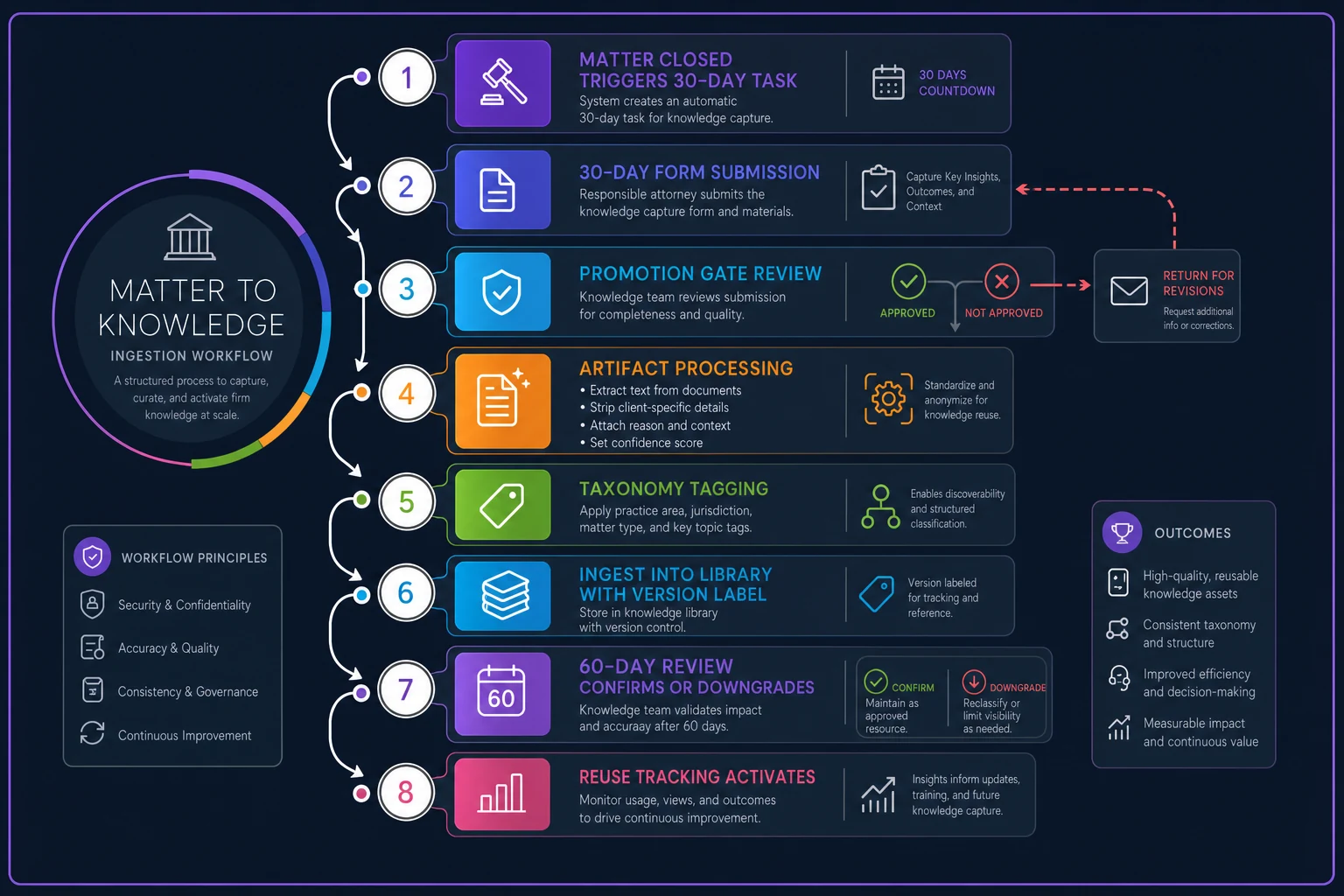
This is exactly where AI-assisted operational platforms earn their keep — not by replacing legal judgment, but by removing the clerical drag. Automated ingestion workflows can trigger the review tasks on matter close, pre-fill the routine form fields from matter data you already have, suggest taxonomy tags based on the artifact text, and route items through the promotion gate without anyone chasing an email. The lawyer still decides what's worth keeping and why. The software just makes sure nothing quietly falls through the cracks, which is what kills most manual systems.
Tracking reuse so the library earns its keep
A precedent library with no reuse metrics is a hope, not a system. If you can't see whether anything is actually being used, you can't defend the time spent maintaining it, and you can't tell which artifacts are pulling weight.
-
Reuse count per artifact — how many times each precedent has been pulled into new work
-
Time-to-first-reuse — how long between ingestion and the first time someone uses it
-
Capture rate — percentage of closed matters that actually got a completed 30-day review
-
Promotion rate — of captured items, how many made it past the gate (too high means the gate is too loose)
-
Dead-weight ratio — artifacts that have sat for 12+ months with zero reuse
That last one is the honest mirror. A big chunk of any library never gets touched, and that's fine — but if 80% of it is dead weight, your capture criteria are too broad and reviewers are promoting things nobody needs.
A realistic example
A mid-sized commercial firm — roughly 30 lawyers — had a shared drive folder people optimistically called their "precedent library." In practice it was a dumping ground. Associates rebuilt the same NDA carve-outs and discovery objection sets from scratch because searching the folder was hopeless and the tags, where they existed, were personal shorthand.
They put in a 30/60-day capture form tied to matter close, a controlled tag taxonomy of around 40 tags that matched their drafting library, and a single partner as the promotion gate. First quarter, capture rate on closed matters was maybe 55% — people were still forgetting or deprioritizing it. By the second quarter it was closer to 85% once the tasks fired automatically on close.
The number that got the partners' attention: within about six months, one clause package — a negotiated limitation-of-liability set — had been reused in roughly 14 new matters, saving somewhere between 30 and 40 minutes of drafting and review each time. Not glamorous. But that's one artifact, and it more than paid for the whole effort. The dead-weight review also showed nearly a third of promoted items had never been touched, which told them to tighten the promotion criteria going forward.
When this is worth it — and when it isn't
This system pays off when your work is repetitive enough that the same clauses, arguments, and structures recur. Commercial transactional work, employment, real estate, insurance defense — anywhere patterns repeat, a disciplined capture-and-reuse loop compounds.
When it's a bad idea: if nearly every matter is genuinely bespoke — some boutique litigation and specialized advisory work is — you'll spend more time capturing than you'll ever save reusing. Forcing a heavy review process onto truly one-off work just adds overhead and breeds resentment.
Who should not do this yet: firms that don't have a functioning precedent library to feed. Post-matter review is the intake pipeline; if there's no organized, tagged, searchable destination on the other end, you're capturing knowledge into a void. Build the shelf first, then build the process that stocks it.
One honest caution: don't over-engineer the forms. The instinct is always to add "just one more field." Every field you add lowers your completion rate. The firms that succeed here keep the 30-day form short enough to finish between meetings and accept that they'll capture 80% of the value with 20% of the questions.
The takeaway
The knowledge your firm generates on every matter is expensive to produce and cheap to lose. Short, disciplined post-matter reviews — split across a 30-day and 60-day window, run through explicit conversion rules, aligned to a taxonomy your library actually uses, and fed by an ingestion path that doesn't depend on someone remembering — turn that knowledge into precedents you can pull off the shelf instead of rebuilding from scratch.
Start with one matter type. Build the two forms. Pick your tags to match your existing library. Name one person as the promotion gate. Then watch the reuse numbers, because those numbers are what tell you whether you built something real or just another folder nobody opens.
The knowledge your firm generates on every matter is expensive to produce and cheap to lose. Short, disciplined post-matter reviews — split across a 30-day and 60-day window, run through explicit conversion rules, aligned to a taxonomy your library actually uses, and fed by an ingestion path that doesn't depend on someone remembering — turn that knowledge into precedents you can pull off the shelf instead of rebuilding from scratch.
Start with one matter type. Build the two forms. Pick your tags to match your existing library. Name one person as the promotion gate. Then watch the reuse numbers, because those numbers are what tell you whether you built something real or just another folder nobody opens.
Ready to elevate your legal practice management?
Join 500+ law firms using Casioly to optimize case workflows, reduce administrative burden, and improve client satisfaction.