


Most retainer disputes don't start with a big, obvious error. They start with a $340 draw against the wrong matter, an invoice applied to earned fees before the trust balance actually moved, or a replenishment request that went out three weeks after the balance dropped below the floor. By the time anyone notices, the client already has a bill they don't understand, and the conversation has shifted from "here's your invoice" to "explain every transaction on this account."
This post is about one narrow thing: the retainer drawdown workflow — how money moves from trust to earned, when it moves, who approves it, and what triggers a hold or a replenishment. Get this wrong and you're not just looking at a bookkeeping headache. You're looking at bar complaints, clawbacks, and clients who stop trusting your invoices entirely.
The Specific Failure: Draws That Outrun the Ledger
Here's the pattern that causes the most damage, and it's rarely dramatic.
A firm bills monthly. Time entries get approved around the 5th, invoices generate around the 7th, and the bookkeeper applies retainer funds around the 10th. On paper, fine. In practice, the sequence drifts. Someone runs the invoice batch before the trust-to-operating transfer clears. The accounting system marks the invoice "paid from retainer" the moment it's generated, but the actual movement of funds from the trust account happens later — or gets missed entirely because the trust balance was already too low to cover it.
Now you have an invoice that says it was paid from a retainer that didn't have the money. The operating ledger thinks it collected. The trust ledger disagrees. Nobody reconciles the gap until month-end, and by then three more matters have the same problem.
The core issue is that the drawdown event and the accounting event are treated as the same thing when they're not. Earning a fee, invoicing it, and actually drawing funds from trust are three separate operations. When your posting rules collapse them into one step, you lose the ability to see where the money actually is.
Why Posting Rules Matter More Than People Think
Posting rules sound like back-office trivia until you watch a matter with three fee arrangements running at once — a flat fee for the initial phase, hourly for litigation, and a held evergreen retainer that's supposed to stay untouched until trial.
Never miss a critical deadline again.
Casioly helps legal teams manage cases efficiently and stay on top of critical tasks.
- Centralized case tracking
- Automated deadline reminders
- Secure client communication
No credit card required
In real operations, the breakdown usually happens when a single time entry gets posted against the wrong bucket. A paralegal logs four hours of document review. It should draw against the hourly pool. Instead it hits the evergreen retainer reserved for trial. The balance the client thinks is protected quietly erodes, and the first time anyone sees it is when the replenishment notice goes out for an amount that makes no sense.
-
Which fee arrangement does this entry belong to?
-
Is this arrangement drawable right now, or is it held or reserved?
-
Does drawing this entry push the balance below the replenishment floor?
-
Does this matter have a client-specific rule — for example, no draws without written approval over a certain amount?
If your intake process doesn't capture the fee structure precisely enough to answer those four questions automatically, you're going to be answering them manually. And manual answers drift.
A Drawdown Decision Structure That Holds Up
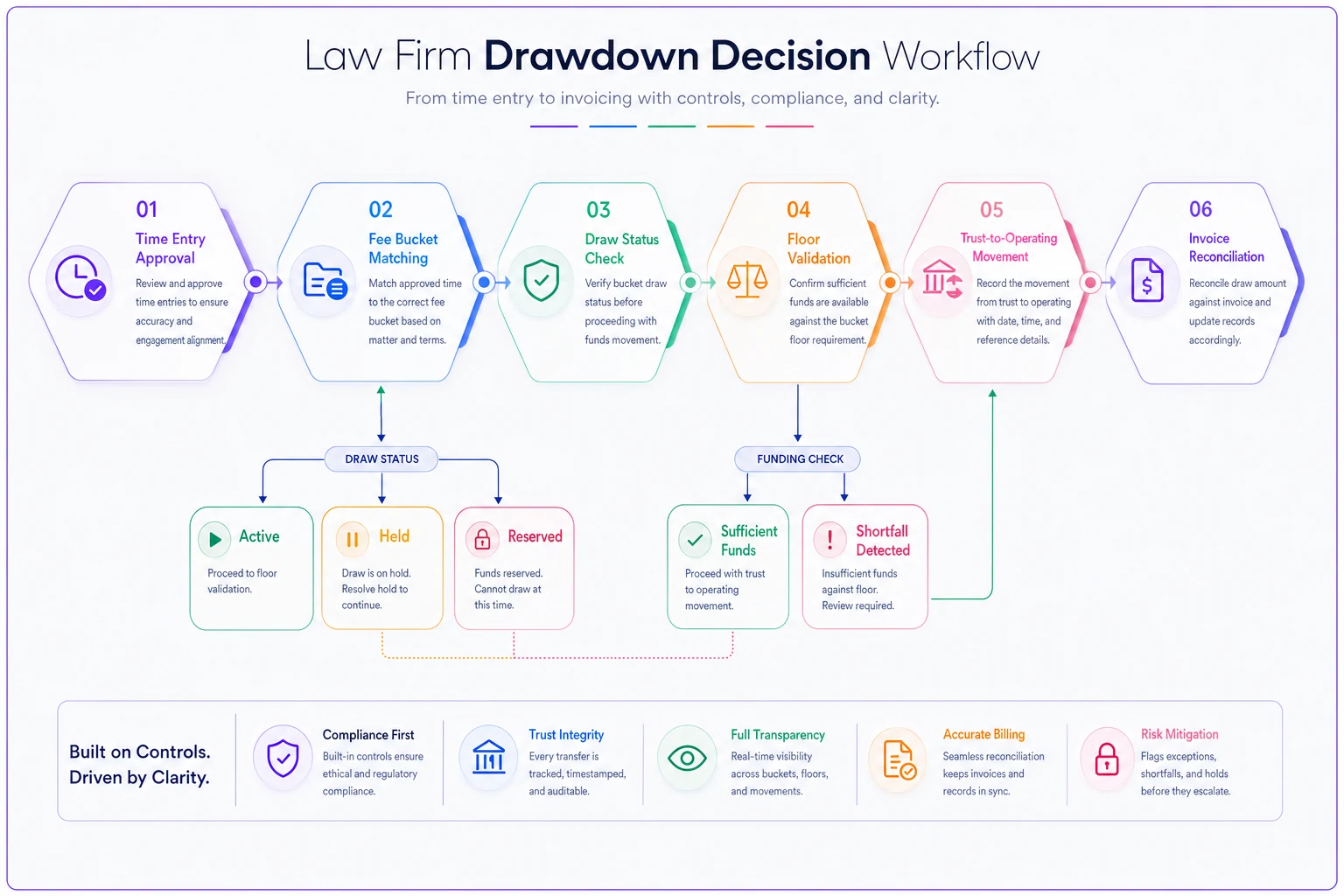
The draw itself should follow an explicit algorithm, not a bookkeeper's judgment call. Here's a structure that survives scrutiny:
-
Verify the entry is earned and approved. Unapproved time never draws. This sounds obvious, but batch systems love to sweep unapproved entries into a draw.
-
Match the entry to its correct fee bucket using the matter's fee map, not the default account.
-
Check the bucket's draw status — active, held, or reserved. Held buckets require an explicit release event tied to a matter milestone.
-
Confirm the draw won't breach a floor. If drawing the full amount drops the balance below the replenishment threshold, draw what you can and flag the shortfall.
-
Record the trust-to-operating movement as its own transaction with a timestamp, not as a byproduct of invoicing.
-
Reconcile the invoice against the actual movement before the invoice is marked paid.
The difference between step 5 done right and done wrong is the difference between a clean audit and a three-hour explanation to a disciplinary board. Trust movement is a real event with a real date. It should never be inferred from an invoice status.
For the reconciliation side of this, the checkpoints that catch these breaks tend to live in your month-end process — the same discipline covered in Matter-Linked Trust Reconciliation: Month-End Checklist, Ledger Mappings and Red-Flag Rules. Drawdown rules and reconciliation are two ends of the same rope. If the draw is sloppy, no reconciliation will fully save you, but a tight reconciliation will at least catch it early.
> GRAPH: Drawdown Decision Flow — Illustrate the sequential decision path from time entry approval through fee bucket matching, draw status check, floor validation, trust movement recording, and invoice reconciliation.
Getting this sequence locked in is mostly a discipline problem. The logic isn't complicated. The hard part is making sure it runs the same way on the 10th of a slow month as it does on the 10th of a month where everyone's scrambling to close.
Holds and Replenishment: The Triggers That Actually Prevent Disputes
Most firms set a static replenishment floor — top up when it hits $2,500 — and stop there. That's not enough. The floor that made sense at intake rarely makes sense mid-matter. A matter heading into an expert-witness phase burns retainer far faster than the discovery phase did.
The triggers worth building are event-tied, not just balance-tied:
| Trigger Type | What Fires It | What Should Happen |
|---|---|---|
| Balance floor | Trust balance drops below threshold | Auto-draft replenishment notice, flag responsible attorney |
| Burn-rate spike | Weekly draw exceeds 1.5x rolling average | Hold, notify attorney to confirm before continuing draws |
| Matter-stage change | Entry into a high-cost phase (trial prep, expert phase) | Recalculate floor, request pre-funding |
| Held-bucket release | Milestone met (e.g., trial date set) | Release reserved funds, notify client of status change |
| Negative-balance risk | Projected draws exceed available funds | Freeze non-critical draws, escalate |
The burn-rate trigger is the one people skip, and it's the one that saves you the most grief. A matter quietly accelerating from $1,800 a week to $6,000 a week in draws is the classic setup for a client who opens their invoice and feels blindsided. Catching that spike before the money leaves trust gives you a chance to have the conversation while it's still a normal update, not a defensive explanation.
Monitor the rolling weekly average and set burn-rate alerts; they catch accelerating draws before trust funds are exhausted.
Setting these floors intelligently ties back into how you scope the matter in the first place. The cost-driver logic in a Matter Budgeting Framework: Standard Cost-Driver Taxonomy, Stage-Tied Budgets and Partner Accountability is what tells you which phases are going to burn retainer fast enough to justify a stage-based floor rather than a flat one.
Client-Notice Language: Where Firms Lose the Dispute Before It Starts
You can run a flawless drawdown workflow and still lose a fee dispute if your notices are vague. The replenishment notice is often the only document a client reads carefully, and firms routinely send something like: "Your retainer balance is low. Please remit $5,000."
That tells the client nothing about what they paid for, and it reads like a demand. When the dispute comes, that notice becomes Exhibit A for "they never explained the charges."
-
They show the starting balance, the draws applied, and the resulting balance — not just the amount owed.
-
They tie draws to matter events or work performed, in plain language, something like "document review and deposition prep, week of March 12."
-
They state the replenishment amount and the deadline clearly, and reference the engagement letter provision that requires it.
-
They flag any held or reserved funds separately so the client understands what's untouched.
A client who can follow the money rarely disputes it. Disputes come from opacity, not from the size of the bill.
A Short Real Scenario
A six-attorney litigation boutique kept running into the same month-end mess. Roughly one in five matters had a mismatch between the trust ledger and the operating ledger — usually a draw posted before the transfer cleared, or an entry hitting the wrong fee bucket. Their bookkeeper was spending close to two days each month untangling it, and twice in a single year it escalated into a client refusing to pay pending an explanation.
The fix wasn't complicated, just disciplined. They separated the invoicing event from the trust-movement event, added a burn-rate flag at 1.5x the rolling weekly average, and rewrote their replenishment notice to show the full transaction history rather than just the top-up amount. Within a few months, month-end mismatches dropped to a handful of edge cases, the bookkeeper's reconciliation time fell to roughly half a day, and the two clients who'd previously balked started paying on the normal cycle. Nothing dramatic — just money that moved when it was supposed to, documented the way it happened.
Where Automation Earns Its Place
None of this requires software to be correct. It requires software to be consistent.
The failures described above are almost never conceptual — every firm knows draws should match earned fees. They happen because the checks depend on someone remembering the sequence every single time, across dozens of matters, at month-end when everyone's rushing.
Operational software with built-in automation helps in a narrow but meaningful way: enforcing the posting sequence so an invoice can't be marked paid before the trust movement is recorded, firing burn-rate and floor triggers automatically instead of relying on someone to eyeball balances, and generating replenishment notices that pull the real transaction history rather than a manually typed number. The rules are yours. The point of automation is that it applies them the same way on the busiest day of the month as it does on the quietest.
When Tighter Drawdown Rules Make Sense — and When They Don't
Worth the effort when you're running multiple fee arrangements per matter, carrying evergreen or reserved retainers, or handling matters with sharp cost phases like litigation. The more moving parts, the more a strict drawdown workflow pays off.
Probably overkill when you're doing simple flat-fee work with a single arrangement per matter and no ongoing trust balance to manage. Building event-tied triggers for a practice that bills a flat $1,500 and closes the file is solving a problem you don't have.
Who should be cautious: solo and very small firms tempted to bolt complex hold logic onto a system nobody has time to maintain. If the rules are more complicated than your team can follow consistently, you've just moved the failure point, not removed it. Start with the two changes that matter most — separating the trust movement from the invoice event, and making replenishment notices transparent — and layer in triggers only as the matter mix justifies them.
Closing Thought
Retainer disputes are rarely about money the firm didn't earn.
They're about money that moved in a way nobody could clearly account for after the fact. The fix isn't more diligence at month-end; it's a drawdown workflow where the earning, the invoicing, and the actual trust movement are distinct, sequenced, and visible — with triggers that surface problems while they're still routine updates rather than confrontations. Build that, document it as it happens, and most disputes never reach the stage where anyone has to argue about them.
Retainer disputes are rarely about money the firm didn't earn. They're about money that moved in a way nobody could clearly account for after the fact. The fix isn't more diligence at month-end; it's a drawdown workflow where the earning, the invoicing, and the actual trust movement are distinct, sequenced, and visible — with triggers that surface problems while they're still routine updates rather than confrontations. Build that, document it as it happens, and most disputes never reach the stage where anyone has to argue about them.
Ready to elevate your legal practice management?
Join 500+ law firms using Casioly to optimize case workflows, reduce administrative burden, and improve client satisfaction.