

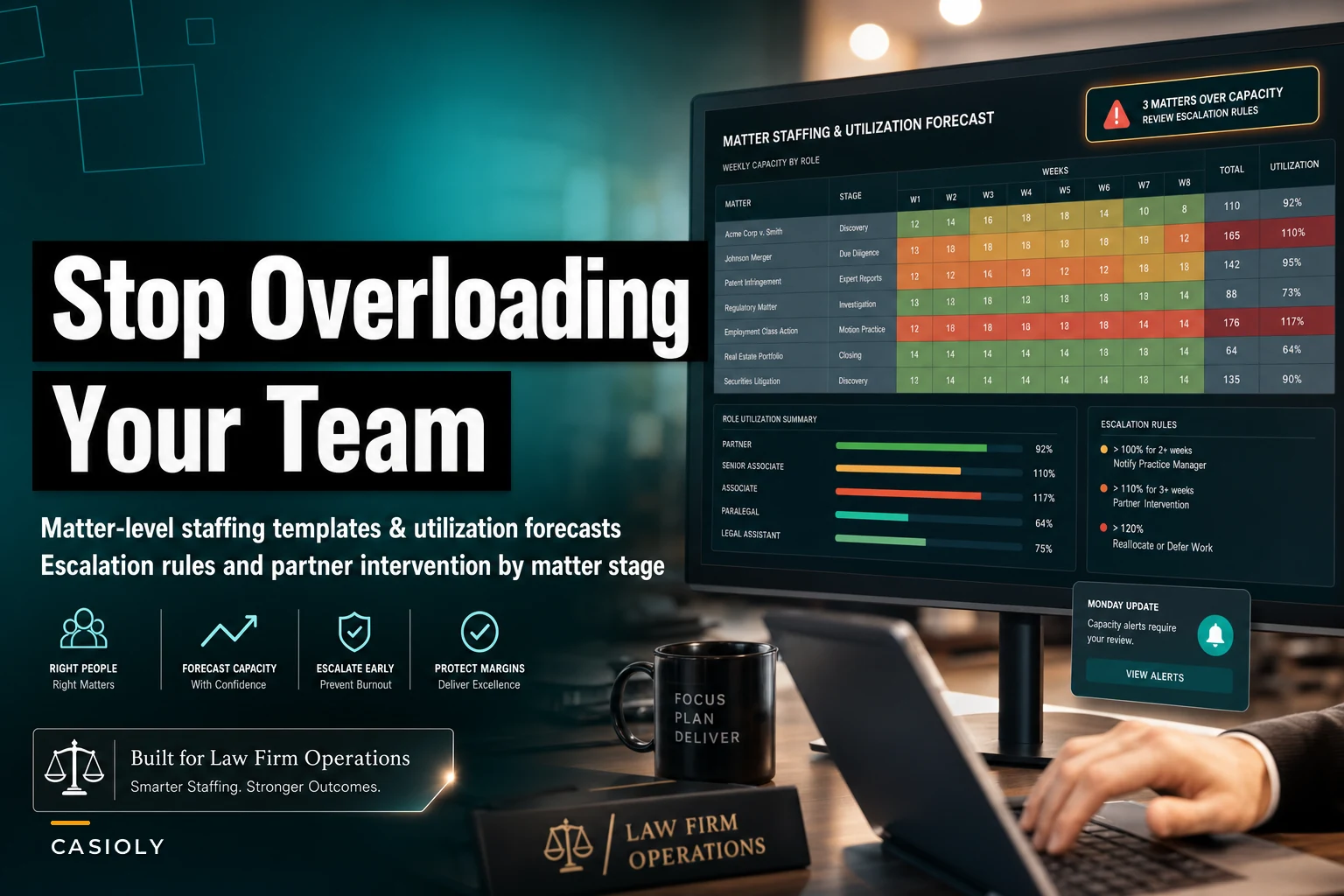

Three associates billing 2,100 hours each doesn't mean your firm has 6,300 hours of capacity. This staffing mistake breaks most mid-sized firms around year three or four of growth.
The real capacity calculation: take those 2,100 billable hours, factor in that complex litigation matters eat 40% more time than originally scoped, subtract 200 unbilled hours your senior associate spends training juniors, and you're looking at maybe 4,800 usable hours. Add a major M&A deal needing immediate attention, and your entire staffing model collapses.
Most firms discover this gap when matters start missing deadlines. By then, you've damaged client relationships and burned out your best people.
Why Standard Utilization Models Break Down
Law firms inherited their staffing models from 1980s accounting firms. Back then, work was predictable—annual audits, quarterly filings, standardized processes. Legal work doesn't follow those patterns.
A commercial lease review might take 8 hours one week, then balloon to 40 hours when the landlord introduces unexpected environmental clauses. Your employment litigation sits dormant for two months, then suddenly needs 120 hours of document review in ten days. The patent prosecution you staffed with one associate hits an obviousness rejection requiring senior partner expertise.
Traditional utilization targets assume work flows evenly. They pretend an 85% utilized associate can handle any matter that walks through the door. Reality: that associate is probably underwater on three complex matters, and adding a fourth causes cascading delays.
Firms that survive past 20 attorneys build matter-specific capacity models. They know exactly when securities litigation needs partner oversight versus when associates can run independently. They track utilization at the matter level, not just the timekeeper level.
Building Matter Complexity Templates
Every matter type has a complexity curve. The trick is mapping it before you're drowning.
Never miss a critical deadline again.
Casioly helps legal teams manage cases efficiently and stay on top of critical tasks.
- Centralized case tracking
- Automated deadline reminders
- Secure client communication
No credit card required
Start with your bread-and-butter work. For corporate firms, that might be standard M&A deals. Track ten recent matters and plot their resource needs week by week. Patterns emerge:
Standard M&A Deal (Sub-$10M)
-
Weeks 1-2
1 partner (4 hrs), 1 senior associate (20 hrs)
-
Weeks 3-6
1 senior associate (30 hrs/week), 1 junior (15 hrs/week)
-
Weeks 7-8
1 partner (8 hrs), 2 seniors (40 hrs each), 1 junior (30 hrs)
-
Week 9+
1 senior (10 hrs/week monitoring)
Complex M&A Deal ($50M+, Multiple Jurisdictions)
-
Weeks 1-2
2 partners (8 hrs each), 1 senior (30 hrs)
-
Weeks 3-6
1 partner (10 hrs/week), 2 seniors (40 hrs/week each), 2 juniors (30 hrs/week each)
-
Weeks 7-10
2 partners (15 hrs/week each), 3 seniors (45 hrs/week each), 2 juniors (40 hrs/week each)
-
Weeks 11+
1 partner (5 hrs/week), 1 senior (20 hrs/week)
The difference isn't just hours—it's timing and seniority mix. Complex deals need heavy partner involvement early and again at closing. Standard deals run mostly on senior associate power with partner check-ins.
These templates become your staffing blueprint. When a new matter arrives, you immediately know if you have capacity or need to shuffle resources.
Month-by-Month Forecasting That Works
Most firms forecast annually and adjust quarterly. That's like steering a ship by looking at last month's weather.
Effective matter staffing happens monthly with weekly adjustments:
Create a simple spreadsheet with every active matter listed vertically and the next 12 weeks horizontally. For each matter-week intersection, enter expected hours by role level. Keep it simple—Partner, Senior, Junior, Paralegal.
| Matter | Week 1 | Week 2 | Week 3 | Week 4 |
|---|---|---|---|---|
| Smith v. Jones (litigation) | P:2, S:20, J:15 | S:25, J:20 | P:5, S:30, J:25 | S:15, J:10 |
| ABC Corp Acquisition | P:4, S:15 | S:20, J:10 | P:8, S:35, J:20 | P:10, S:40, J:25 |
| Patent Filing - TechCo | P:1, S:8 | S:12 | S:10 | P:2, S:5 |
Sum each column by role. Compare to available capacity (factor in vacation, training, admin time). When any role hits 90% capacity in any future week, that's your warning signal.
Here's a simple workflow to visualize the forecasting process.
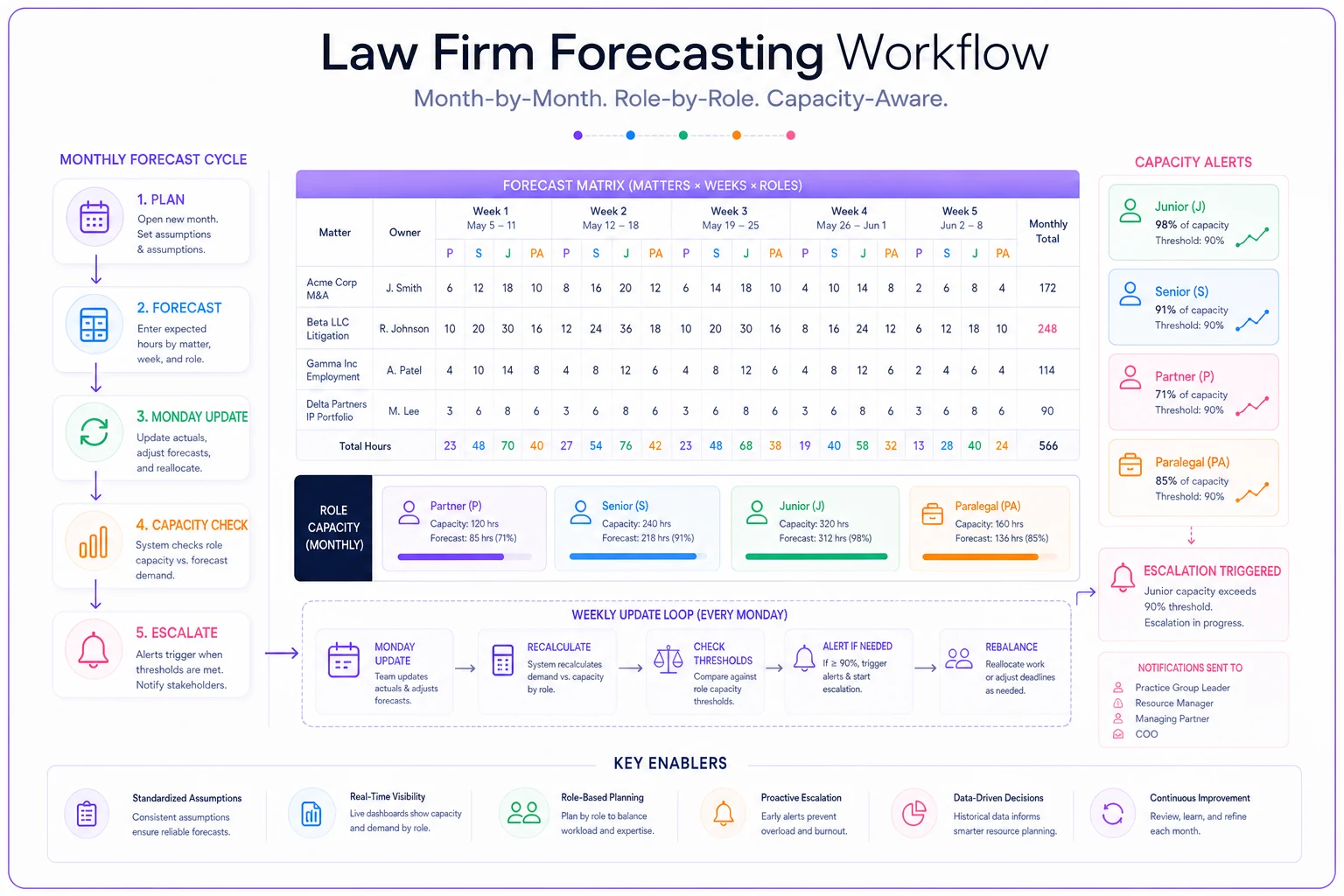
The magic happens when you update this weekly. Monday morning, spend 20 minutes adjusting based on what actually happened. Did the ABC acquisition hit a snag requiring more partner time? Adjust weeks 3-4 immediately.
Setting Utilization Targets by Matter Stage
Blanket utilization targets ignore matter reality. An associate working on discovery bills differently than one drafting merger agreements.
Discovery-heavy litigation can push associates to 95% utilization for short bursts—it's predictable, supervised work. But the same associate might hit only 70% utilization during trial prep when they're constantly waiting for partner feedback.
Reasonable utilization by matter stage:
Litigation Matters:
-
Initial pleadings
75% (lots of strategy discussions)
-
Discovery
90% (heads-down document work)
-
Motion practice
80% (research plus partner review cycles)
-
Trial prep
70% (constant pivots and waiting)
-
Trial
95% (all hands on deck)
Transaction Matters:
-
Due diligence
85% (systematic review work)
-
Drafting
75% (requires thinking time)
-
Negotiation
65% (lots of waiting between rounds)
-
Closing
90% (final push, clear tasks)
Build these targets into your forecasting. Staffing an associate at 85% utilization during negotiation phase sets them up to fail.
Decision Rules for Partner Intervention
Partners hate surprise escalations. Associates hate not knowing when to escalate. Clear rules solve both problems.
Map escalation triggers to specific matter events, not subjective judgment. Your matter lifecycle stages should already identify critical decision points. Add staffing triggers to each stage.
For litigation matters:
-
Document review finds privileged materials from opposing party → Partner reviews within 4 hours
-
Settlement discussions begin → Partner leads all communications
-
Discovery costs exceed initial estimate by 25% → Partner approves continuation
-
Opposing counsel raises jurisdiction questions → Partner reviews within 24 hours
For corporate transactions:
-
Due diligence reveals undisclosed liability over $100k → Partner notified within 2 hours
-
Negotiation stalls for 48 hours → Partner intervenes
-
Client requests material contract changes after first draft → Partner approves approach
-
Regulatory approval delayed beyond 10 days → Partner engages with agencies
These are automatic triggers, not suggestions. Build them into your matter management system. When triggered, the system notifies the assigned partner and logs the escalation.
Specificity matters. "If things get complicated" isn't a rule. "If opposing counsel files a motion for summary judgment" is.
Tracking What Actually Happens
Every Monday, compare last week's planned hours to actual hours billed. Track variance by matter and person. Patterns emerge quickly:
-
Johnson always underestimates patent prosecution by 30%
-
Smith's litigation matters spike 3x during motion deadlines
-
Corporate matters with foreign entities take 40% more partner time
Use these patterns to adjust templates. After tracking 20-30 matters, forecasts become surprisingly accurate.
When a matter starts consuming 150% of planned hours in week 2, something's wrong. Maybe scope creep, maybe unexpected complexity, maybe inefficient staffing. You can intervene before week 8 when everyone's burned out.
When Matter Complexity Changes Mid-Stream
About 30% of matters dramatically shift complexity partway through. The simple contract review becomes a full renegotiation. The straightforward divorce turns high-conflict with hidden assets.
Most firms handle these shifts by throwing bodies at the problem. That's how you end up with five associates doing partner-level work poorly.
-
Originating partner reassesses matter needs using complexity templates
-
Check current team utilization across all matters
-
Either add appropriate-level resources or redistribute existing matters
-
Update forecast for remaining matter lifecycle
-
Notify client of scope change if needed
The delegation and routing matrices you've built should define who can handle what complexity. Use them to guide reassignment decisions.
Building Your Escalation Playbook
Your escalation rules need teeth. Otherwise they become suggestions everyone ignores when busy.
Every matter needs:
-
Primary partner (strategic decisions)
-
Supervising attorney (day-to-day management)
-
Escalation partner (backup for urgent issues)
These can't all be the same person, especially on complex matters.
Define escalation speeds:
Immediate escalation (within 2 hours):
-
Ethical concerns discovered
-
Client threatening to fire firm
-
Opposing counsel alleging malpractice
-
Court sanctions threatened
Same-day escalation:
-
Budget overrun exceeding 25%
-
Key team member unavailable unexpectedly
-
Discovery of material facts affecting strategy
-
Client requesting major scope change
Next-day escalation:
-
Persistent scheduling conflicts
-
Resource constraints affecting deadlines
-
Junior attorney requesting significant guidance
-
Quality concerns in work product
Build these into your matter management workflow. When an associate logs an ethical concern, the system immediately notifies both supervising attorney and managing partner. No judgment calls, no delays.
Making the Model Sustainable
The best staffing model is worthless if no one maintains it. Most firms build elaborate capacity planning systems that die within three months.
Sustainability requires reducing friction. Your model should take less than 30 minutes per week:
-
10 minutes Monday
Update forecast based on last week's actuals
-
5 minutes Wednesday
Quick scan for capacity warnings
-
10 minutes Friday
Review any escalations and adjust
-
5 minutes anytime
Log when matter complexity changes
If it takes longer, you've overengineered it.
Reserve a single uninterrupted calendar slot Monday morning for forecast updates to keep the process under 30 minutes.
The payoff comes during planning meetings. Instead of guessing whether you can take on a new matter, you know exactly which weeks have capacity. Instead of wondering why realization is down, you can point to specific matters that exceeded complexity estimates.
Software That Actually Helps
Most practice management systems treat all matters equally—just different buckets for timekeeping. That's why firms manage capacity in spreadsheets nobody updates.
Modern operational platforms can automate most of this process. They track matter complexity patterns, flag when utilization exceeds targets, and automatically escalate based on your rules.
The good ones learn from your patterns. They notice that employment matters always spike during week 3, or that international deals need 30% more partner time. They adjust forecasts automatically and alert you to potential resource conflicts weeks in advance.
This isn't about replacing human judgment. It's about surfacing information you need to make good staffing decisions before problems cascade. When the system tells you next month's capacity is overbooked by 200 hours, you can redistribute work now instead of burning out your team later.
AI-powered platforms excel at pattern recognition across matters. They spot when similar matters had resource spikes and warn you proactively. They track which team combinations work efficiently together and suggest optimal staffing. They identify when matters are likely to shift complexity based on early indicators.
Matter staffing capacity planning isn't about predicting the future perfectly. It's about building systems that adapt quickly when reality doesn't match the plan.
Your associates will still occasionally bill 60-hour weeks. Partners will still sometimes need to jump in unexpectedly. But with proper templates, forecasting, and escalation rules, these become managed exceptions rather than constant chaos.
Start simple. Pick your five most common matter types and build basic templates. Track actual versus planned for a month. Add escalation triggers for the problems that burned you last quarter.
The firms that scale successfully aren't the ones with perfect plans. They're the ones with systems that tell them immediately when plans are breaking, with clear rules for what to do next. Build those systems now, while you still have breathing room to implement them properly.
Ready to elevate your legal practice management?
Join 500+ law firms using Casioly to optimize case workflows, reduce administrative burden, and improve client satisfaction.