



Most matter system rollouts don't fail because the software is bad. They fail because the firm treats "go-live" as a finish line instead of the beginning of a fragile adoption period where half the attorneys are still saving things to their desktop and the other half are quietly running the old spreadsheet in parallel "just in case."
That parallel-system phase is where the money burns. You're paying for the new platform, paying people to maintain old habits, and losing the exact data integrity you bought the thing to fix. What follows is a matter system rollout playbook built around one idea: your change management should be anchored to matter-lifecycle artifacts, not to generic training slides. If a training session doesn't produce a correctly structured matter, it didn't work. If a data migration doesn't validate against a real matter, it isn't done.
Why rollouts break in ways nobody predicts
The common assumption is that adoption is a training problem. Teach people the buttons, and they'll use the system. In reality, adoption breaks along the seams between roles.
A partner doesn't care about field-level data entry. A paralegal cares about almost nothing else. An associate cares about deadlines and whether the calendar entry they made will actually surface later. Billing cares about time capture and matter codes. When a rollout is designed as one uniform training track, every one of these groups sits through a session that's 60% irrelevant to them, and they mentally check out during the 40% that actually matters.
The other predictable failure is scope. Firms try to migrate everything at once — open matters, closed matters, ten years of documents, three legacy naming conventions — and then act surprised when go-live week turns into a data archaeology project. The pattern is almost always the same: the rollout stalls not because people resist change, but because the system launches full of garbage, and garbage-in on day one destroys trust permanently. Once an attorney pulls up a matter and sees the wrong client, wrong deadline, or a missing document, they stop trusting the platform for months.
So the sequencing matters as much as the tooling. You want to prove the system works on a small, clean slice before you ask the whole firm to depend on it.
Start with a pilot that has teeth
A pilot isn't a demo. A demo shows the software doing what the vendor built it to do. A pilot proves the software doing what your firm actually needs it to do, on real matters, with real people who have opinions.
Never miss a critical deadline again.
Casioly helps legal teams manage cases efficiently and stay on top of critical tasks.
- Centralized case tracking
- Automated deadline reminders
- Secure client communication
No credit card required
The mistake that comes up constantly is scoping the pilot around a friendly volunteer instead of a representative workflow. The most cooperative attorney in the firm is usually the worst pilot candidate, because their cooperation masks the friction everyone else will hit. Pick a pilot group that includes at least one skeptic, one high-volume matter type, and one workflow that crosses departments.
Scoping the pilot
Keep the pilot narrow on volume but wide on complexity. A good target is something like 15–30 active matters spanning two or three practice areas, run for roughly four to six weeks. That's enough to expose edge cases without betting the firm on it.
Define what the pilot is testing before you start. Not "does everyone like it" — that's useless feedback. Test specific things:
-
Can a new matter be opened end-to-end without touching the old system?
-
Does a deadline entered on Monday reliably surface in the right person's view?
-
Can billing pull a clean time report at month-end?
-
Does a document filed by a paralegal appear where the associate expects it?
Acceptance criteria that actually mean something
This is where most pilots go soft. "Users are comfortable with the system" is not an acceptance criterion. You need pass/fail conditions tied to matter outcomes.
| Weak criterion | Acceptance criterion with teeth |
|---|---|
| "Team is trained on matter intake" | "90% of new matters opened during pilot have all required intake fields populated, verified against a sample of 10" |
| "Calendaring works" | "Zero deadline entries missing an owner and a due date across all pilot matters" |
| "Documents are organized" | "Every pilot matter has documents filed to the correct lifecycle stage with no items in the 'unsorted' bucket after 48 hours" |
| "Billing is happy" | "Month-end time export reconciles to within 2% of manual time records" |
If you can't measure it against a matter, it isn't an acceptance criterion — it's a hope. The firms that get this right treat the pilot like a controlled experiment, and they refuse to expand until the criteria pass. This is also where your existing law firm case lifecycle framework does heavy lifting: the required data at each stage becomes your checklist for what "correctly configured" even means.
Training sprints, not training days
The single-day, sit-everyone-in-a-conference-room training is where adoption goes to die. People retain almost nothing from a four-hour session, and by the time they need the skill three weeks later, it's gone.
A realistic sprint structure
Think of training as three or four sprints spread across two to three weeks, each around 45–75 minutes, each producing a real artifact by the end.
Sprint 1 — Intake and setup (paralegals, intake staff) Agenda: open a real matter, populate required fields, run the conflict check, assign the responsible attorney. Deliverable: three correctly opened matters, reviewed live.
Sprint 2 — Active matter management (associates, paralegals) Agenda: enter deadlines with owners, file a document to the right stage, log a task, hand off to another team member. Deliverable: a matter that has moved through two lifecycle stages cleanly.
Sprint 3 — Oversight and reporting (partners, managers) Agenda: pull a matter status view, read the dashboard, spot an overdue item, approve a stage transition. Deliverable: each partner locates a real overdue task in their own matters. This tends to be the moment skeptical partners convert — when they see something they'd have otherwise missed.
Sprint 4 — Billing and close-out (billing, admin) Agenda: time capture, matter code accuracy, month-end export, matter closing checklist. Deliverable: a clean export reconciled against known figures.
The sequence matters. People learn the intake flow, go do intake for a few days, then come back for the next piece. The knowledge sticks because it's immediately put to use — not filed away somewhere after a marathon session.
Don't let partners skip their sprint and delegate it entirely.
When leadership never learns to read the matter views, they keep asking associates to pull manual status reports, and the whole point of centralizing information quietly collapses. The system becomes a data-entry chore that feeds nobody.
Data migration is where trust is won or lost
You can run a perfect pilot and perfect training and still torch the whole rollout in a single bad data migration. Attorneys judge the system in the first ten minutes they use it in anger. If the first matter they open has stale data, you've lost them.
The core discipline here is validation before anyone depends on the data. Don't migrate and then check. Build validation into the migration itself.
A migration validation sequence
-
Freeze and snapshot the source. Lock the legacy system to a read-only state for the migration window so you're not chasing a moving target. Even a soft freeze — "no new matters in the old system after Friday" — prevents most reconciliation nightmares.
-
Migrate a sample batch first. Move 20–30 matters, not the whole book. Validate these by hand against the source. If the sample fails, the full run would have failed hundreds of times over.
-
Run automated validation checks. Row counts, required-field completeness, date-format consistency, orphaned documents (files with no matter), and duplicate client records. These five checks catch the overwhelming majority of migration defects.
-
Reconcile financial and deadline data separately. These two categories cause the most damage when wrong. A missing statute deadline or a mis-mapped trust balance isn't a data cleanup issue — it's a malpractice or ethics issue. Validate them with their own pass.
-
Do a "cold open" test. Have someone who wasn't involved in the migration open ten random migrated matters and confirm they look right. Fresh eyes catch what the migration team has gone blind to.
Visualize the migration validation workflow:
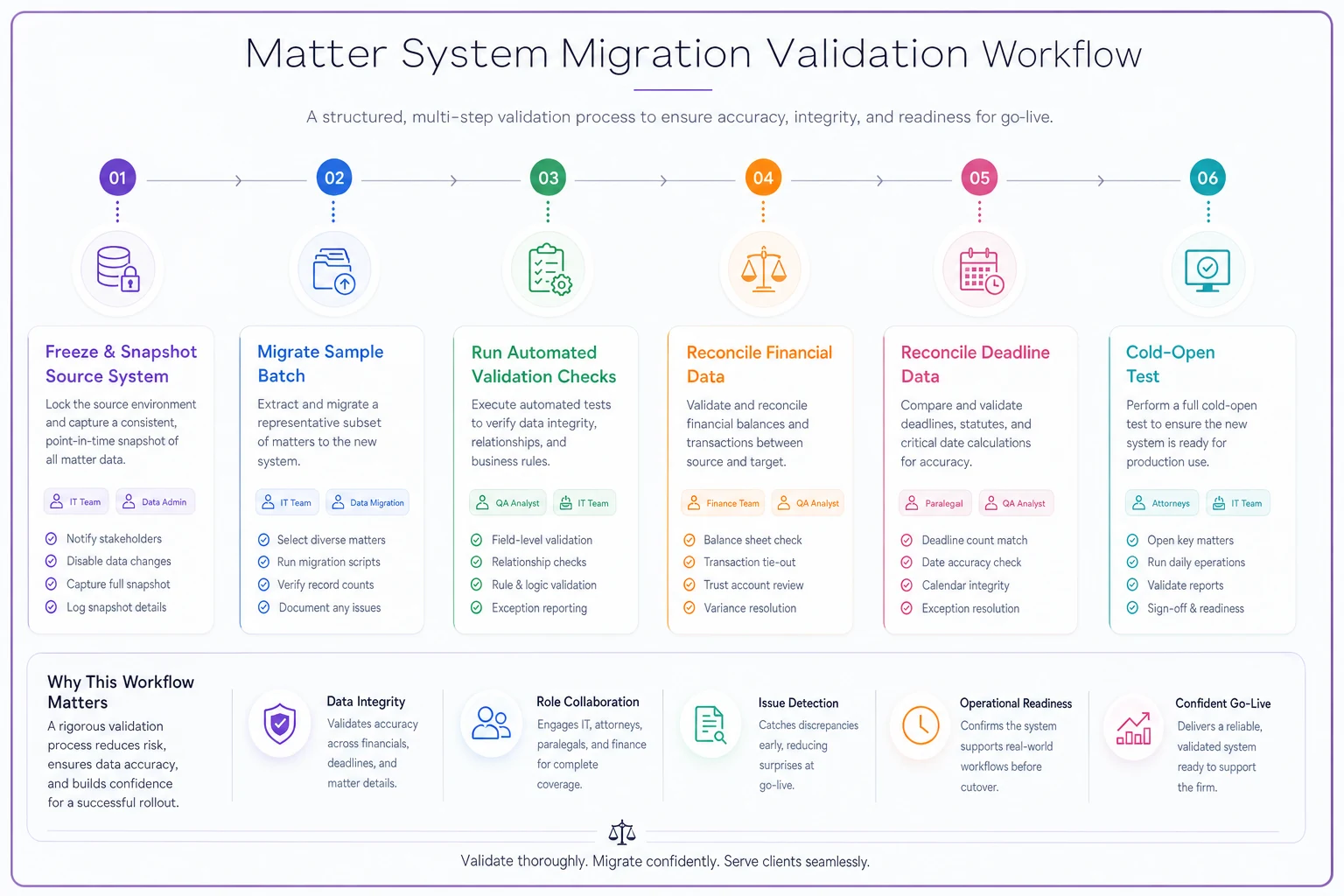
The firms that skip step 2 — the sample batch — are the ones who discover on go-live morning that every date came across in the wrong format. Validate small, then scale.
The validation checklist worth keeping
-
Total matter count matches source (within a documented, explained variance)
-
Every open matter has a responsible attorney assigned
-
No matter is missing a client association
-
All active deadlines carry an owner and a date
-
Document counts per matter reconcile to source
-
Trust and billing balances match to the cent
-
No duplicate client or matter records introduced
-
Legacy naming conventions mapped to the new taxonomy consistently
The firms that skip step 2 — the sample batch — are the ones who discover on go-live morning that every date came across in the wrong format. Validate small, then scale.
Adoption KPIs that map to matter outcomes
Once you're live, "how's adoption going?" needs a real answer. Login counts are the classic vanity metric — people log in and still do their real work somewhere else. What you actually want to measure is whether matters are being run through the system correctly.
| KPI | What it really tells you | Rough healthy target |
|---|---|---|
| % of new matters opened in-system | Whether intake has actually migrated | 95%+ within 30 days |
| % of matters with complete required fields | Data integrity at the source | 90%+ |
| % of deadlines with a named owner | Whether calendaring discipline holds | ~100% (this one's non-negotiable) |
| Avg. time from event to system entry | Whether the system is real-time or reconstructed after the fact | Under 1 business day |
| % of matters with no "unsorted" documents | Whether filing discipline is holding | 85%+ and climbing |
| Manual status reports still being requested | Whether leadership trusts the dashboards | Trending toward zero |
That last one is underrated. As long as partners keep asking for manually built status updates, adoption isn't real — it's theater on top of a system nobody trusts yet.
Remediation loops
KPIs without a remediation loop are just a scoreboard. The point is to catch drift and correct it fast, while the behavior is still new and correctable.
A workable loop: review adoption KPIs weekly for the first month, then every two weeks. When a metric dips — say, required-field completeness drops from 90% to 70% on family-law matters — you don't send a firm-wide email. You trace it to the specific team and the specific field they're skipping, and you fix the cause. Usually it's one of three things: a field that's genuinely unnecessary for that matter type, a workflow that's slower than the old way, or one person who never got the sprint. Each has a different fix. Blasting everyone with a reminder fixes none of them.
This is the same logic behind good project governance generally. If you've built RACI assignments by stage, the remediation loop has a natural home — the accountable person for that stage owns the metric for that stage. The legal project management playbook covers how those accountability lines get drawn, and a rollout is just that framework applied to a moment of change.
A real scenario
A litigation-heavy firm with around 18 attorneys had bought a matter platform and half-launched it eight months earlier. "Half-launched" meaning: the system existed, some people used it, and everyone still kept a shadow spreadsheet for deadlines because nobody trusted the migrated calendar data. Billing was spending roughly two extra days each month reconciling time entries between the platform and people's individual notes.
The re-rollout didn't touch the software config much. It fixed the sequence. They ran a four-week pilot on about 22 active matters across litigation and a small transactional group, with hard acceptance criteria on deadline ownership and time-entry accuracy. They re-migrated the deadline data after finding that roughly 15% of dates had been imported without owners — the exact reason people kept the shadow spreadsheets.
Training was rebuilt into role-based sprints. The partners' oversight sprint was the turning point: two of the most resistant partners found overdue tasks in their own matters that they hadn't known about, and the shadow-spreadsheet habit started dying that week.
Within about two months, required-deadline ownership was effectively at 100%, manual status report requests had mostly stopped, and billing's month-end reconciliation dropped from two days to a few hours. Nothing dramatic happened. The system just started being the one place the work lived.
Where the right platform quietly helps
None of this depends on any specific product, but the mechanics get much easier when your matter platform actually enforces the lifecycle instead of just storing data. When required fields are tied to stage transitions, "90% field completeness" stops being something you police manually — the system won't advance a matter without it. When deadline entries require an owner by design, the "100% ownership" KPI takes care of itself.
This is also where AI automation earns its place in the rollout rather than just being a feature on a sales sheet: flagging matters missing required data, surfacing deadlines with no owner, catching duplicate client records during migration, and nudging the person accountable for a stage when something's overdue. The value isn't that it's clever — it's that it removes the manual checking that otherwise makes adoption KPIs a full-time job for whoever got stuck owning the rollout. An operational platform that handles that background validation lets you spend your attention on the human side, which is the part that actually determines whether the rollout sticks.
When this playbook makes sense — and when it doesn't
When it makes sense: you're rolling out or re-rolling out a matter system across a firm with multiple roles and real matter volume, and you've been burned before by a launch that fizzled. The pilot-plus-sprint approach is built for exactly that situation — where trust has to be earned incrementally.
When it's overkill: a two-person firm with 40 active matters doesn't need a formal four-week pilot and four training sprints. You can compress the whole thing into a couple of focused sessions and a careful manual data check. The principles still apply — validate before you depend, train against real matters — but the ceremony doesn't.
Who should not do this: anyone trying to migrate ten years of closed matters, three legacy systems, and every scanned document on day one. Don't. Migrate the active book, get adoption solid, then backfill history in the background once the system is trusted. Front-loading the archive is the single most reliable way to poison a rollout with data nobody validated.
Bringing it together
A matter system rollout isn't a software installation — it's a change in how people work, and change sticks only when it's proven in small, honest increments. Scope a pilot with real acceptance criteria. Train in short sprints that end with real matters, not slideware. Validate your migration before anyone leans on it. Then measure adoption by what's happening to your matters, not by login counts, and close every KPI gap with a remediation loop that finds the actual cause.
Do that, and the shadow spreadsheets fade on their own — not because you banned them, but because the system finally became the easier place to work.
Ready to elevate your legal practice management?
Join 500+ law firms using Casioly to optimize case workflows, reduce administrative burden, and improve client satisfaction.