

Most billing disputes don't come from big, dramatic errors. They come from small, boring ones that nobody caught: a partner rate that didn't update after the annual increase, a duplicate time entry that got pasted twice during a late-night catch-up, a line charged two days before the engagement letter was actually signed. Individually they look harmless. Across a monthly pre-bill run of a few hundred invoices, they quietly erode realization and damage the relationships that matter most.
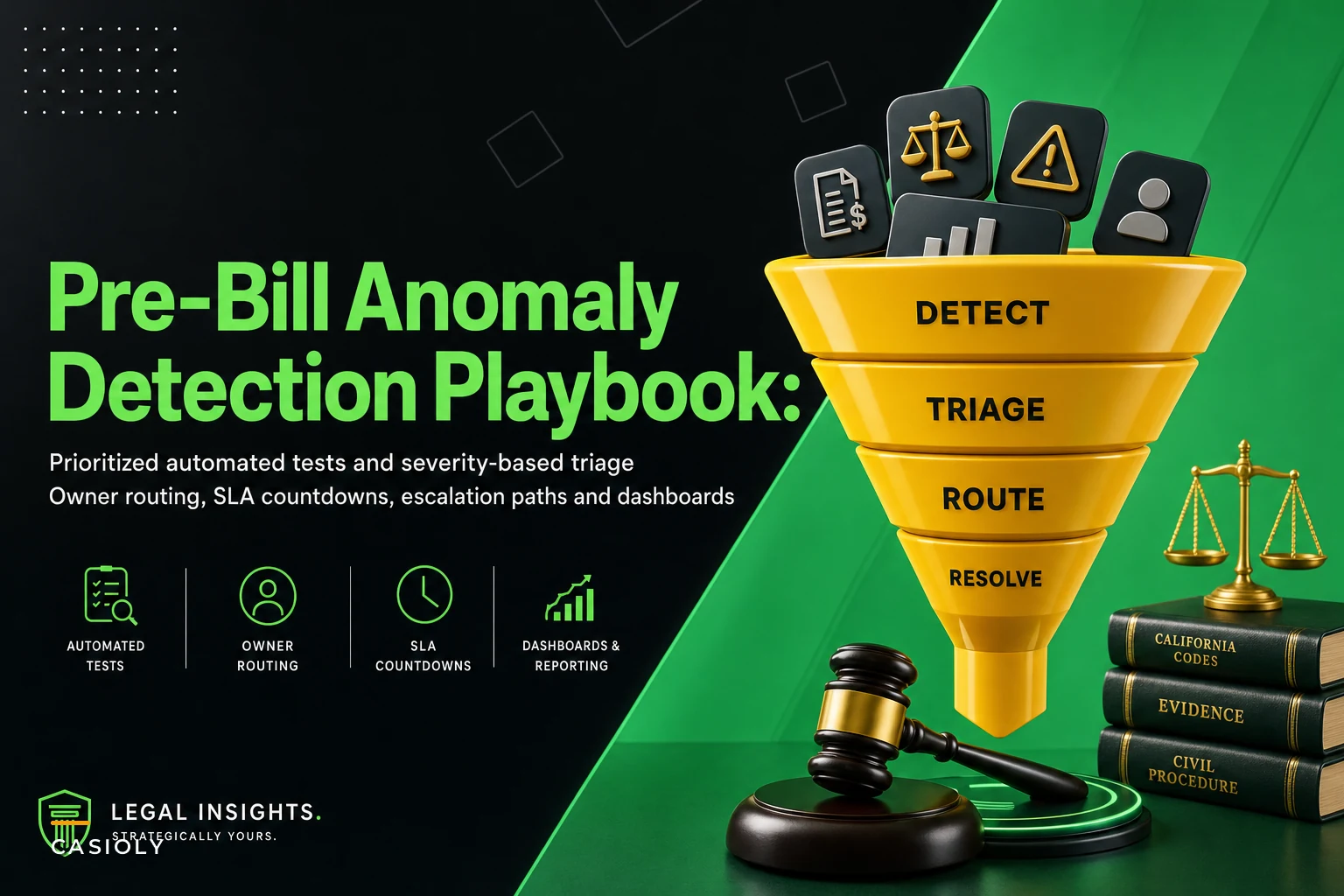
Firms that handle this well don't review every line manually — nobody has the hours. Instead they run a prioritized set of automated checks against the pre-bill, route the exceptions that actually matter to the right person, and let everything else flow through. This playbook is about building that layer: what to test, how to rank the tests, how to route exceptions, and what the dashboards should actually show so partners don't ignore them.
Why the pre-bill is the only place this gets cheap to fix
Once an invoice leaves the firm, every problem becomes a negotiation. A $4,200 rate overcharge discovered by the client's legal-ops team isn't a correction anymore — it's a credibility hit, and often a line-item write-down plus a request to re-audit the prior three invoices. The same error caught during pre-bill review costs about ninety seconds to fix.
That asymmetry is the whole argument. The pre-bill window is the last moment where a fix is internal, invisible, and free. After that, every dollar of error carries a dispute tax on top of it.
The problem is that most pre-bill review is still a partner skimming a PDF the night before invoices go out, looking for things that "jump out." Nothing subtle jumps out at 11pm. Duplicate entries don't jump out. A rate that's $15/hour stale doesn't jump out. Narrative that technically describes work but reads badly to a sophisticated client doesn't jump out. These are exactly the kinds of errors automated checks are built to catch.
The test library, ranked by dispute impact
Not all anomalies deserve equal attention. If you flag everything, reviewers tune out and start clicking "approve all." The goal is a ranked library where the highest-impact tests are near-impossible to ignore and the low-value ones never interrupt anyone.
Never miss a critical deadline again.
Casioly helps legal teams manage cases efficiently and stay on top of critical tasks.
- Centralized case tracking
- Automated deadline reminders
- Secure client communication
No credit card required
Here's a practical priority ranking that holds up across firms of different sizes:
| Priority | Test | What it catches | Why it ranks here |
|---|---|---|---|
| P1 | Rate override / stale rate | Timekeeper billed at a rate that doesn't match the current matter rate card | Direct client-visible overcharge; triggers audits of prior bills |
| P1 | Billing-before-engagement | Time or expense dated before engagement letter execution | Hard to defend; looks like you charged for pitching |
| P1 | Duplicate entries | Same narrative + duration + date across one or two timekeepers | Pure overbilling; indefensible if found |
| P2 | Block-billing over threshold | Single entries above ~2.5 hours with multiple tasks bundled | Common guideline violation; auto-reduced by e-billing systems |
| P2 | Vague-narrative flag | Entries like "attention to file," "review documents" with no object | Soft-dollar write-downs; erodes trust over time |
| P2 | Trust/retainer mismatch | Billed amount exceeds available retainer balance | Causes replenishment friction and payment delays |
| P3 | Rounding patterns | Timekeeper whose entries round suspiciously to .5 or 1.0 | Pattern risk more than single-bill risk |
| P3 | Task-code / phase mismatch | Work narrative doesn't match the LEDES task code assigned | Rejections at submission; relevant for e-billed matters |
The P1 tests share one trait: if the client finds them, you don't just lose the dollars — you lose the benefit of the doubt on everything else. That's the ranking logic. It isn't about frequency, it's about what each error does to the relationship when discovered externally.
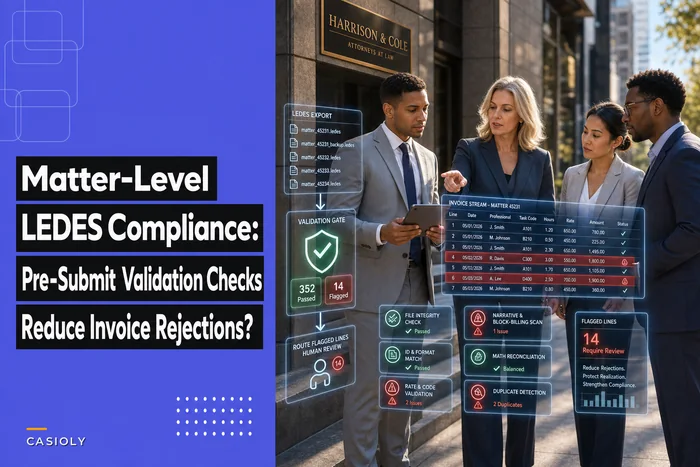
One note on task-code and narrative-formatting checks: if you're already running structured validation before e-billing submission, a lot of this overlaps with your LEDES compliance and pre-submit validation layer. The pre-bill checks and the pre-submit checks should share logic, not duplicate it — the narrative that passes your client's outside counsel guidelines is the same one that should pass your internal pre-bill read.
How these errors actually get into the pre-bill
Rate overrides almost never come from someone typing a wrong number on purpose. They come from a rate increase applied to the global rate table that never got pushed to matters opened before the change — or matters with a negotiated rate cap that a new timekeeper's default rate quietly overrode. A typical scenario: a mid-level associate gets added to a capped-rate matter in March, the system assigns their standard $495 rate, and the $420 cap sits in a field nobody checks until the client does.
Billing-before-engagement shows up when intake and timekeeping run on different clocks. The partner starts working the moment the client says yes on the phone. The engagement letter gets signed four days later. The time entries are dated to the actual work. Now you have twelve hours dated before an executed agreement — technically unbillable and difficult to defend on an invoice.
Duplicates are usually a copy-paste artifact. Someone reconstructs a week of time on Friday, pastes a block of entries, edits most of them, misses one. Or two timekeepers on the same call both log "0.5 — conference with co-counsel re: discovery strategy," which isn't a duplicate in the system's eyes but reads exactly like one to a reviewer.
Vague narratives are a time-capture habit problem more than a billing problem. The entry was written to be fast, not to be read by a skeptical accounts-payable analyst.
Knowing the entry point matters because it determines whether to fix the bill or fix the upstream workflow. A duplicate is a one-time correction. A recurring rate-override pattern on matters opened before a rate change is a systemic hole that will reappear every month until someone plugs it.
Acceptance criteria: what "clean" actually means
Vague standards are why pre-bill review drifts. "Looks fine" isn't a criterion. Each test needs a pass/fail rule a machine can apply and a human can defend.
-
Rate override Every billed rate must equal the matter rate-card rate for that timekeeper's effective date. Any variance, up or down, fails and routes for review.
-
Billing-before-engagement No billable entry may carry a service date earlier than the executed engagement date on the matter record. Hard stop — these never auto-approve.
-
Duplicate Two or more entries matching on date + duration + normalized narrative (case-insensitive, whitespace-collapsed) on the same matter fail and surface as a pair.
-
Block-billing Entries over 2.5 hours containing more than one task verb ("drafted… reviewed… called…") flag for split, unless the matter is flagged as flat-fee.
-
Vague narrative Entries matching a stoplist ("attention to file," "work on matter," "review") with no noun object flag for rewrite.
-
Retainer mismatch Draft invoice total must not exceed available trust/retainer balance where the matter is retainer-funded; overage routes to the responsible attorney plus billing.
The important design decision here is separating hard stops from soft flags. Billing-before-engagement and rate variance are hard stops — the invoice cannot finalize until someone clears them. Vague narrative and block-billing are soft flags — they surface, but a partner can approve-with-reason if the client relationship warrants it. Treating everything as a hard stop is how you train people to override the whole system.
Triage routing: getting the exception to the one person who can fix it
A flagged exception that lands in a shared inbox dies there. Routing logic is what turns detection into resolution, and it's where most firms underinvest. Every exception has to answer one question: who owns this, and by when?
-
Classify the exception by test type and severity (P1/P2/P3).
-
Map to an owner based on the error's origin, not the invoice's partner by default. Rate overrides route to billing/finance — they own the rate table. Billing-before-engagement routes to the intake owner and the responsible attorney. Duplicates and narrative issues route to the originating timekeeper first.
-
Attach an SLA tied to the billing cycle. P1 exceptions get 24 hours; P2, 48; P3 can clear by the next cycle. The SLA has to be shorter than the gap between pre-bill generation and invoice send, or it's just theater.
-
Escalate on breach. If the originating timekeeper doesn't resolve a duplicate in the window, it escalates to the supervising partner, then to the billing partner. No exception sits unowned.
-
Record the disposition — corrected, approved-with-reason, written down — so the pattern is queryable later.
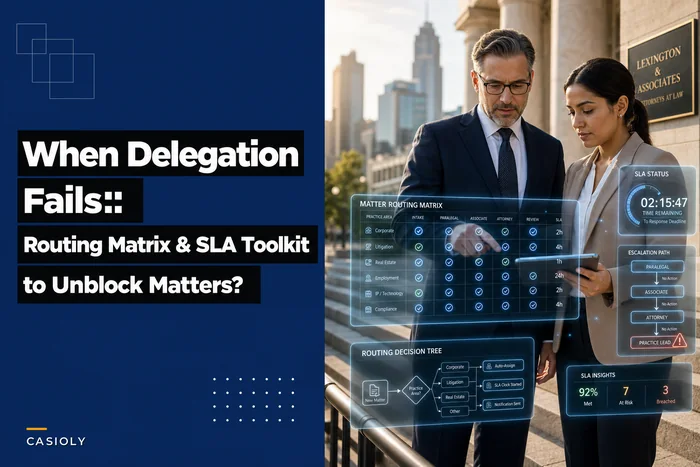
If you've built routing matrices for anything else in the firm, this is the same discipline applied to billing. The logic mirrors what's laid out in the delegation routing matrix and SLA toolkit — the failure mode is identical: work that's technically assigned to "the team" is assigned to no one, and it stalls until a deadline forces it.
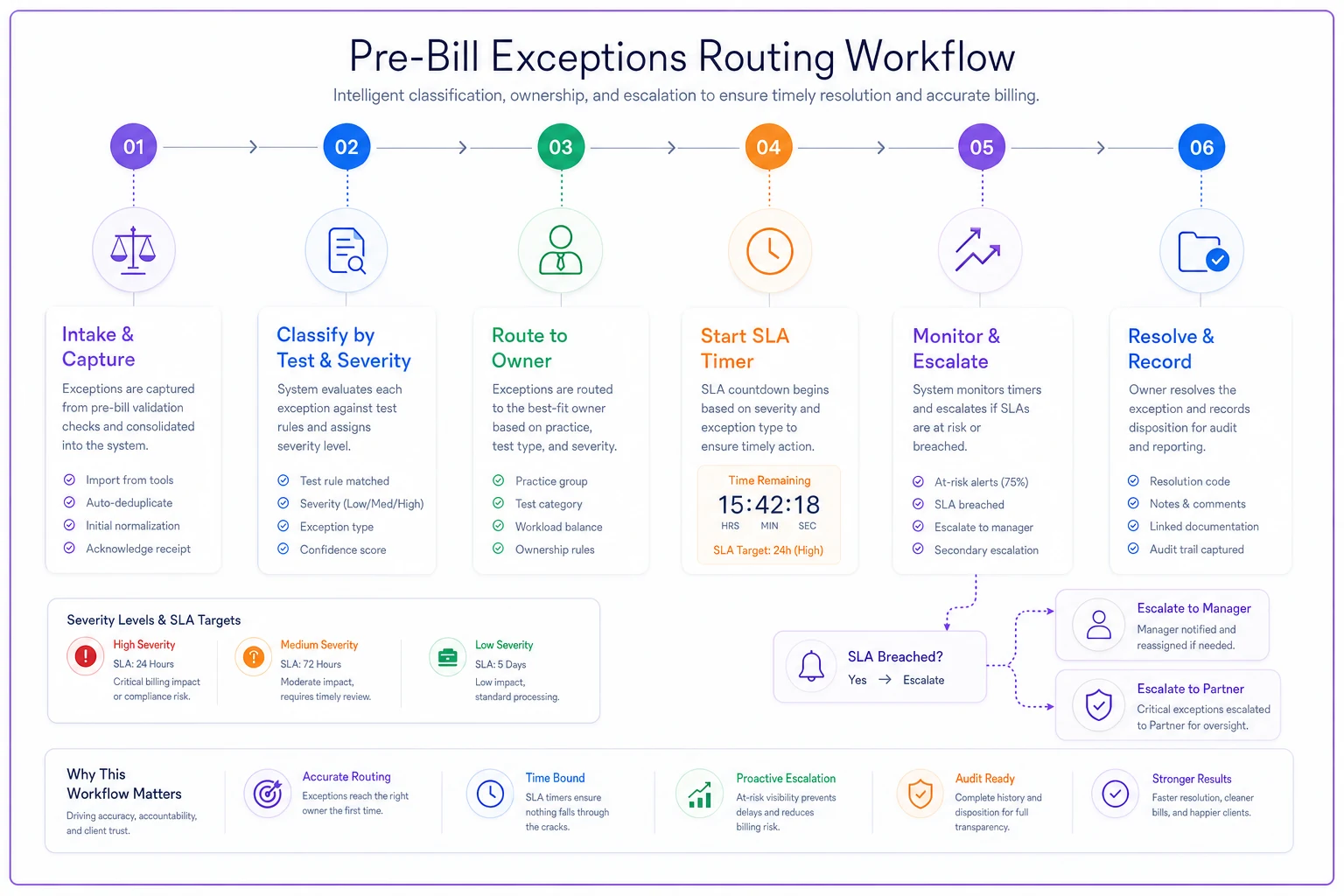
The one piece people consistently get wrong: routing a rate-override exception to the responsible partner. The partner can't fix the rate table — they'll just email finance, adding a hop and a day. Route it to the person who can actually make the change.
Exception dashboards tied to matter state
A flat list of flags is useless to a partner. The dashboard has to answer one thing: "what's blocking money from going out this cycle, and whose job is it to clear it?" Tying exceptions to matter state is what makes it readable.
Dashboard 1 — Cycle Exception Board (billing manager view)
-
Open P1 (hard stops)
count, total dollars affected, owner, hours-to-SLA-breach
-
Open P2 (soft flags)
count, owner, age
-
Cleared this cycle
corrected vs approved-with-reason vs written down
-
Breached SLA
exceptions past their window, escalation status
The dollar-affected column is what gets partners to pay attention. "14 open exceptions" is noise. "$31k in invoices held by 6 unresolved rate flags" is a meeting.
Dashboard 2 — Timekeeper Pattern View (practice-group leader view)
-
Duplicate rate per 100 entries
-
Vague-narrative rate
-
Block-billing frequency
-
Average time-to-clear when flagged
This one isn't about any single bill — it's about coaching. A timekeeper with vague narratives on 30% of entries doesn't need their invoices fixed indefinitely; they need a five-minute conversation about writing the object into the entry.
Dashboard 3 — Matter-State Blocks (managing partner / finance view)
-
Pre-engagement billing flags on newly-opened matters (intake gap signal)
-
Retainer-mismatch flags on active matters (replenishment needed)
-
Rate variances clustered on matters opened before the last rate change (systemic table gap)
When pre-engagement flags cluster on recently-opened matters, the problem isn't billing — it's that intake and timekeeping aren't synchronized. That's a workflow fix, not an invoice fix.
A real scenario
A litigation boutique, around 18 timekeepers, was running pre-bill as a single partner reviewing a stacked PDF the night invoices went out. Over one quarter they'd had three separate clients push back on invoices — two rate issues, one set of duplicated conference entries — and each pushback turned into a re-audit request that ate a paralegal's week and ended in roughly $9k–$11k of write-downs across the three, plus a noticeably cooler relationship with their biggest client.
They layered in automated pre-bill checks: the P1 set as hard stops, P2 as soft flags, routed by origin with a 24-hour SLA on hard stops. The first month surfaced around 40 exceptions across roughly 160 invoices — most minor, but four were exactly the rate-and-duplicate type that had caused the earlier disputes. Those four represented a little over $6k that would otherwise have gone out wrong.
Nothing dramatic happened after that, which was the point. Client-side pushback dropped to effectively nothing over the next two cycles. The partner's pre-bill night went from a two-hour skim to clearing a short exception list. And the pattern dashboard flagged two timekeepers whose vague-narrative rate was driving most of the soft flags — one conversation each, and the flag volume dropped the following month.
When this is worth building — and when it isn't
When it makes sense: you're billing more than a few dozen invoices a month, you bill hourly against negotiated or capped rates, you have clients sophisticated enough to audit (corporate, insurance, institutional), or you've already eaten a dispute that cost real money. The more timekeepers and the more rate variation, the faster this pays off.
When it's overkill: a solo or two-lawyer flat-fee practice billing fixed amounts has almost nothing for these tests to catch. If every matter is a $2,500 flat fee, rate overrides and block-billing don't exist. Don't build infrastructure for problems you don't have.
Who should skip the full build: firms that haven't nailed down a clean rate card and an accurate engagement-date field. The checks are only as good as the reference data. If your rate table itself is wrong, automated rate-variance checks will either flood you with false positives or silently pass real errors. Fix the reference data first, then turn on the detection.
Getting started without boiling the ocean
You don't need all eight tests on day one. Start with the three P1 checks — rate variance, billing-before-engagement, duplicates — because those are the ones that actually cause disputes. Run them for a cycle in "flag only, don't block" mode so you can see the false-positive rate and tune the thresholds before anything becomes a hard stop. Once the P1s are clean and trusted, layer in the P2 narrative and block-billing flags.
Run P1 checks in flag-only mode for one cycle to measure false positives before turning on hard stops.
The quiet win here isn't the dollars you recover on any single bill. It's that disputes stop happening, re-audit requests stop eating your paralegals, and your most sophisticated clients stop finding errors before you do. That last one is worth more than the write-downs — because the client who never catches you overbilling is the client who keeps sending work.
The quiet win here isn't the dollars you recover on any single bill. It's that disputes stop happening, re-audit requests stop eating your paralegals, and your most sophisticated clients stop finding errors before you do. That last one is worth more than the write-downs — because the client who never catches you overbilling is the client who keeps sending work.
Ready to elevate your legal practice management?
Join 500+ law firms using Casioly to optimize case workflows, reduce administrative burden, and improve client satisfaction.