

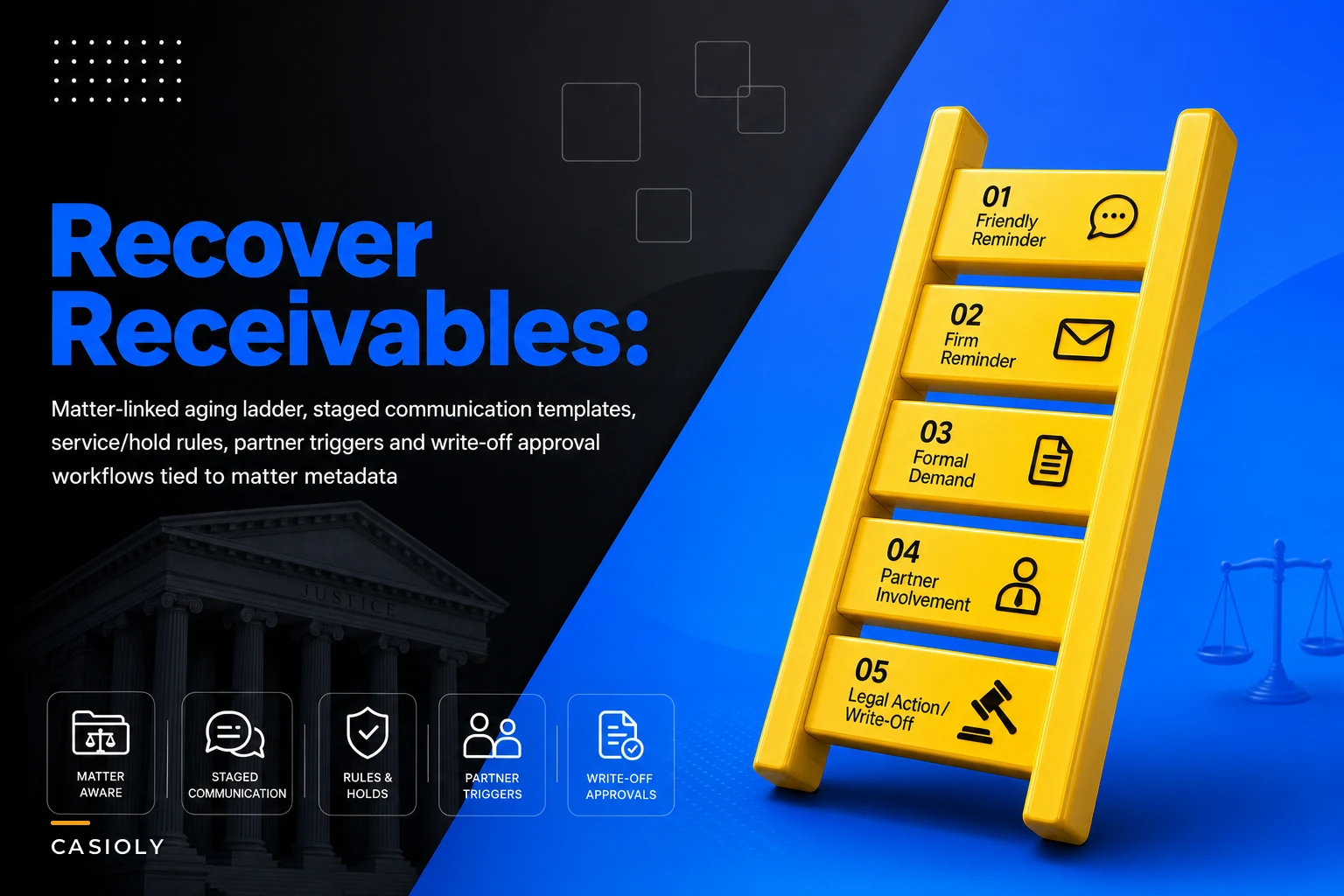

Here's the pattern that quietly bleeds firms: collections gets run against the client, not the matter. Somebody pulls an AR aging report, sees "Client X owes $47k," and fires off a statement. But Client X has four open matters, two of which are perfectly current, one that's in a fee dispute, and one that's been sitting at 90 days because the responsible partner keeps waving off the reminders. Treat that as a single balance and you either alienate a good client or let the real problem hide behind three healthy matters.
Why most firm collections fail at the matter level, not the client level
Firms that collect well treat every matter as its own credit file. The aging ladder, the tone of each reminder, whether the file goes on hold, when the partner gets pulled in, who can approve a write-off — all of it hangs off matter-level metadata, not a client-level lump sum.
This is the piece most collection policies skip. They have a "net 30" line in the engagement letter and nothing after that. So let's build the actual mechanics.
The matter-linked aging ladder
Aging by matter means every invoice carries context the moment it's issued: matter type, fee arrangement, responsible partner, whether a retainer is in play, and the client's payment history on that matter. A contingency matter and a monthly-billed corporate matter should never sit on the same aging schedule, because "60 days late" means completely different things for each.
Never miss a critical deadline again.
Casioly helps legal teams manage cases efficiently and stay on top of critical tasks.
- Centralized case tracking
- Automated deadline reminders
- Secure client communication
No credit card required
| Age (days) | Standard hourly matter | Retainer-backed matter | Fee-sensitive / relationship client | System state |
|---|---|---|---|---|
| 0–15 | Invoice issued, no action | Auto-draw against trust | Invoice issued, no action | Current |
| 16–30 | Soft reminder email | Replenishment notice if trust low | Soft reminder, partner CC'd | Watch |
| 31–45 | Second reminder + statement | Draw stopped, replenishment demand | Partner-approved reminder | Aging |
| 46–60 | Phone follow-up logged | Service-hold warning | Partner call, no auto-escalation | At risk |
| 61–90 | Service hold + partner notify | Service hold active | Partner decides hold | Escalated |
| 90+ | Write-off review triggered | Write-off / trust reconciliation | Partner + billing committee | Terminal |
The key move here: the ladder isn't uniform. The metadata (feearrangement, clienttier, retainer_flag) routes the invoice down a different lane depending on what the matter actually is. A relationship client with $200k in annual spend doesn't get an auto-generated service-hold notice at day 61 — that's a partner conversation. A one-off transactional matter with no future value can move down the aggressive lane without anyone losing sleep over it.
Where this connects to forecasting: your aging buckets feed directly into cash timing. If you've already mapped matter-stage probabilities to realization curves and cash-timing forecasts, the aging ladder is the enforcement arm of that model. The forecast says when you expect the money; the ladder is what you do when it doesn't show up on schedule.
Staged communication templates that don't torch relationships
The biggest self-inflicted wound in collections is tone drift. Whoever sends the reminder writes it in their own voice — one associate is apologetic enough to practically invite delay, another sounds like a demand letter at day 20. Clients notice the inconsistency, and it reads as disorganization.
-
Stage 1 (day 16–30) — Soft reminder. Neutral, assumes good faith. "Invoice #4412 for the Henderson acquisition matter shows as outstanding — attaching a copy in case it got buried." No mention of consequences. An associate or billing coordinator can send this.
-
Stage 2 (day 31–45) — Firm reminder. References the first contact, states the balance and matter clearly, offers a payment call. Still relationship-preserving. Sent under the responsible partner's name, even if drafted by billing.
-
Stage 3 (day 46–60) — Consequence notice. Introduces the possibility of a service hold specific to that matter. Requires partner sign-off before it goes out.
-
Stage 4 (day 61–90) — Formal escalation. Written to be defensible if the matter ends in a fee dispute. Documents prior outreach, states the hold, and gives a cure deadline.
What most firms miss: each template should reference the specific matter and the work at risk, not the aggregate balance. "Continued work on your pending trademark filing will pause" lands very differently than "your account is past due." One creates urgency tied to something the client actually cares about; the other just creates resentment.
Keep the templates tied to matter metadata so the merge fields aren't just name and balance.
Keep the templates tied to matter metadata so the merge fields aren't just name and balance — pull in matter type, responsible partner, next deadline, and the specific deliverable at risk. That last field is what actually converts a non-response into a payment call.
Hold and service rules — the part everyone avoids
Service holds are where collections policy goes to die, because nobody wants to be the one who stopped work on a client's file. The default becomes "keep working and hope they pay," which is exactly how a 45-day problem becomes a 180-day write-off.
-
The trigger — usually an age threshold combined with a metadata condition. Example:
daysoutstanding > 60 AND retainerbalance < minimum AND client_tier != strategic. -
The scope — does the hold apply to that matter only, or all of the client's matters? This should default to matter-only. Blanket client holds should require partner and billing-committee approval, because that's the nuclear option.
-
The exceptions — statutory deadlines, court dates, anything where stopping work creates malpractice exposure. A hold rule that pauses work two days before a filing deadline is worse than no hold at all.
That third point is non-negotiable. The hold logic has to read the matter's calendar. If there's a hard deadline inside the next ten business days or so, the automated hold suppresses itself and routes to the partner instead. You never let a collections rule create a malpractice claim.
For retainer-backed matters, the hold conversation is usually cleaner — the trigger is a depleted trust balance, not an aging invoice. If you've set up matter-level drawdown rules with automated holds and replenishment triggers, the service-hold decision is already made: work pauses when the trust runs dry, and the replenishment notice does the talking. That's a far better position than chasing a delivered-work invoice after the fact.
Partner-notification triggers
The reason aging balances sit isn't usually that billing forgot to send reminders. It's that the responsible partner never saw the problem until it was severe — or saw it and did nothing because there was no forcing function.
-
First trigger (day ~30) informational. "Your Delgado matter invoice is now 30 days out. No action needed yet — flagging for awareness."
-
Second trigger (day ~45) decision required. The partner must approve the Stage 3 consequence notice or override with a documented reason and a follow-up date.
-
Third trigger (day ~61) escalation. If no partner action has been logged, the notification copies the practice-group lead or managing partner. This is the accountability layer — inaction becomes visible upward.
Worth stealing from firms that actually do this well: make the second trigger require an explicit choice — approve escalation or override. An override is fine. Silence isn't. What kills collections is the matter that ages because everyone assumed someone else was handling it. Forcing a logged decision at day 45 eliminates the "I thought billing had it" excuse, and it also creates a paper trail if the fee ever gets disputed.
One thing that tends to happen after the first quarter of running this: overrides drop noticeably. When partners know the override is logged and their name is on it, the reflex to wave off a reminder fades. The behavior change comes from visibility, not from the reminder itself.
Write-off approval workflows tied to matter metadata
Write-offs are the collections step with the least discipline and the highest cost. In a lot of firms, a write-off happens because a partner verbally tells billing to "just clear it," and it vanishes with no analysis of why. That's how the same avoidable write-off happens on the next matter, and the one after that.
| Write-off amount | Required approver | Required documentation |
|---|---|---|
| Under $1,500 | Responsible partner | Reason code |
| $1,500–$7,500 | Partner + practice-group lead | Reason code + collection history |
| Over $7,500 | Billing committee | Full matter review + root-cause note |
The reason code is the part that actually matters long-term. A dropdown of causes — scope creep never billed, client dispute over quality, fee sensitivity misjudged at intake, missed replenishment, work performed on a matter that should've been on hold — turns write-offs into data. After two quarters you can see that a disproportionate share of losses traces back to one matter type or one intake gap, and you fix the source instead of eating the loss over and over.
Metadata also lets you catch the write-off that shouldn't disappear quietly. If a matter flagged as strategicclient and highrealization suddenly hits a write-off request, that should route to a human review — it's out of pattern. The write-offs that slip through most easily are usually the ones that deserve the most scrutiny.
A short real scenario
A 14-attorney litigation and corporate firm was carrying somewhere around $310k in AR over 90 days. When they sorted it by matter, most of it was concentrated in a handful of files where reminders had been sent but no partner had ever made a call.
They did three things. First, they split aging by matter type and stopped treating multi-matter clients as single balances. Second, they set the day-45 partner trigger to require an approve-or-override decision. Third, they added reason codes to every write-off.
Within about two quarters, over-90 AR dropped to somewhere in the $180k–$200k range — not because they got more aggressive, but because problems surfaced weeks earlier and partners actually made decisions. The write-off reason codes also flagged that a chunk of the losses traced to one flat-fee matter type that was consistently under-scoped at intake. They repriced it. That one fix probably mattered more than the collections process itself.
The escalation flow, visualized
For firms trying to socialize this internally, it helps to see the decision points laid out sequentially. Here's how a matter moves through the collections workflow from invoice to resolution:
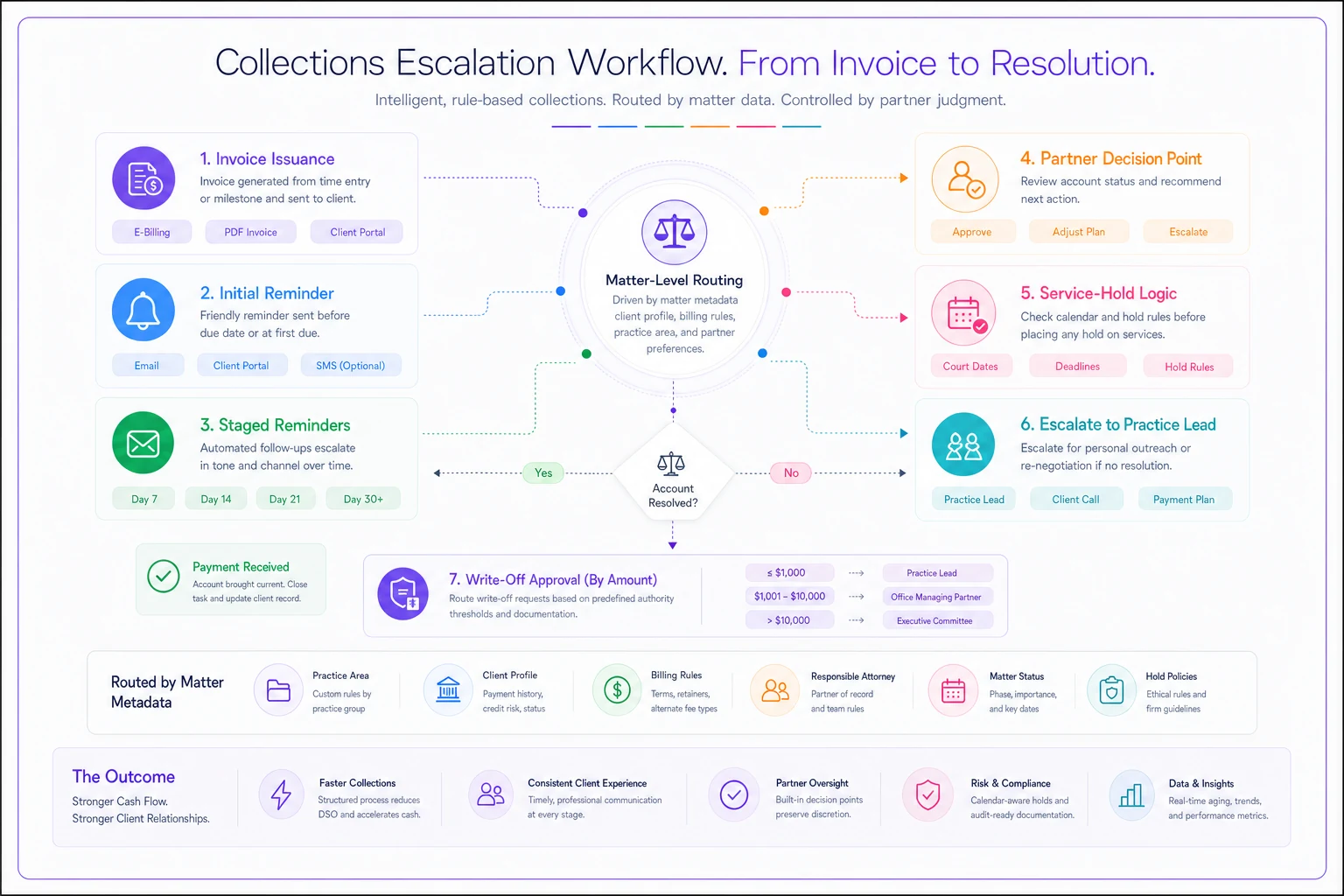
[Invoice Issued] | Day 0–15: No action (current) | Day 16–30: Soft reminder sent (billing coordinator) | Day 31–45: Firm reminder under partner name | Day 45: Partner trigger — approve escalation or override (logged) | ├── Override logged → partner sets follow-up date | └── Approved → Stage 3 consequence notice issued | Day 46–60: Phone follow-up, service-hold warning | Day 61: Service hold activated (matter-only, calendar checked) | Partner inaction → practice-group lead notified | Day 90+: Write-off review triggered → approval workflow by amount
Each decision point is tied to matter metadata, not a blanket policy. The calendar check before any hold activation is what keeps this from becoming a malpractice risk.
When this level of structure makes sense — and when it doesn't
When it's worth it: you're running more than a handful of attorneys, you have clients with multiple concurrent matters, and you carry meaningful AR past 60 days. The multi-matter clients are the real tell — if untangling one client balance takes a spreadsheet, you need matter-level aging.
When it's overkill: a solo or two-attorney practice on mostly flat fees or retainers, collecting almost everything up front, rarely needs staged partner-notification triggers. A simple aging list and a personal call will do more than a workflow diagram.
Who should not bolt this on blindly: firms with a broken intake process. If matters open without clear fee terms, scope, or a responsible partner assigned, no collections ladder will save you — you'll just be automating chases against ambiguity. Fix the front of the pipeline first, then build the collections mechanics behind it.
Bringing it together
Matter-level collections works because it puts the decision where the information lives. The responsible partner knows whether a 70-day balance is a genuine problem or a client who always pays late and always pays. The metadata knows whether stopping work risks a deadline. The reason codes know why money keeps leaking. A client-level aging report knows none of that.
The whole system really comes down to four connected decisions — how fast to escalate, how to phrase it, when to stop working, and who signs off on giving up — each one routed by what the matter actually is rather than by a single number on a report. Build those four decisions into rules ahead of time, tie them to the matter record, and collections stops being the uncomfortable end-of-quarter scramble and starts being something the firm just runs.
Matter-level collections works because it puts the decision where the information lives. The responsible partner knows whether a 70-day balance is a genuine problem or a client who always pays late and always pays. The metadata knows whether stopping work risks a deadline. The reason codes know why money keeps leaking. A client-level aging report knows none of that.
The whole system really comes down to four connected decisions — how fast to escalate, how to phrase it, when to stop working, and who signs off on giving up — each one routed by what the matter actually is rather than by a single number on a report. Build those four decisions into rules ahead of time, tie them to the matter record, and collections stops being the uncomfortable end-of-quarter scramble and starts being something the firm just runs.
Ready to elevate your legal practice management?
Join 500+ law firms using Casioly to optimize case workflows, reduce administrative burden, and improve client satisfaction.