

Trust accounting SOPs mostly assume a clean world: client pays a retainer, you draw against it, you reconcile at month-end. That world falls apart the moment a matter involves third-party funds — a settlement that needs to be split among a lienholder, a medical provider, and the client; a real estate escrow where you're holding earnest money for parties who aren't your client; a structured funding arrangement where part of the money belongs to a litigation funder.
These hybrid-funding matters are where firms get into real trouble. Not because anyone is stealing, but because the ledger wasn't set up to distinguish whose money is sitting in trust, the approval process treats a $900 disbursement the same as a $90,000 one, and nobody documented who was supposed to be notified before funds moved.
This is a narrow SOP for exactly that situation. If your matters only ever involve client retainers, you've already got what you need in a standard month-end trust reconciliation routine. This article is about the harder case — when the matter escrow SOP at your law firm has to account for money that doesn't belong to your client.
Where hybrid-funding matters actually break
The failure almost never happens at intake. It happens at a lifecycle event — a settlement funds, a closing date hits, a funder's tranche arrives — and the operational setup wasn't built to handle multiple beneficiaries inside one matter balance.
A typical breakdown looks like this. A personal injury firm settles a case for $120k. The money lands in the trust account under the matter. The paralegal sees the balance and processes the client's share plus the firm's fee. Two weeks later the medical lienholder calls asking about their $18k. Technically the money is still there — but nobody mapped that $18k as a restricted sub-balance, so the ledger showed a healthy positive number and the disbursement to the client went out at full freight.
Now you've over-disbursed against a lien, and you're chasing the client to claw back funds that are already spent.
The root cause is almost always the same two things:
-
The trust ledger treats the matter as a single pool instead of a set of earmarked sub-ledgers tied to specific parties.
-
Disbursement approval is a single human eyeballing a number, with no threshold logic that forces extra scrutiny when third-party interests are in play.
Neither of those is a software problem at its core. It's a design problem in how the matter's money is structured.
Specialized ledger mappings: splitting one matter balance into earmarked sub-ledgers
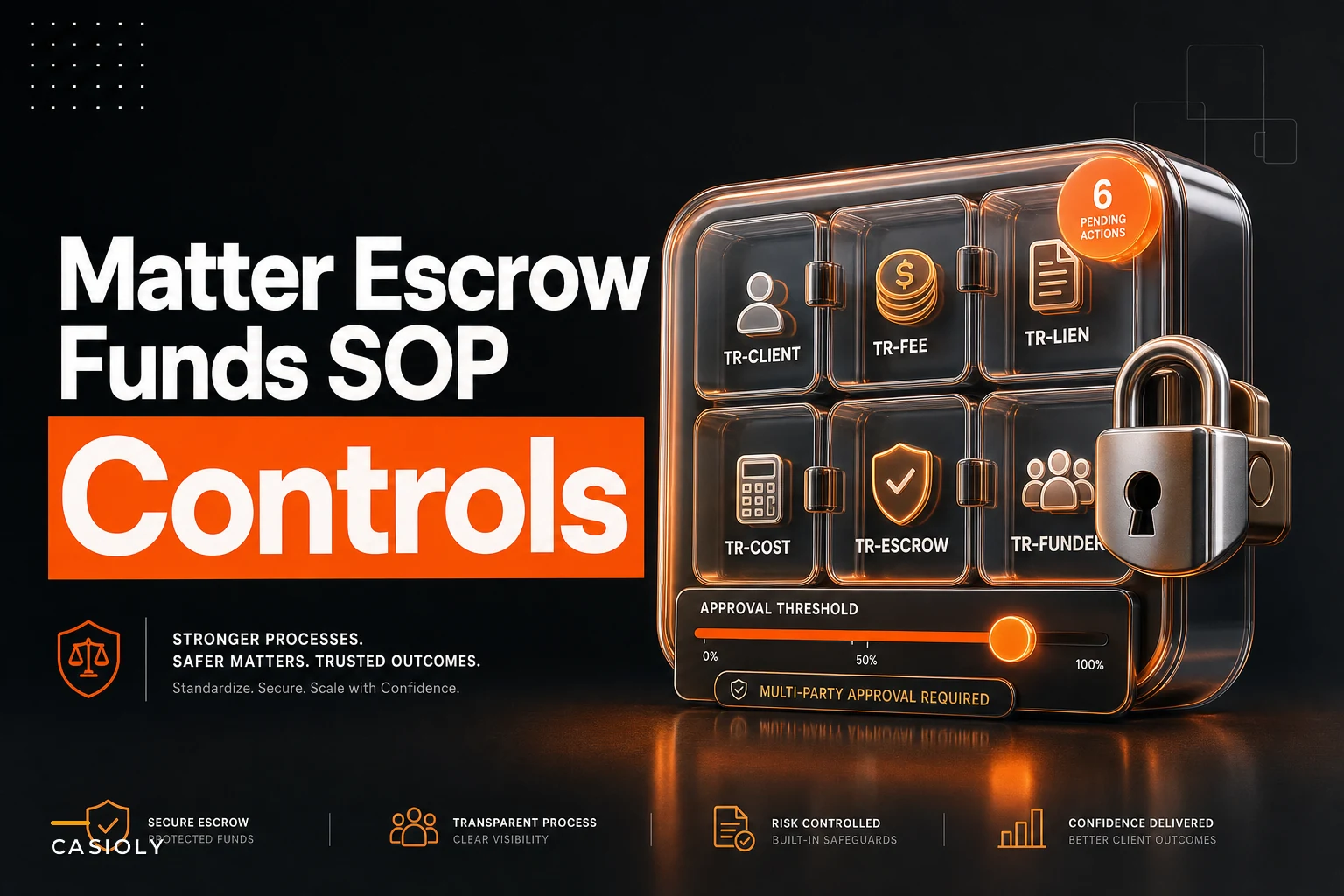
The fix starts with refusing to treat the matter trust balance as one number. Every hybrid-funding matter should carry a set of sub-ledgers, each tied to a beneficiary and a release condition. The matter total is just the sum — but you never disburse against the total, only against a specific sub-ledger that's been cleared for release.
Never miss a critical deadline again.
Casioly helps legal teams manage cases efficiently and stay on top of critical tasks.
- Centralized case tracking
- Automated deadline reminders
- Secure client communication
No credit card required
Here's a mapping structure that works for the common hybrid scenarios:
| Sub-ledger code | Beneficiary type | Typical source event | Release condition |
|---|---|---|---|
| TR-CLIENT | Client net proceeds | Settlement funds / closing | After all senior claims resolved |
| TR-FEE | Firm fee | Settlement funds | Fee agreement + client approval |
| TR-LIEN | Medical/statutory lienholder | Settlement funds | Lien resolution or negotiated payoff letter |
| TR-COST | Reimbursable case costs | Settlement funds | Cost ledger reconciled to matter |
| TR-ESCROW | Non-client party (buyer/seller/counterparty) | Escrow deposit | Written release or closing instructions |
| TR-FUNDER | Litigation funder tranche | Funding arrangement payout | Funder payoff statement |
The point isn't the specific codes — build your own. The point is that when a settlement for $120k lands, it doesn't post as "+$120k to the matter." It posts as allocations across TR-CLIENT, TR-LIEN, TR-COST, and TR-FEE, with the lien amount locked until there's a payoff letter on file.
A few operational notes from how this plays out in practice:
-
The allocation happens at the funding event, not later. The single biggest mistake is receiving funds into an unallocated matter balance and promising to "break it out before disbursement." That gap is where over-disbursements live.
-
Locked sub-ledgers should be visually distinct from releasable ones. Whoever's processing the payment needs to see red before they type a number.
-
Costs are their own sub-ledger, reconciled separately. Firms constantly fold reimbursable costs into the fee math and end up disbursing on a number that was never verified against the actual case-cost record.
The allocation happens at the funding event, not later.
The allocation-at-funding discipline prevents the common gap where an unallocated matter balance gets spent before being properly broken out.
Disbursement approval thresholds tied to who the money belongs to
Standard approval policies set a dollar threshold — "anything over $10k needs a partner." That's necessary but not sufficient for hybrid matters, because a $4k lien disbursement to the wrong payee is a bar complaint, while a $40k release of the firm's own earned fee is routine.
The better model layers two dimensions: dollar amount and beneficiary type. A disbursement from TR-ESCROW or TR-LIEN gets more scrutiny than the same amount from TR-FEE, regardless of size.
-
Firm fee (TR-FEE), any amount Single approver (billing partner), standard.
-
Client net proceeds (TR-CLIENT) under $25k Single approver, plus confirmation that all senior sub-ledgers are cleared.
-
Client net proceeds $25k and up Dual approval — responsible attorney plus trust administrator.
-
Any disbursement from TR-LIEN Dual approval and a payoff/release document attached, regardless of amount.
-
Any disbursement from TR-ESCROW to a non-client Dual approval plus written release/closing instructions on file.
-
Any disbursement from TR-FUNDER Dual approval plus funder payoff statement matching to the dollar.
The rule that saves firms the most pain: no disbursement from a client sub-ledger until every senior sub-ledger in the matter is either paid or formally released. This is the digital version of the old settlement-disbursement discipline, and it's exactly the kind of control that pairs with the drawdown and automated-hold logic firms use on the retainer side. The difference is that on the escrow side, the "hold" protects third parties, not just the firm.
When stricter thresholds are a bad idea
Not every matter needs this level of process weight. If you're a transactional practice occasionally holding a small escrow deposit and releasing it on a clean closing, forcing dual approval and document matching on a $2k earnest-money return just creates friction that people route around. The sub-ledger discipline still applies — you always want to know whose money it is — but the approval requirements should scale to real exposure. Over-engineering the SOP for low-risk matters is how you train staff to treat the whole process as theater.
Client and third-party notification language tied to lifecycle events
The notification gap is subtler than the ledger gap but just as damaging. When funds move in a hybrid matter, more than one party often has a right to know — and the timing of that notice matters for both ethics and disputes.
Build around this pattern: every disbursement from a shared or third-party sub-ledger triggers a notice, and that notice goes out before or at the moment of disbursement, not after.
On funding (settlement received):
> "We've received settlement funds of [amount] in connection with your matter. These funds are being held in our trust account. Before any portion is disbursed, we will provide you a full settlement statement showing the firm's fee, reimbursable costs, amounts owed to lienholders or other parties, and your net proceeds. No funds will be released until you've reviewed and approved this statement."
On lien/third-party payoff (releasing TR-LIEN):
> "As part of resolving your matter, we are disbursing [amount] to [lienholder] in satisfaction of [lien/claim], per the payoff statement dated [date]. A copy is enclosed. This disbursement reduces the amount owed from your settlement and has been reflected in your settlement statement."
On client net disbursement (releasing TR-CLIENT):
> "All senior claims against your settlement have been paid or released. We are now disbursing your net proceeds of [amount] by [method]. Your full accounting is attached, showing every deduction from the gross settlement."
On escrow release to a non-client party:
> "Per the [closing instructions / written release] dated [date], we are releasing [amount] held in escrow to [party]. This completes our escrow obligations in this matter."
The notification isn't a courtesy — it's an evidentiary record. When a client disputes "where their money went" eighteen months later, a clean trail of event-tied notices, each matching a sub-ledger disbursement, ends the argument fast. Firms that notify casually — a phone call with no written record — are the ones that lose these disputes even when they did everything right financially.
Audit scripts for escrow and hybrid-funding matters
Month-end trust reconciliation catches the big stuff — does the ledger match the bank. But hybrid matters need a sharper, more frequent audit because the risk isn't a reconciliation break, it's a mis-allocation that still reconciles perfectly. The bank balance can be correct to the penny while the lien money is sitting in the wrong sub-ledger.
Run these checks on any matter carrying third-party funds, at least monthly and always before a major disbursement:
-
Sum check Does the total of all sub-ledgers equal the matter trust balance? A mismatch means an allocation error.
-
Locked-balance check Are all TR-LIEN, TR-ESCROW, and TR-FUNDER sub-ledgers still locked, or has anything been released without a corresponding document on file?
-
Document-match check For every disbursement from a third-party sub-ledger in the period, is there a payoff letter, release, or closing instruction attached, and does the dollar figure match?
-
Senior-claim-first check For any matter where TR-CLIENT was disbursed, confirm all senior sub-ledgers were cleared before that date.
-
Notification-match check Does every third-party disbursement have a corresponding notice on record, dated on or before the disbursement?
-
Stale-escrow check Any TR-ESCROW balance held longer than [your threshold, e.g., 90 days] past the expected release event gets flagged for follow-up — unclaimed third-party funds drift toward escheatment problems.
-
Negative sub-ledger check No individual sub-ledger should ever go negative, even if the matter total stays positive. A negative sub-ledger means you disbursed someone else's money.
That last check is the one most reconciliation routines miss entirely, because they only look at matter-level and account-level totals. The whole value of sub-ledger mapping is that it lets you catch an over-disbursement inside a matter that still balances at every higher level.
A real scenario: PI firm, settlement with liens
A small plaintiff-side firm handling personal injury and a bit of workers' comp — six attorneys, around 40 active matters at any time. Their trust account reconciled cleanly every month. The problem showed up as recurring friction at settlement time: lienholders calling after client checks had gone out, two instances in a year of having to claw back funds from clients, and one near-miss where a Medicare conditional payment almost got overlooked.
The root issue was that settlements posted as single matter balances. Whoever handled the disbursement worked off memory and a spreadsheet of liens kept separately from the trust ledger.
They restructured around sub-ledgers and a beneficiary-based approval matrix. Settlements now allocate on receipt into locked lien and cost sub-ledgers, and no client proceeds release until the lien ledgers hit zero or carry a release document. Before the change, settlement disbursement on a lien-heavy case took the better part of a day of back-and-forth and still produced the occasional clawback. After, the clawbacks stopped entirely over the following year, and the disbursement step tightened to a couple of hours because the approver was checking cleared sub-ledgers instead of reconstructing the math from scratch each time.
Nothing about the dollars changed. The money was always there and always correct at the bank level. What changed was that the firm could finally see whose money was whose without rebuilding it by hand every time.
How the sub-ledger workflow actually flows
This flow isn't complicated — the sequencing is what matters.
-
[Settlement/Escrow Funds Received]
-
Allocate to Sub-Ledgers at Funding Event TR-CLIENT | TR-FEE | TR-LIEN | TR-COST | TR-ESCROW | TR-FUNDER
-
Lock Third-Party Sub-Ledgers (TR-LIEN, TR-ESCROW, TR-FUNDER)
-
Obtain Release Documents for Each Locked Sub-Ledger
-
Run Pre-Disbursement Audit Checks - Sum check - Locked-balance check - Document-match check - Senior-claim-first check
-
Disburse Per Threshold Matrix + Notify Parties
-
Post-Disbursement Audit
Negative Sub-Ledger + Notification Match
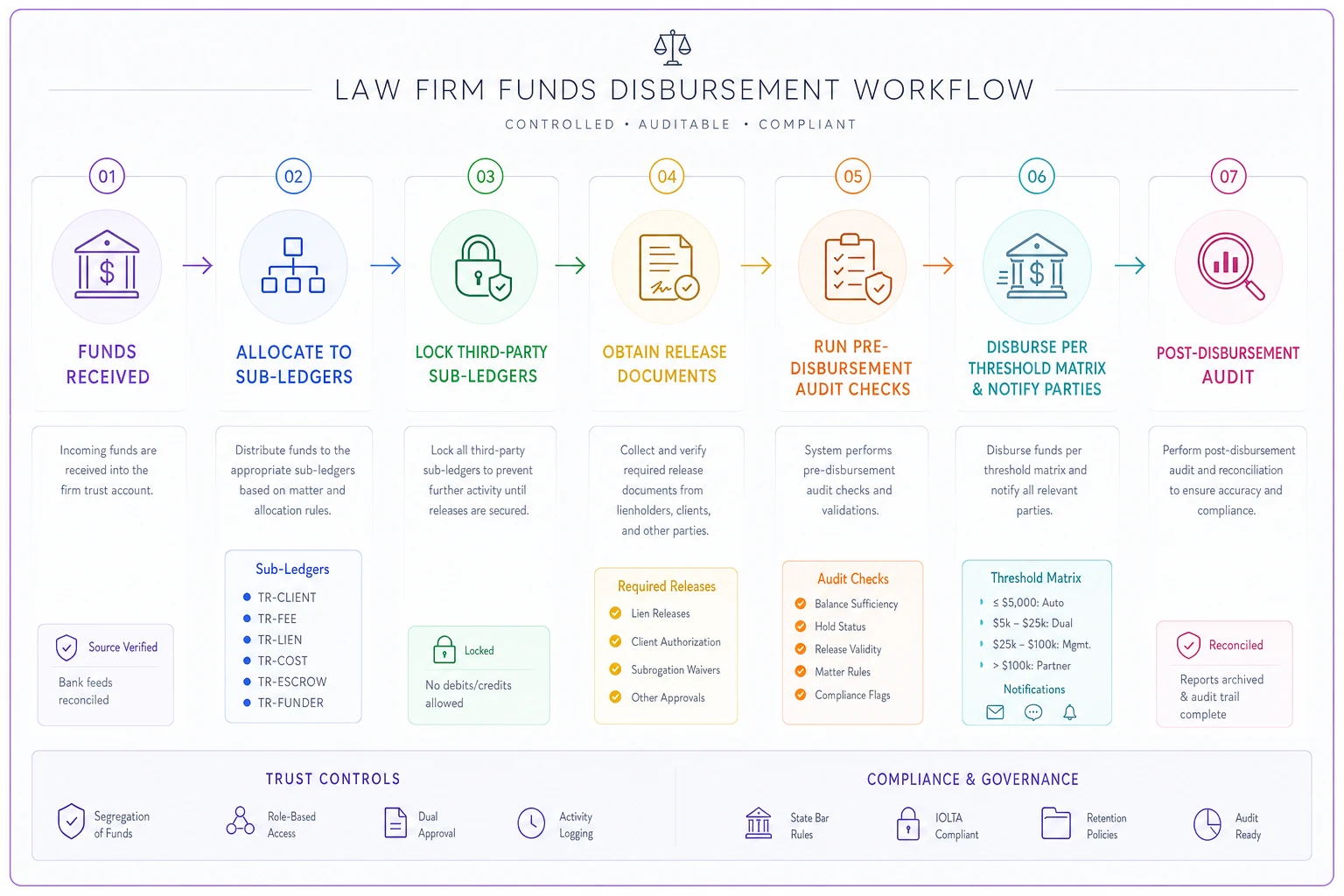
Allocation happens first, disbursement happens last, and nothing moves from a client sub-ledger until every locked sub-ledger above it is cleared.
Where practice-management tooling actually helps
You can run all of this in a disciplined set of spreadsheets, and plenty of small firms do. But sub-ledger mapping, threshold logic, and notification trails are exactly the kind of repetitive, rule-based work where an AI-assisted practice management platform earns its place — allocating incoming funds across predefined sub-ledgers at the funding event, locking third-party balances until a release document is attached, flagging a disbursement that would clear client proceeds before a senior claim is resolved, and generating event-tied notice drafts so they're consistent every time.
The point isn't to automate judgment. A partner still approves the disbursement and a human still reviews the lien resolution. What the automation handles is the checks — the senior-claim-first rule, the document-match, the sum verification across sub-ledgers — so a mis-allocation surfaces before the money moves instead of surfacing eighteen months later in a dispute. When the ledger structure and the approval rules are both encoded, the audit scripts above mostly run themselves.
The one thing to get right
Stop treating a hybrid-funding matter as a single trust balance. The moment third-party money enters a matter, split it into earmarked sub-ledgers, lock the ones that aren't yours to release, and refuse to disburse client proceeds until every senior claim is paid or released. The approval thresholds, the notification templates, and the audit scripts all hang off that one structural decision.
Reconciliation tells you the money is there. Sub-ledger mapping tells you whose it is. On escrow and hybrid matters, the second question is the one that actually gets firms in trouble — and it's the one a standard trust SOP quietly leaves unanswered. Getting that structure right before a settlement funds, not after, is the difference between a clean disbursement and a clawback conversation nobody wants to have.
Reconciliation tells you the money is there. Sub-ledger mapping tells you whose it is. On escrow and hybrid matters, the second question is the one that actually gets firms in trouble — and it's the one a standard trust SOP quietly leaves unanswered. Getting that structure right before a settlement funds, not after, is the difference between a clean disbursement and a clawback conversation nobody wants to have.
Ready to elevate your legal practice management?
Join 500+ law firms using Casioly to optimize case workflows, reduce administrative burden, and improve client satisfaction.