

The ugly truth about closed matters is that they only get interesting again at the worst possible moment. A matter you closed four years ago gets pulled into a dispute, opposing counsel sends a preservation demand, and suddenly you need every email, draft, engagement letter, and disbursement record from a file nobody has touched since the last partner who worked it walked out the door.
That's when archive indexing stops being a filing-cabinet problem and becomes a defensibility problem. If you can't produce a clean chain of what you preserved, when, and why — or worse, if your "archive" is a shared drive folder named SmithFINALv3USETHIS_ONE — you're not just slow. You're exposed.
This post is about the one narrow thing most firms get wrong: the handoff between closing a matter and making it findable under e-discovery pressure. Not general records management. Not retention policy philosophy. The actual indexing, metadata, trigger, and recall mechanics that decide whether a closed matter surfaces in minutes or stays buried for weeks.
Where closed matters actually go wrong
The failure almost never happens at close. It happens six months later.
At close, people are motivated. The post-matter review gets done, the ledger gets reconciled, the retention date gets set. Then the matter goes quiet and the data starts drifting. Someone archives the DMS but forgets the email was stored separately. The accounting export lives in the finance system under a different matter number. A paralegal saved the client's native Excel files to a personal OneDrive during the engagement and never moved them.
So when the recall request comes, the "archive" isn't one thing. It's four or five disconnected buckets, each indexed differently, each owned by someone who may no longer be at the firm.
A typical example: a mid-size litigation boutique gets a subpoena referencing a matter closed in 2021. The matter number in the DMS is 2021-0847. The billing system shows it as LIT-847-21. The shared drive folder is Henderson Dispute. Email was journaled into a separate archive that only indexes by custodian, not matter. Nobody documented that the client-provided evidence lived on an external drive in the war room. Reassembling the full picture took an associate about 30 hours they couldn't bill to anyone — and they still weren't confident it was complete.
The root cause isn't laziness. It's that nothing enforced a single index at the moment of archiving. The close checklist cared about reconciliation and retention. It didn't care whether the archived matter could be found as one unit later.
The index is the product, not the files
When you archive a matter for e-discovery readiness, the valuable deliverable isn't the preserved files. It's the index that points to all of them.
Never miss a critical deadline again.
Casioly helps legal teams manage cases efficiently and stay on top of critical tasks.
- Centralized case tracking
- Automated deadline reminders
- Secure client communication
No credit card required
-
What matter is this, under every ID it's ever carried?
-
Where does every data type physically live now?
-
Who were the custodians?
-
What's the retention and destruction status?
-
Is there an active hold overriding destruction?
-
When was the last time this index was verified against reality?
If that record exists and is accurate, recall is a lookup. If it doesn't, recall is an archaeology project.
This connects directly to how you classify and retain matters in the first place. If your underlying data-governance matrix for classification and retention is solid, the archive index becomes a thin layer on top. If it isn't, the index inherits every inconsistency in your data.
A metadata template that survives recall
Most firms already capture metadata. The problem is they capture it for management — who's working it, what stage, what budget — not for retrieval under legal pressure. Those are different field sets.
For archive indexing specifically, here's the minimum template that actually holds up when someone needs to find and produce a closed matter fast:
| Field | Purpose | Example |
|---|---|---|
| Canonical matter ID | The one true ID, mapped to all aliases | 2021-0847 |
| Alias IDs | Every other ID this matter wore | LIT-847-21, Henderson Dispute |
| Client ID | Links to conflicts and related matters | CLI-00231 |
| Practice area / matter type | Scopes likely data types | Commercial litigation |
| Custodian list | People whose data may be relevant | 3 named individuals |
| Data location map | Physical/logical location per data type | DMS, email archive, finance export, external drive |
| Date range | Opened / closed dates | 2019-03 to 2021-11 |
| Retention class | Destruction schedule category | 7-year post-close |
| Scheduled destruction date | When it may be purged | 2028-11 |
| Hold status | Active / none, with hold ID | None |
| Last verification date | When index was last checked against reality | 2024-06 |
| Index owner | Who is accountable now | Records manager |
The two fields people skip — and then regret — are alias IDs and the data location map. Alias IDs let a search for any historical name resolve to the right matter. The data location map prevents the "we found four of the five buckets" nightmare. If a data type exists but isn't in the map, it effectively doesn't exist when you're under a deadline.
Require a non-null entry in the data location map for every expected data type for that matter type.
One pattern worth stealing: require a non-null entry in the data location map for every expected data type for that matter type. If a commercial litigation matter has no email location listed, that's not "there was no email." That's a gap to investigate before you archive — because the absence is suspicious, not reassuring.
Preservation triggers: the part that creates liability
Indexing a closed matter means nothing if it gets quietly destroyed on schedule while a hold should have stopped it. The whole defensibility story collapses exactly where retention and holds collide.
-
No scheduled destruction may execute without a live hold check. The destruction date is a candidate for deletion, never an automatic deletion. Every candidate must pass a hold-status verification before anything is purged.
-
A new hold freezes destruction across all aliases and data locations. If the hold references any alias ID, it must propagate to the canonical matter and lock every location in the data map — not just the DMS.
-
Related-matter contagion. When a hold lands on one matter, check the client ID for related matters. Disputes rarely stay in one file.
-
Hold release requires a documented decision, not a timeout. Holds should not silently expire. Someone with authority releases them, and that release is logged.
-
Every trigger event is timestamped and attributed. Who triggered, when, on what authority. This log is your defensibility narrative later.
The most common mistake here is treating holds as a flag on a single system. A hold is only as strong as its weakest unprotected data location. If email archive deletion runs independently of the DMS hold flag, you have a hold that doesn't actually hold.
If you've already built out your preservation-notice and custodian process at intake, the archive-side triggers should mirror it exactly. There's a direct line from your e-discovery intake process for custodian lists and preservation notices to how you freeze those same custodians' data years later in the archive. The custodian list you built at intake is the custodian list you preserve against at recall — if the index carried it forward.
Rapid-recall: the procedure you should be able to run under deadline
Recall is where everything you did earlier either pays off or doesn't. The test is simple: someone drops a matter reference on your desk Monday morning with a Wednesday production deadline. What happens?
A workable recall procedure, assuming the index above exists:
Step 1 — Resolve the identity. Take whatever reference you were given — old name, billing code, client name — and resolve it to the canonical matter ID through the alias field. If it doesn't resolve cleanly, that's your first red flag and your first hour of work.
Step 2 — Pull the data location map. Now you know exactly which systems to touch. No guessing. No "ask whoever worked it."
Step 3 — Freeze before you touch. Apply or confirm a hold across every location in the map before collecting anything. Collection without a confirmed hold risks spoliation during the recall itself.
Step 4 — Verify the map against reality. This is the step firms skip and shouldn't. Confirm each listed location still actually contains what the index claims. Migrations, decommissioned systems, and departed custodians all break location maps silently.
Step 5 — Log the recall. Timestamp, who requested, what was resolved, what was frozen, what gaps were found. If this ends up in front of a court, this log is the difference between "defensible process" and "they winged it."
Visual workflow of the recall procedure:
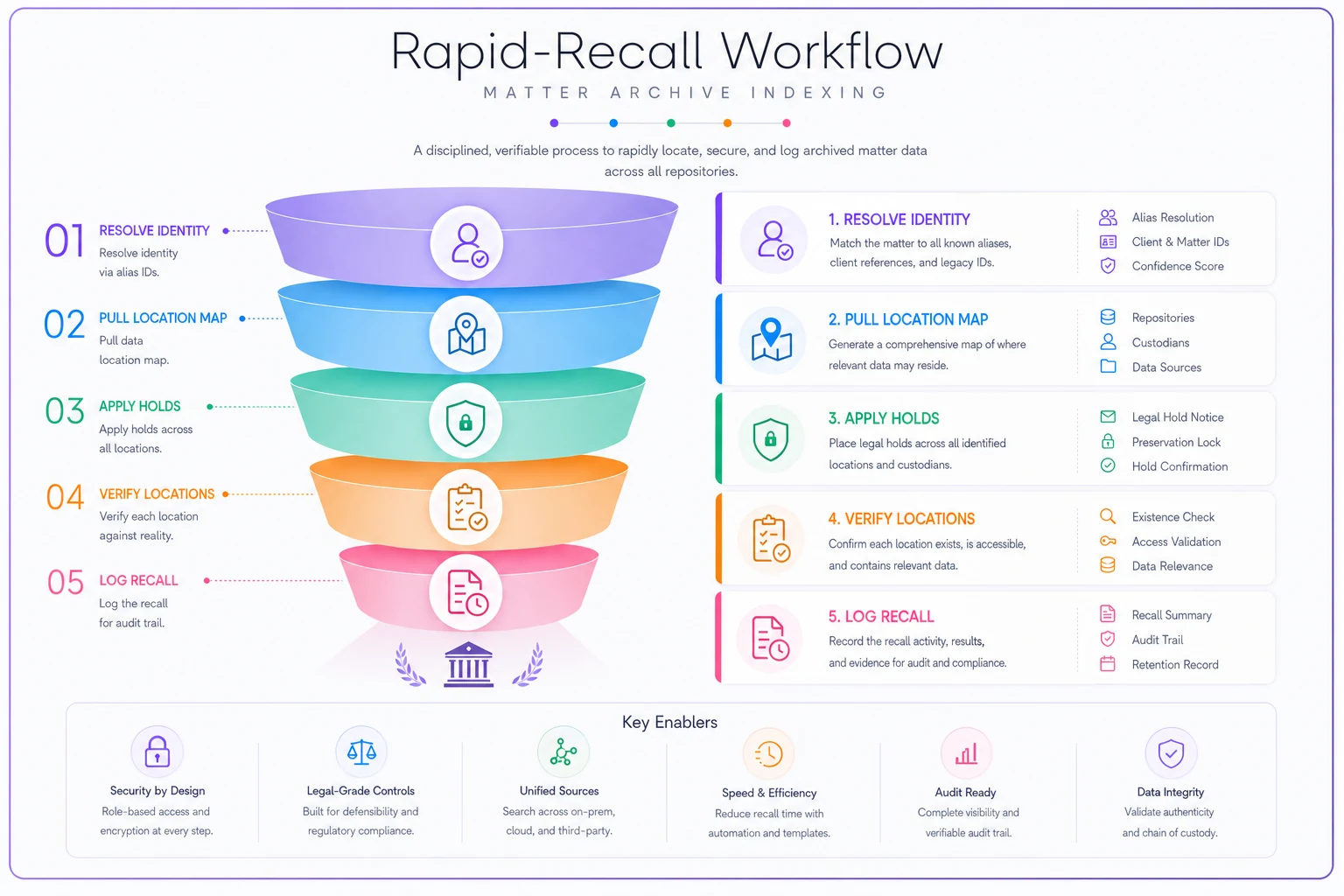
The quiet value of this procedure is in Step 4. A location map that was accurate when archived in 2021 may be wrong in 2025 because a system got replaced. The last-verification-date field exists precisely so you know how much to trust the map before you bet a deadline on it.
When heavy indexing is worth it — and when it isn't
Not every matter deserves the full treatment, and pretending otherwise makes the index so expensive nobody maintains it.
When full archive indexing makes sense:
-
Litigation and dispute matters, where future recall probability is genuinely high
-
Matters for clients in regulated industries who get audited or subpoenaed regularly
-
Any matter involving third-party data or large custodian lists
-
High-value engagements where a defensibility failure would be catastrophic
When lighter indexing is fine:
-
Routine transactional matters with low recall probability and short retention
-
Small, single-custodian matters where the whole file genuinely lives in one system
-
Flat-fee, high-volume work where the indexing cost per matter exceeds the realistic recall risk
Who should not build an elaborate index: a two-person firm doing mostly transactional work with everything in one practice management system doesn't need a separate alias table and multi-location map. For them, the index already exists — it's the DMS. Adding a parallel system creates drift, not safety. The index only earns its keep when matter data is genuinely scattered across multiple systems.
A decision rule that tends to work: tier your indexing by recall probability, not by matter value. A modest matter in a litigious area may be far more likely to come back than a large transactional one. Index for the probability of recall, not the size of the bill.
A real scenario
A roughly 40-attorney firm with a strong commercial litigation practice kept hitting the same wall: closed-matter recall was taking anywhere from two to five weeks and burning associate time nobody could bill. The data was always there — it just lived across the DMS, a separate journaled email archive, the accounting system, and periodically on external media from active-matter war rooms.
They didn't buy new software first. They built the index template, retroactively applied it to every matter closed in the prior three years (around 600 matters), and the exercise itself surfaced the real problem: roughly one in six matters had at least one data location that no longer matched reality — a migrated system, a decommissioned drive, an archived mailbox that had been partially purged.
After the cleanup, they ran their next three recall requests against the new index. Resolution time dropped from weeks to under a day for two of them. The third still took about three days — because it was an older matter whose location map hadn't been verified since archiving. That's exactly the case the verification-date field is designed to flag. The lesson wasn't "the index is magic." It was that an unverified index is a liability dressed up as an asset.
Making the index self-maintaining
The reason archive indexes decay is that maintaining them is nobody's daily job. They're accurate the day a matter is archived and wrong the day a system gets replaced, and no one's watching the gap.
This is where the right operational tooling earns its spot. A workflow-and-matter-management platform with sensible automation can carry the index forward rather than letting it rot:
-
Alias capture at close, so every ID the matter ever carried is pulled into the index automatically instead of reconstructed later
-
Destruction-candidate holds, where the scheduled destruction date generates a review task with a mandatory hold check rather than firing a deletion
-
Hold propagation, so applying a hold on any alias locks every mapped location at once instead of relying on someone to remember the email archive
-
Periodic verification prompts, nudging the index owner to re-confirm location maps for high-recall matters on a cadence, so the last-verification-date never silently ages out
None of this replaces judgment. A person still decides what to preserve, what to produce, and when to release a hold. But the mechanical parts — propagating a hold across every data location, flagging a stale location map before someone bets a deadline on it, keeping aliases linked — are exactly the kind of error-prone manual coordination that quietly fails at the worst moment. Getting those pieces out of people's heads and into an automated workflow means the index stays trustworthy without depending on anyone's memory.
The bottom line for defensibility
Making closed matters defensibly searchable comes down to three disciplines that have to exist together: an index built for retrieval rather than management, preservation triggers that no destruction schedule can bypass, and a recall procedure you've actually rehearsed.
Miss any one and the other two won't save you.
The firms that handle matter archive indexing for e-discovery well aren't the ones with the most storage or the fanciest tools. They're the ones who treated the index as the real deliverable, kept it honest with periodic verification, and made sure a hold means a hold across every place the data lives. Do that, and the four-year-old matter that lands on your desk Monday morning is a lookup — not a crisis.
Making closed matters defensibly searchable comes down to three disciplines that have to exist together: an index built for retrieval rather than management, preservation triggers that no destruction schedule can bypass, and a recall procedure you've actually rehearsed.
The firms that handle matter archive indexing for e-discovery well aren't the ones with the most storage or the fanciest tools. They're the ones who treated the index as the real deliverable, kept it honest with periodic verification, and made sure a hold means a hold across every place the data lives. Do that, and the four-year-old matter that lands on your desk Monday morning is a lookup — not a crisis.
Ready to elevate your legal practice management?
Join 500+ law firms using Casioly to optimize case workflows, reduce administrative burden, and improve client satisfaction.