


Most law firms don't have an org design problem on paper. They have one in practice. The chart says who reports to whom, but nobody can tell you who owns realization on a stalled matter, or who's accountable when a matter budget blows past its cap by 40%. Titles exist. Ownership doesn't.
That gap between "who has authority" and "who actually moves the matter forward" is where legal operations org design either works or quietly falls apart. And it gets worse as you grow — at 6 lawyers you can hold the whole operation in your head, but at 30 you absolutely cannot.
This is a system-level article. Not a list of legal-ops job titles. The goal is to show how firm structure, RACI, hiring sequence, and role-level KPIs connect — and where each of those breaks when the firm scales past the point where informal coordination stops working.
The Real Problem: Structure Built Around People, Not Outcomes
Here's the pattern you see across firms that grew organically. The org chart is a snapshot of hiring history, not a design. Someone was good at billing, so they "own" billing. A senior associate is naturally organized, so matters flow through them informally. The office manager somehow became the de facto conflicts checker.
None of that is written down. It works until one of those people leaves, gets overloaded, or the firm doubles headcount. Then you discover that half your operational continuity lived inside three people's habits.
The deeper issue is that most firm structures are organized around functions (billing, IT, admin, paralegals) instead of matter outcomes (realization, cycle time, budget adherence, deadline integrity). Functions describe what people do all day. Outcomes describe what the firm actually needs to be true for a matter to be profitable and clean.
When you organize purely by function, nobody owns the outcome. Billing owns invoices. Partners own client relationships. Paralegals own tasks. But realization — the number that decides whether the firm makes money — falls between all of them. Everyone touches it. No one is accountable for it.
That's the thing to fix. Not the boxes on the chart. The ownership underneath them.
What Breaks at Each Stage of Growth
Org design isn't one decision. It's a sequence of decisions triggered by size. The structure that's correct at 8 lawyers is actively harmful at 25, and building a heavy ops layer too early just burns cash.
Never miss a critical deadline again.
Casioly helps legal teams manage cases efficiently and stay on top of critical tasks.
- Centralized case tracking
- Automated deadline reminders
- Secure client communication
No credit card required
| Firm size | What usually breaks first | What the structure needs |
|---|---|---|
| 5–10 lawyers | No single owner for intake, conflicts, or billing consistency | One part-time ops coordinator; partners still own outcomes directly |
| 10–20 lawyers | Matters stall between stages; nobody owns handoffs | Dedicated legal-ops lead; documented RACI by matter stage |
| 20–35 lawyers | Realization and budget variance become invisible until quarter-end | Ops manager + billing/finance analyst; role-level KPIs |
| 35+ lawyers | Coordination across practice groups collapses; duplicate systems | Legal-ops function with sub-owners for finance, tech, and process |
The mistake firms make is jumping to the wrong row. A 12-lawyer firm doesn't need a "Director of Legal Operations" with a six-figure salary. It needs one person who owns the handoffs between intake, staffing, and billing — and the authority to actually enforce them.
A 30-lawyer firm running on a single overloaded office manager, on the other hand, is sitting on a pile of hidden losses. Matters slip a week here, a budget overrun there. Individually small. In aggregate, it's often the difference between a healthy year and a mediocre one.
RACI That's Actually Tied to Matter Outcomes
Most RACI charts in law firms are useless because they're mapped to tasks, not outcomes. "Draft complaint — R: associate, A: partner." Fine. But that tells you nothing about who's accountable when the matter's cycle time doubles or the budget breaks.
The fix is to build RACI around matter-stage outcomes, not activities. Here's a simplified version for the core stages of a matter:
| Outcome | Responsible | Accountable | Consulted | Informed |
|---|---|---|---|---|
| Intake accuracy & conflict clearance | Intake coordinator | Legal-ops lead | Responsible partner | Billing |
| Matter budget set & baselined | Legal-ops lead | Responsible partner | Finance analyst | Associate team |
| Staffing matched to matter scope | Ops manager | Responsible partner | Practice group lead | Paralegals |
| Stage-to-stage handoff completeness | Legal-ops lead | Ops manager | Assigned associate | Partner |
| Realization on matter | Billing analyst | Responsible partner | Legal-ops lead | Finance |
| Clean matter closeout | Paralegal | Legal-ops lead | Billing | Partner |
Notice two things. First, Accountable almost always lands on either the responsible partner or a single ops role — never a committee, never "the team." If two people are accountable, no one is. Second, the legal-ops lead shows up repeatedly as the connective tissue: responsible for handoffs, accountable for closeout, consulted on realization. That's intentional. Someone has to own the seams between stages, and it can't be the partner who's buried in billable work.
For a deeper breakdown on stage-based RACI and change control, the Legal Project Management Playbook covers how to structure acceptance criteria and milestone ownership at each stage — it pairs directly with the outcome-mapping above.
One common failure worth calling out: firms build a solid RACI, circulate it once, and never reference it again. RACI only works if it's attached to something people actually use — the matter opening checklist, the staffing decision, the closeout process. If it lives in a shared drive nobody opens, it's decoration.
A 12–24 Month Hiring Roadmap (Sequenced, Not a Wishlist)
The hardest part of legal-ops hiring isn't deciding who to hire. It's the order. Hire the analyst before you have a process owner and you get clean reports on a broken workflow. Hire the director before you have volume and you've got an expensive person with nothing to run.
-
Months 0–3
Legal-ops lead (or promote internally).
This is the first real hire. One person who owns handoffs, intake quality, and matter-stage discipline. Often this is a strong senior paralegal or practice manager elevated with actual authority. Salary range varies, but you're usually looking at the mid five figures for a promoted internal versus more for an external hire with real ops experience. -
Months 3–6
Billing / finance analyst.
Once someone owns process, you need someone who owns the numbers — realization, WIP aging, budget variance. This role pays for itself faster than almost any other legal-ops hire. Catching even a few points of realization leakage across the firm typically covers the cost. -
Months 6–12
Intake / conflicts coordinator.
As matter volume climbs, intake quality degrades if it's still bolted onto whoever's free. A dedicated coordinator stabilizes the front door — and a bad front door poisons everything downstream. -
Months 12–18
Ops / project manager.
Now that the seams are owned and the numbers are visible, you add capacity to manage staffing allocation and cross-matter coordination. This person works closely with partners on matching people to matters. Overloading teams is one of the most expensive quiet failures in firms — it's worth reading through the matter-level staffing templates and utilization forecasts approach before you define this role, since utilization ownership is really the core of the job. -
Months 18–24
Legal-ops manager/director layer (only if volume justifies it).
By now you might have 3–4 ops staff. If so, they need a single manager. If you don't have that headcount yet, skip this tier — a director managing one analyst is a title, not a function.
Hire against the slip, not against the aspiration.
The signal that you're ready for the next hire is almost always the same: an outcome nobody currently owns starts slipping visibly. Realization drifts. Handoffs stall. Intake errors climb.
Role-Level KPIs That Aren't Just Staffing Numbers
Most firms measure ops people on activity — matters processed, invoices sent, hours logged. Activity metrics tell you someone is busy. They don't tell you the firm is healthier.
The better approach ties each role's KPIs to the matter-stage outcomes they're accountable for in the RACI. If someone's accountable for realization, measure realization. If they own handoffs, measure handoff completeness and cycle time.
-
- Legal-ops lead - Stage-to-stage handoff completeness (% of matters with clean handoffs, no rework) - Matter cycle time variance vs. baseline - % of matters opened with complete intake data
-
- Billing / finance analyst - Realization rate (firm-wide and by practice group) - WIP aging — % of WIP over 90 days - Budget variance — % of matters within their stage-tied budget
-
- Intake coordinator - Conflict-check turnaround time - Intake data completeness at matter open - Rework rate caused by intake errors
-
- Ops / project manager - Utilization spread across the team (are a few people at 130% while others sit at 60%?) - % of matters staffed to scope vs. over/under-staffed - Escalations resolved within SLA
-
- Responsible partners (yes, they get ops KPIs too) - Realization on their matters - Budget adherence - Timely approvals (how long matters wait on a partner sign-off)
That last one matters more than firms admit. A significant amount of matter delay isn't associate slowness — it's matters sitting in a partner's inbox waiting for approval. If you don't measure partner responsiveness, you'll blame the wrong people for slow cycle times.
One caution on KPIs: pick three per role, not ten. A dashboard with fifteen metrics per person becomes wallpaper. Nobody acts on it. Choose the two or three that actually predict matter health, and let the rest be diagnostic — pulled only when something looks off.
A Real Scenario: The 14-Lawyer Firm With Invisible Leakage
Consider a mid-sized litigation and transactional firm — around 14 lawyers, one office manager doing everything from conflicts to billing follow-up. On paper, profitable. In practice, quarter-end was always a scramble, and realization hovered somewhere in the low 80s without anyone knowing exactly why.
The problem wasn't lazy people. It was that no single person owned realization or handoffs. Matters moved from intake to active work with half the budget data missing. Invoices went out late because billing was reactive. WIP aged quietly. Two associates were routinely maxed out while a third had slack — but nobody was measuring utilization spread, so it never surfaced.
The firm made two moves over about nine months. First, they promoted their strongest paralegal into a legal-ops lead role with real authority over intake and handoffs. Second, they brought in a part-time billing analyst focused solely on realization and WIP aging.
Within roughly two quarters, realization moved up several points — not dramatic on any single matter, but meaningful across the whole book. WIP over 90 days dropped noticeably because someone was finally watching it weekly instead of at quarter-end. The quarter-end scramble mostly disappeared because the numbers were visible continuously.
No new software, no reorg chaos, no consultants. Two roles with clear outcome ownership and three KPIs each. The structure did the work.
When This Level of Structure Makes Sense — and When It Doesn't
When it makes sense: You're past 10–12 lawyers, matters are slipping between stages, realization is drifting and you can't explain why, or the whole operation depends on a couple of overloaded people. Those are the signals that informal coordination has hit its ceiling.
When it's premature: You're a 5-person firm. Building a formal RACI and hiring a legal-ops lead at that size adds process overhead for coordination problems you don't actually have yet. At that scale, the partners are the ops function, and that's fine.
Who should not do this: Firms that want the org chart without the accountability. If leadership won't give the legal-ops lead real authority to enforce handoffs and intake standards — if every decision still routes back to a partner who overrides it — then all you've built is an expensive coordinator with no power. That's worse than no structure, because you've got the cost without the benefit.
How the Pieces Connect
The reason to treat this as a system rather than a hiring checklist is that each piece only works because of the others.
The org chart defines who exists. The RACI defines what each role owns at the outcome level. The hiring roadmap sequences those roles so you build ownership before you layer reporting on top of it. And the KPIs close the loop — they measure whether the person accountable for an outcome is actually delivering it.
Below is a simple workflow visual.
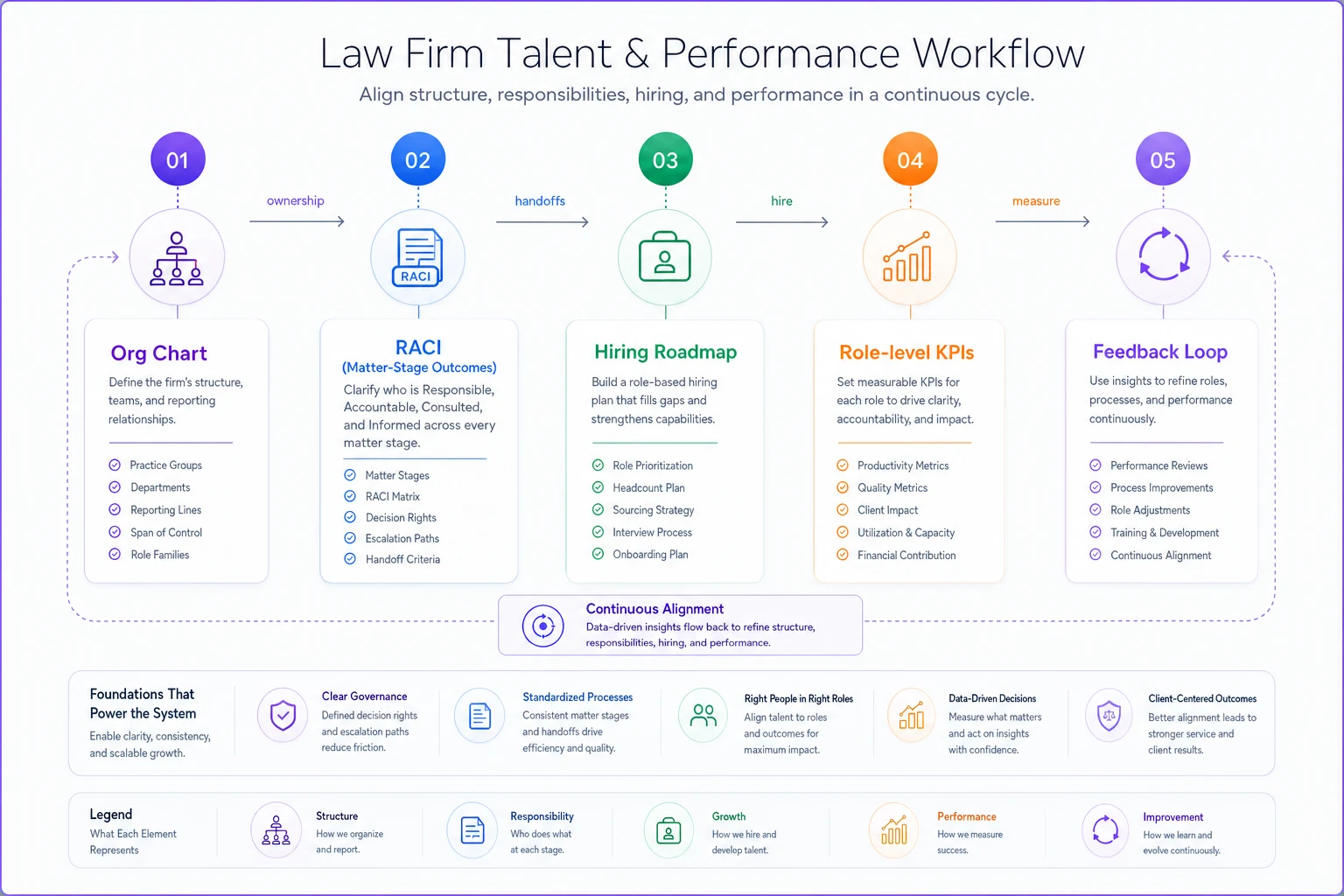
Break any one link and the others degrade. A great RACI with the wrong hiring sequence means you've assigned accountability to roles that don't exist yet. Good KPIs on a functional org means you're measuring activity, not outcomes. A clean org chart with no RACI means the boxes exist but ownership doesn't.
Start with the two or three outcomes that most affect your firm's health right now — usually realization, cycle time, and intake quality — assign a single accountable owner to each, give them authority and a few real KPIs, and build the rest of the structure around those seams. Everything else in the org chart gets easier once ownership is settled.
Ready to elevate your legal practice management?
Join 500+ law firms using Casioly to optimize case workflows, reduce administrative burden, and improve client satisfaction.