


Most firms think they have an ethical wall because someone sent an email saying "please don't discuss the Henderson matter with anyone on the litigation side." That's not a wall. That's a hope.
The problem shows up later, usually at the worst possible time. A lateral partner joins, brings a conflict, and six weeks into the screen someone discovers the paralegal who got reassigned still had document-management access to the walled matter the whole time. Now you're not explaining a policy. You're explaining a breach — and the question isn't "did we have a wall," it's "can you prove it held every single day."
That second question is the one most firms can't answer. They have the policy memo. They don't have the evidence. This piece is about closing that gap — the technical controls, the monitoring checks, the attestation cadence, and the actual audit queries you run to prove wall integrity on a specific matter.
Where walls quietly fail
The failure almost never happens at setup. At setup everyone is paying attention. The conflict gets flagged, the memo goes out, access gets restricted, and everyone feels good. The failure happens in the weeks and months after, through drift.
What drift actually looks like in a real document system:
-
A new associate is added to a practice group security group. That group has inherited access to a folder tree that includes the walled matter. Nobody noticed because the access came through group membership, not a direct grant.
-
A partner on the walled side needs "just one document" and gets a temporary exception that never gets revoked.
-
The matter gets re-coded during a billing cleanup and loses its restricted-matter flag.
-
A document gets saved to the wrong matter workspace, carrying its permissions with it, and suddenly a privileged file is sitting somewhere the screened team can reach.
The common thread is permission inheritance. Walls built on folder-level or matter-level explicit deny rules are strong. Walls that rely on the absence of a grant are fragile, because inheritance keeps handing out access through the side door. If you've dealt with access creep before, this is the same disease described in the matter-linked governance and permissions playbook — it just carries far higher stakes when the matter is screened.
The two-layer control model
A defensible wall needs two independent layers. If you only have one, a single misconfiguration takes the whole thing down.
Never miss a critical deadline again.
Casioly helps legal teams manage cases efficiently and stay on top of critical tasks.
- Centralized case tracking
- Automated deadline reminders
- Secure client communication
No credit card required
Layer one is the explicit deny. Screened individuals get a direct, named deny on the matter — not merely "they aren't on the access list." Explicit deny should override inheritance in your document system. This matters because it survives group-membership changes. If an associate gets added to a practice group tomorrow, the explicit deny still blocks them.
Layer two is the document-level exception handler. Even with a solid matter-level deny, documents move. Someone emails an attachment, files it to the wrong matter, or a document migrates during a system sync. Layer two tags documents originating from a walled matter so they carry their restriction regardless of where they land. The restriction travels with a document metadata flag, not just the folder it sits in.
| Control approach | What it protects against | Where it breaks |
|---|---|---|
| Access-list only (no deny) | Casual, accidental access | Group inheritance silently re-grants access |
| Matter-level explicit deny | Group changes, reassignments | Documents copied/moved out of the matter |
| Document-level restriction flag | Misfiled or exported documents | Requires disciplined tagging at creation |
| Deny + document flag (both) | Nearly all common drift paths | Only if monitoring confirms both stay intact |
The firms that get burned almost always ran on row one or, at best, row two alone. The combination in the bottom row is what holds up under scrutiny.
Setting the wall up: the sequence that matters
The order you do this in determines whether the wall is clean from day one or has a gap baked in from the start. Below is the setup workflow that actually produces a defensible record.
-
Freeze the matter before you screen it. The moment a conflict is identified, put a temporary full-restriction on the matter so no new access is granted while you sort out who stays and who goes. A wall built while people are still actively touching the matter inherits whatever mess already exists.
-
Pull the current access report. Get the full list of everyone who can reach the matter today — direct grants, group inheritance, and administrative overrides. You cannot screen people you don't know have access.
-
Build the screened-persons list and apply explicit denies. Named individuals, not roles. Roles change; the deny needs to attach to the person.
-
Apply document-level restriction flags to all existing matter documents. Retroactively tag what's already there, not just future files.
-
Remove the temporary freeze for the clean team only. The people who should have access get restored; everyone else stays denied.
-
Capture a baseline snapshot. Export the exact access state on day one. This is your "known good" that every later audit compares against. Without a baseline you can detect that something is wrong but you can't prove when it went wrong.
Step six is the one people skip, and it's the one that saves you. If a question comes up eight months later, the baseline snapshot plus the monitoring log tells the complete story. Without it, you're reconstructing from memory.
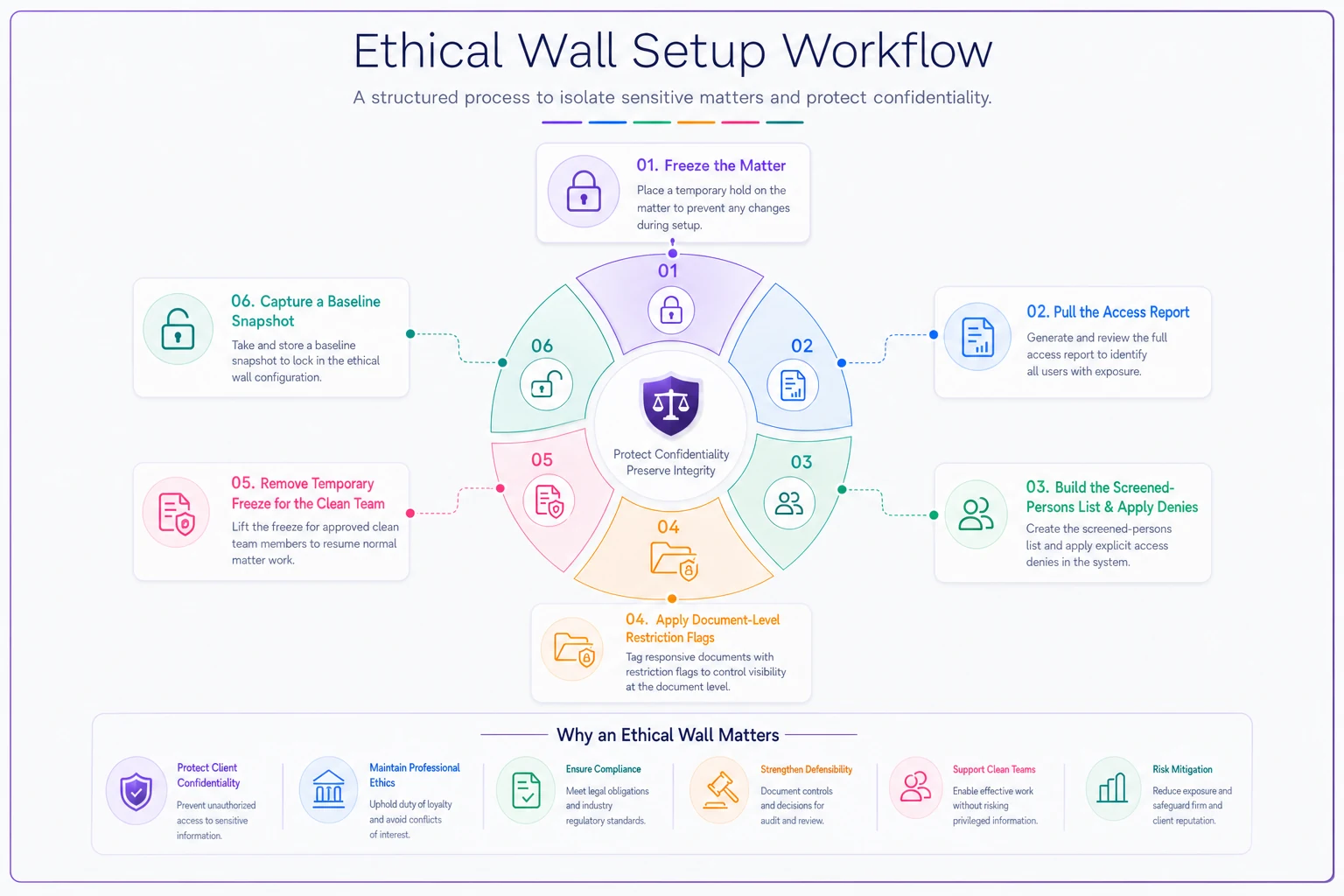
This visual shows the sequence and the critical point to capture a day-one baseline snapshot.
The monitoring checks that catch drift early
A wall is only as good as the checks confirming it's still standing. These need to run on a schedule, not on an "I'll check when I remember" basis.
Prioritize daily access-delta checks for high-risk matters.
Daily automated check — access delta. Compare current access on the walled matter against the baseline snapshot. Any new principal who can reach the matter gets flagged immediately. A one-day exposure is a problem; a ninety-day exposure is a catastrophe.
Weekly check — group inheritance scan. Walk every security group that intersects the matter's folder tree and confirm no screened individual has been added to a group that inherits access. This is the single most common drift path, so it deserves its own dedicated scan.
Weekly check — document location audit. Query for any document carrying the walled-matter restriction flag that now lives outside the matter workspace. A hit here means a document escaped, and you need to know where it went.
Monthly check — exception expiry. Every temporary access exception should have an expiry date. Pull all exceptions tied to the matter and flag any that are past due or missing an expiry entirely. Exceptions without expiry dates are how "temporary" access becomes permanent.
One thing most firms miss: monitoring isn't about catching a dramatic breach. It's about catching the boring, administrative drift that becomes a breach if left alone. The paralegal reassignment, the group-membership change, the stale exception — none of these feel like violations when they happen. They only look like violations in hindsight.
Audit queries to prove integrity
When someone asks you to prove the wall held, you need queries that return evidence, not assurances. Here's the set to have ready. These are written as plain logic you can adapt to your document system's query or reporting tool.
Query 1 — Who could access the matter, and when did that change? Return every principal with any form of access to the matter (direct, inherited, override), the grant type, the grant date, and the current status. Compare against baseline. The output you want is a timeline showing that screened individuals had explicit deny for the entire screen period.
Query 2 — Did any screened individual actually touch the matter? This is the critical one. Access logs showing attempted access by a screened person that was blocked are good evidence. Access logs showing successful access by a screened person are the breach. Query the activity log filtered by the screened-persons list against the matter, return every event, and confirm every event is a blocked attempt, not a completed action.
Query 3 — Where do the walled documents live now? Return all documents carrying the matter's restriction flag and their current storage location. Every result should be inside the matter workspace. Anything outside is an escaped document.
Query 4 — What exceptions existed, who approved them, when did they expire? Return every access exception tied to the matter with the requestor, approver, grant timestamp, and expiry timestamp. No open-ended exceptions should appear.
Query 5 — Who changed the wall configuration, and when? Return the full change history on the matter's restriction settings and the screened-persons list. This proves the wall wasn't quietly dismantled and rebuilt to hide a gap.
The pattern across all five: you're building a record where absence of access is affirmatively documented, not just assumed. "No one accessed it" is weak. "Here is the log showing three blocked attempts, zero successful accesses, and no configuration changes" is strong.
Attestation workflows
Technical controls prove the system behaved. Attestations prove the people understood their obligations. You need both, because a regulator or court will ask about human acknowledgment, not just configuration.
Initial attestation — at screen creation. Every screened individual and every clean-team member signs an acknowledgment. Screened people confirm they understand they're walled off and won't seek information about the matter. Clean-team members confirm they understand the matter is screened and won't discuss it with the walled side.
Periodic re-attestation — quarterly for active high-risk matters. The longer a wall stands, the more people forget it exists. A quarterly re-attestation is a cheap re-anchor. It also creates a dated paper trail showing the obligation was live and reinforced throughout the matter's life.
Event-triggered attestation. Any time someone new joins a group that touches the matter, any time a lateral arrives, any time the matter is re-coded — trigger a fresh attestation and a fresh access review. The event-triggered ones are the most valuable because they attach exactly to the moments where drift happens.
A reusable attestation template
-
Matter [Matter ID and generic descriptor — not the sensitive details]
-
Screen effective date [date]
-
My role in this screen ☐ Screened (no access) ☐ Clean team (authorized access)
-
I acknowledge I have been informed this matter is subject to an ethical wall. I will not [access / seek / share — depending on role] information related to this matter outside the authorized team.
-
I have not, to my knowledge, previously accessed information about this matter except as disclosed below: [free text]
-
Signature / date / system timestamp
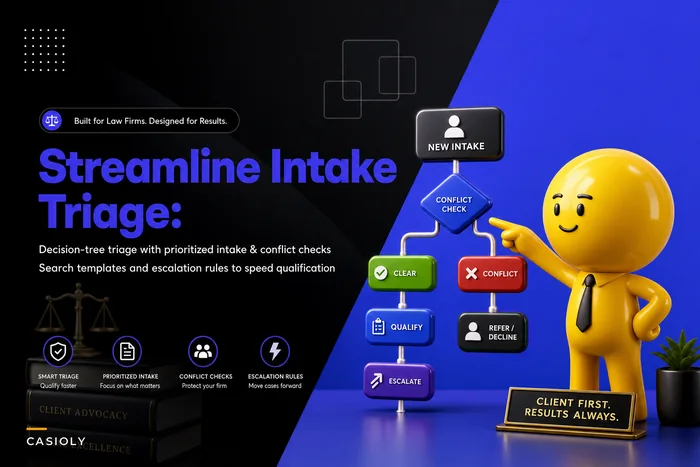
That disclosure line matters more than it looks. It surfaces pre-existing exposure you'd otherwise never learn about — like a lateral who worked an adverse matter at a prior firm. The same discipline that drives a clean conflict check at intake applies here; if your intake process already runs a structured decision-tree conflict check, the wall attestation is the downstream enforcement of what that check flagged.
A real scenario
A roughly 40-attorney litigation-heavy firm brought on a lateral partner from a firm that had represented the opposing party in an active, high-value dispute. The conflict was caught at intake and a wall went up the same week. The policy memo was solid.
What wasn't solid: the lateral was added to the "Partners" security group during HR onboarding, and that group inherited read access to a shared litigation folder containing the walled matter's working documents. The explicit deny had been applied to the lateral individually — but the firm's system let group grants override individual denies in one specific folder type. For about five weeks, the lateral could technically reach several documents.
Nobody accessed them, as it turned out. But the firm couldn't prove that cleanly, because they had no access-delta monitoring and no day-one baseline. Reconstructing the exposure window took a couple of weeks of forensic log review and a very uncomfortable disclosure conversation.
After that they rebuilt the process around the two-layer model, a day-one baseline snapshot, and a daily access-delta check. The next time a lateral-driven conflict came up, the whole proof package — baseline, blocked-attempt logs, zero successful accesses, quarterly attestations — was ready in under an afternoon. The difference wasn't a better policy. It was that the wall now produced its own evidence continuously instead of being reconstructed under pressure.
When this level of rigor makes sense — and when it's overkill
Not every conflict needs the full apparatus. Applying this to every low-stakes screen will exhaust your admin team and train people to treat attestations as noise.
This full SOP makes sense when:
-
The matter involves a current or recent adverse party and a lateral or reassignment
-
Regulatory exposure is high (government investigations, securities, large-dollar disputes)
-
The matter is the kind where a breach would trigger disqualification or a bar inquiry
-
Opposing counsel is the type to probe your screening procedures
This is overkill when:
-
The "conflict" is a mild business-relationship sensitivity with no real adverse-information risk
-
The screen is short-lived and involves only a couple of people who are easy to monitor manually
Who should not try to run this manually: any firm relying on memory and email threads to track who's screened. The volume of small access changes in a modern document system outpaces human attention. If you can't run a scheduled access-delta check, you don't actually have a monitored wall — you have a policy and good intentions, and those two things reconstruct very poorly eighteen months later when someone finally asks for proof.
The point that's easy to miss
A wall's job is not to make access impossible on day one. Almost anyone can do that. A wall's job is to stay intact and provably intact across every group change, reassignment, re-code, and document move that happens over the months it stands. That's an operational discipline, not a one-time configuration.
Build the two layers. Snapshot the baseline. Run the monitoring on a schedule you don't have to remember. Keep the attestations short and dated. Have the five audit queries ready before anyone asks for them — because by the time someone's asking, it's already too late to start building the evidence.
Build the two layers. Snapshot the baseline. Run the monitoring on a schedule you don't have to remember. Keep the attestations short and dated. Have the five audit queries ready before anyone asks for them — because by the time someone's asking, it's already too late to start building the evidence.
Ready to elevate your legal practice management?
Join 500+ law firms using Casioly to optimize case workflows, reduce administrative burden, and improve client satisfaction.