


Most conflict check systems at small and mid-sized law firms are broken. Not because the software doesn't work, but because the intake process feeds it garbage data that makes reliable conflict checking nearly impossible.
Here's what happens: A potential client calls about a contract dispute. The intake person grabs basic contact info, maybe the opposing party's name if they remember to ask, and creates a new matter record. Three weeks later, after initial work has started, someone realizes the opposing party's parent company is an existing client. Now you're dealing with waiver requests, potential malpractice exposure, and a damaged client relationship.
This pattern repeats because most firms treat intake as data entry rather than the critical triage process it actually is. The difference between a clean conflict check and an ethics complaint often comes down to which questions get asked in those first five minutes.
Why Standard Intake Forms Create Conflict Nightmares
The standard intake form most firms use hasn't evolved much since the 1990s. Name, address, phone number, matter type, opposing party. Maybe a notes field where crucial details go to die.
These forms fail because they assume every matter follows the same pattern. A divorce case needs completely different conflict information than a corporate merger. Employment disputes require different searches than real estate transactions. Yet most firms use the same generic form for everything, then wonder why conflicts slip through.
The real breakdown happens between what intake staff know to ask and what the conflict system needs to function properly. Intake staff aren't trained lawyers. They don't instinctively know that a commercial lease dispute might involve guarantors who need conflict checking. They won't think to ask about parent companies, subsidiaries, or beneficial owners unless the process explicitly guides them there.
Many firms also treat conflict checking as a single checkpoint rather than an ongoing process. The initial check might clear, but what happens when the matter scope expands? When new parties get added during discovery? When that small contract review turns into litigation involving multiple defendants?
Building Decision Trees That Actually Work
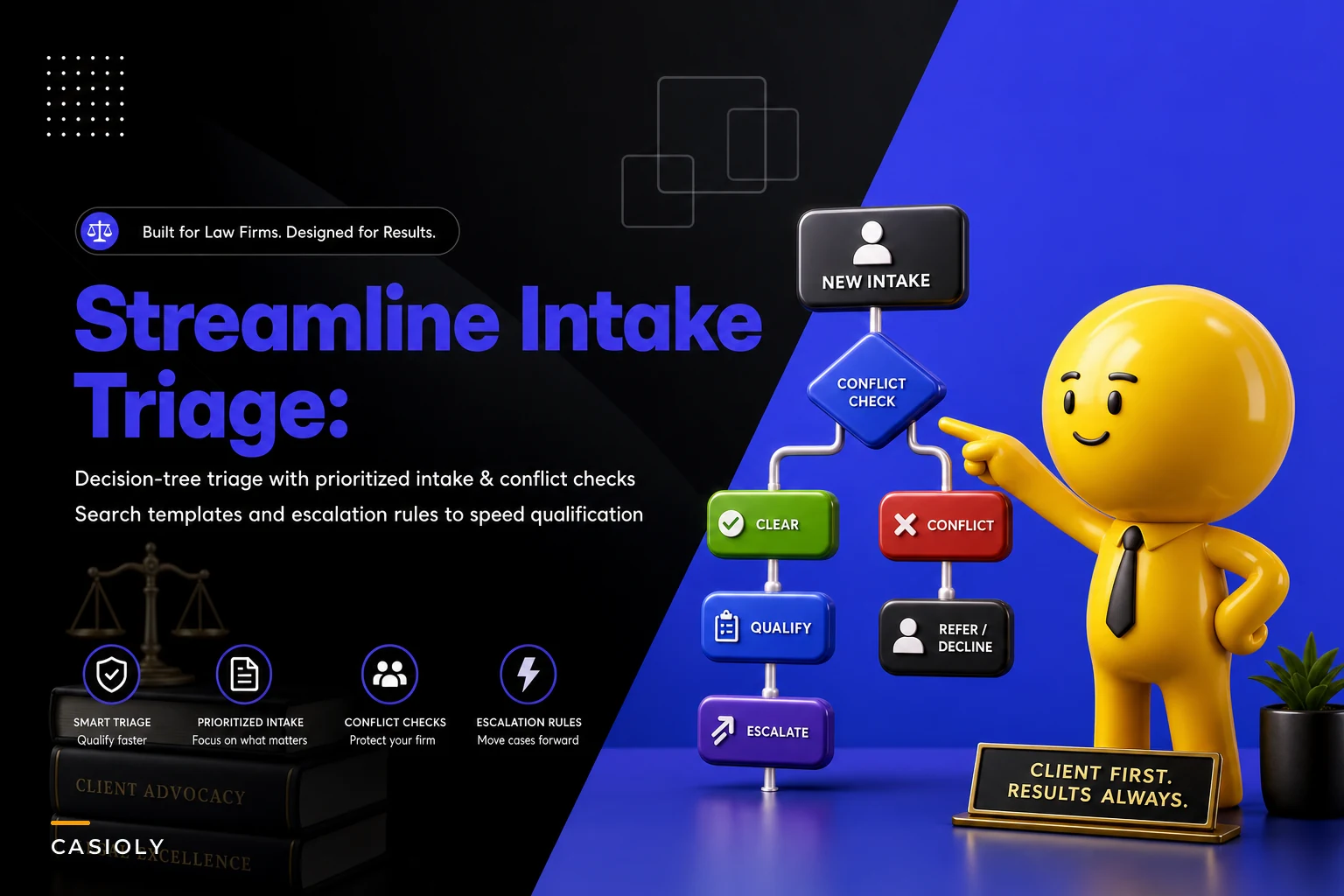
A functional intake triage system starts with decision trees that branch based on matter type, not generic fields that apply to everything. The first question determines the path: litigation, transaction, advisory, or regulatory. Each path then opens specific follow-up questions that capture the exact conflict data that matter type requires.
Never miss a critical deadline again.
Casioly helps legal teams manage cases efficiently and stay on top of critical tasks.
- Centralized case tracking
- Automated deadline reminders
- Secure client communication
No credit card required
For litigation matters, the tree might look like:
-
Single plaintiff or multiple plaintiffs?
-
- If multiple
List all parties and their relationships
-
Single defendant or multiple defendants?
-
- If multiple
Any parent/subsidiary relationships?
-
Any insurance carriers involved?
-
- If yes
Which carriers and what coverage?
-
Any third-party claims anticipated?
-
- If yes
Identify potential third parties
For transactional work:
-
Asset purchase or stock purchase?
-
- If stock
All shareholders with >5% ownership
-
Any lenders involved?
-
- If yes
All lenders and their counsel
-
Any brokers or advisors?
-
- If yes
Names and roles
Each branch leads to specific required fields, not optional notes. The system won't let intake proceed without capturing the critical conflict data for that specific matter type.
Make required fields non-optional on each branch so intake can't proceed without the critical conflict data.
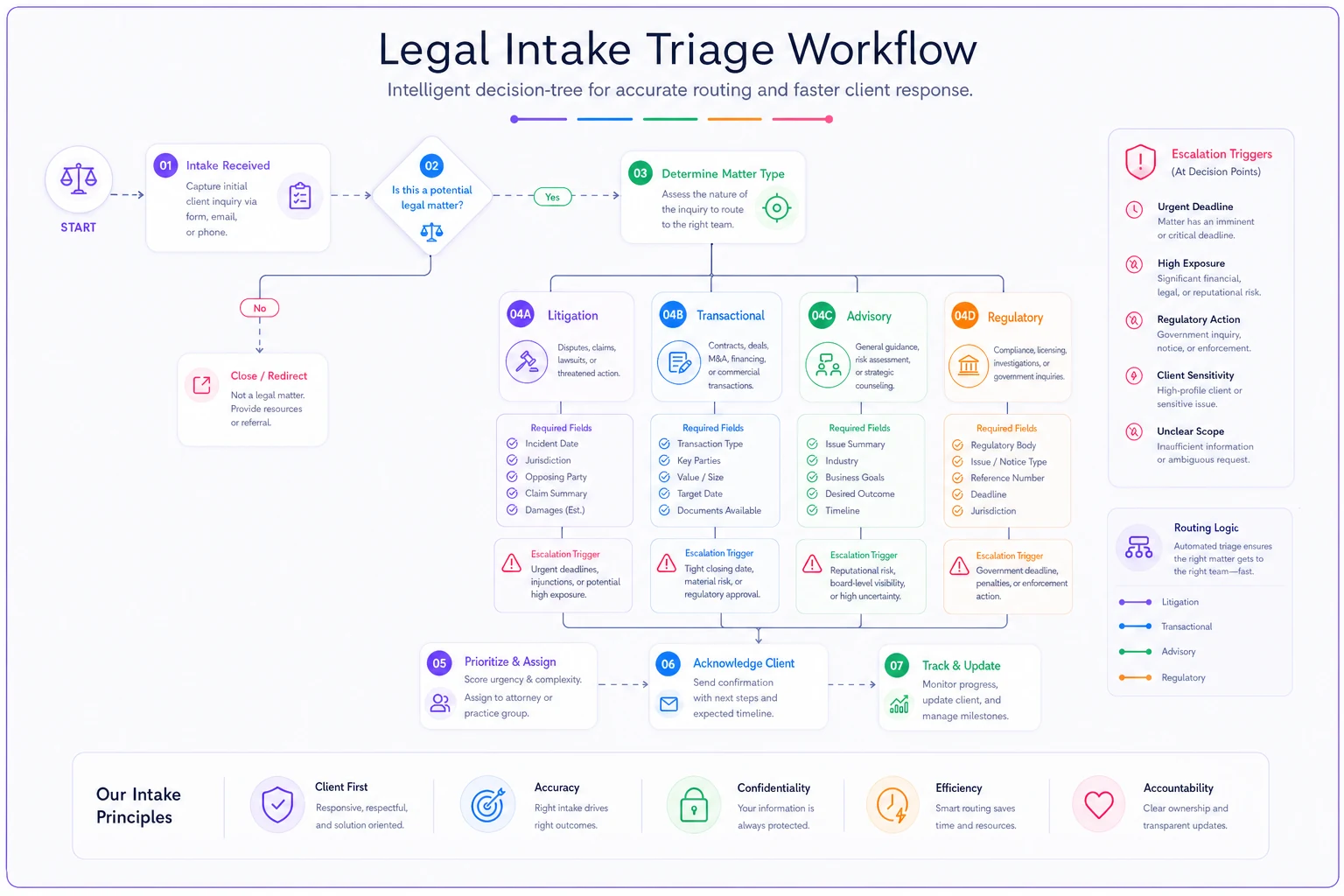
This visual maps branches to required fields and escalation points so you can see how each path forces the right data capture.
Instead of hoping intake staff ask the right questions, the decision tree makes comprehensive conflict checking inevitable. Every path through the tree generates a complete conflict dataset tailored to that exact type of matter.
The Hidden Landmines in Corporate Structures
Corporate entity structures create the most dangerous conflict scenarios because they're invisible during standard intake. A small firm took on what seemed like a straightforward commercial lease dispute for a restaurant owner. Standard conflict check showed all clear. Six months into litigation, they discovered the property owner's LLC was controlled by the same private equity firm that owned three other client businesses.
This wasn't negligence - it was systematic failure. The intake process never prompted anyone to look beyond the surface-level parties. The conflict system had no way to connect corporate structures that weren't explicitly mapped. By the time the connection surfaced, the firm had already taken positions adverse to their own client's parent company.
-
Beneficial ownership behind LLCs and trusts
-
Board members who sit on multiple entities
-
Investment funds with portfolio company relationships
-
Franchise relationships that create quasi-conflicts
-
Joint venture partners who might have adverse interests
A proper intake tree for any corporate matter must dig into ownership structures immediately. Not as an afterthought, but as mandatory fields that won't let the matter proceed without completion. Who owns what percentage? Any institutional investors? Any board overlap with other clients? These questions need to happen during intake, not after you've already sent the engagement letter.
Search Strategies That Catch What Name-Matching Misses
Running a conflict search on "Johnson Properties LLC" and calling it done is like searching for your keys in one pocket and declaring them lost. Real conflict checking requires multiple search strategies running in parallel, each designed to catch different types of conflicts.
The basic search matrix should include:
Direct name searches:
-
Exact entity names
-
Common abbreviations and variations
-
Former names and DBAs
-
Individuals behind entities
Relationship searches:
-
Known subsidiaries and parents
-
Board members and officers
-
Opposing counsel
-
Expert witnesses and consultants
Geographic searches:
-
Properties and addresses involved
-
Jurisdiction-specific requirements
-
Local counsel relationships
Industry searches:
-
Competitors of existing clients
-
Trade association members
-
Regulatory body overlaps
The most overlooked search category is transactional patterns. If you represented a company in its acquisition, you likely can't sue them for the buyer two years later, even if they're technically different entities. These pattern-based conflicts require searching transaction histories, not just current names.
When you run name searches, always include former names and DBAs—those are common blind spots.
One mid-size firm discovered this when they took on a wrongful termination case against a company they'd helped form three years earlier under a different name. The standard name search showed clear, but the historical pattern created an obvious conflict that should have been caught.
Escalation Rules That Prevent Ethical Disasters
Every intake system needs clear escalation triggers that automatically flag matters for deeper review. Not suggestions or guidelines - hard stops that prevent matters from proceeding without senior review.
Automatic escalation triggers should include:
-
Any matter involving current or former clients in any capacity
-
Opposing parties represented by firms you have referral relationships with
-
Matters involving government entities or regulated industries
-
Any situation where the intake person expresses uncertainty
-
Corporate matters involving entities with complex ownership
-
Matters with potential criminal implications
-
Any matter over a certain dollar threshold
The escalation process needs defined response times and clear ownership. When a matter gets escalated, who reviews it? How quickly? What documentation is required? Too many firms have escalation "policies" that are really just suggestions everyone ignores when things get busy.
Real escalation means the matter cannot proceed without documented review. The intake system should literally prevent engagement letters from generating, files from opening, or work from beginning until the escalation is resolved.
A small firm in the Midwest learned this after taking on what seemed like a simple slip-and-fall case. The intake person noted something felt "off" about the opposing party's name but didn't escalate it. Turns out the property owner was the managing partner's brother-in-law's company. The conflict was obvious to anyone who looked, but without mandatory escalation triggers, that review never happened until after the complaint was filed.
Intake Fields That Actually Prevent Problems
Most intake forms collect data that makes the file look complete but doesn't actually prevent conflicts. Client name, matter number, billing address - administrative data that helps with invoicing but not with ethics.
Effective intake fields must capture:
| Field Category | Items |
|---|---|
| Entity relationship data | Parent company (mandatory for any corporate entity) Subsidiaries (with ownership percentages) Board members (full names, not just last names) Major shareholders (anyone over 10%) General counsel and regular outside counsel |
| Matter scope parameters | Initial scope vs. potential expanded scope Specific claims or causes of action Jurisdictions involved (current and potential) Time periods relevant to the matter Any criminal law overlap potential |
| Third-party involvement | Insurance carriers and coverage counsel Lenders and their representatives Brokers, agents, and intermediaries Expert witnesses already identified Vendors or contractors involved in the dispute |
| Historical connections | Prior matters for any parties involved Previous adverse positions taken Related matters that might create issues Settlement agreements that might restrict representation |
Each field needs validation rules that ensure data quality. Corporate entity names should require formal names, not abbreviations. Individual names need first and last, not just initials. Addresses should validate against postal databases. This isn't pedantic - it's the difference between catching a conflict and missing it because someone typed "IBM" instead of "International Business Machines Corporation."
The Qualification Speed vs. Thoroughness Balance
Here's the operational reality: thorough conflict checking takes time, but clients expect immediate responses. The phone rings, they want to know if you can help them, and every minute you spend checking conflicts is a minute they might call another firm.
The solution isn't to skip conflict checking or rush through it. Build a two-phase system that provides quick preliminary clearance while ensuring thorough review before actual engagement.
Phase one happens during the initial call:
-
Quick name search against existing client database
-
Basic adverse party check
-
Obvious conflict indicators
-
Takes under three minutes
If phase one clears, you can tell the potential client you don't see any immediate conflicts but need to complete full clearance before formal engagement. This keeps them on the line while protecting the firm.
Phase two happens before engagement:
-
Full entity structure investigation
-
Complete relationship mapping
-
Historical matter review
-
Industry and geographic analysis
-
Takes 24-48 hours
Phase one must be comprehensive enough to catch obvious conflicts but fast enough to keep potential clients engaged. This requires pre-built search queries, keyboard shortcuts, and trained intake staff who know exactly what to look for.
One firm cut their intake abandonment rate by roughly 60% just by implementing this two-phase approach. Potential clients felt heard and helped immediately, while the firm maintained thorough conflict checking. The secret was having phase one streamlined enough to happen during the call, not after.
Workflow Integration and Team Training
The best conflict checking system in the world fails if your team doesn't actually use it. Most firms spend thousands on conflict software then wonder why problems still slip through. The software isn't the problem - the workflow integration is.
Every person who touches intake needs specific training on their part of the conflict check process. Not general training on why conflicts matter, but specific, step-by-step training on exactly what they need to do in the system. The receptionist who takes initial calls needs different training than the paralegal who does detailed conflict analysis.
The workflow must be embedded in the tools people already use. If intake happens in your practice management system, conflict checking should happen there too, not in a separate database that requires logging into another platform. If your team uses Microsoft Teams for communication, escalation alerts should appear there.
Most importantly, the conflict check process needs to be auditable. Every search, every escalation, every override should be logged with timestamps and user identification. Not for punishment, but for process improvement. When conflicts slip through, you need to understand exactly where the breakdown occurred.
Measuring What Actually Matters
Most firms measure conflict checking success by the absence of problems, which is like measuring fire safety by counting buildings that didn't burn down. You need proactive metrics that show whether your conflict checking process actually works before a disaster proves it doesn't.
Track these operational metrics:
-
Time from initial contact to conflict clearance
-
Percentage of matters requiring escalation
-
False positive rate (unnecessary escalations)
-
Search completeness rate (fields actually filled)
-
Override frequency and reasons
-
Near-miss conflicts caught at phase two
The patterns in these metrics tell you where your process breaks down. High escalation rates might mean your triggers are too sensitive or your intake staff need better training. Long clearance times might indicate search inefficiency or understaffing. High override rates suggest your partners might be taking unnecessary risks.
A firm in Texas discovered through metrics that 40% of their near-miss conflicts involved the same types of corporate structures. They added specific intake fields for those structures and cut their near-misses by more than half. Without tracking metrics, they never would have seen the pattern.
When AI-Powered Intake Makes Sense
The complexity of modern conflict checking pushes even well-trained staff to their limits. AI automation can dramatically improve intake accuracy by automatically extracting entity relationships from corporate documents, identifying potential conflicts in real-time during calls, and suggesting search strategies based on matter type.
AI-powered operational software works particularly well for conflict checking because the rules are clear but the data is complex. The system can instantly search variations of names, identify corporate relationships from public filings, and flag potential issues human reviewers might miss. More importantly, it can do this during the initial intake call, not hours or days later.
The automation handles the repetitive searches and data validation while your team focuses on nuanced judgment calls. Instead of manually checking every name variation, your intake staff can review AI-flagged potential conflicts and make informed decisions. Instead of hoping someone remembers to check parent companies, the system automatically pulls corporate structure data and runs comprehensive searches.
This particularly helps smaller firms that can't dedicate full-time staff to conflict checking. The AI enhancement allows a single intake person to perform conflict checks that would normally require a team, without sacrificing thoroughness or speed.
Building Your Implementation Roadmap
Transforming intake and conflict checking doesn't happen overnight. Trying to revolutionize everything at once usually means nothing actually changes. Start with the highest-risk practice areas and expand from there.
Month one: Map your current state. Document exactly how intake happens now, where conflicts get checked, and where problems have occurred.
-
Month two
Build decision trees for your top three matter types. Not every possible matter - just the ones that represent 80% of your work.
-
Month three
Implement escalation triggers for obvious conflicts. Start with hard stops for the clearest conflict scenarios.
-
Month four
Train and test with a pilot group. Choose your best intake person and have them use the new system for two weeks. Document every issue, refine the process, then expand.
-
Month five
Roll out to full team with intensive support. Expect resistance and confusion. Plan for double the training time you think you need.
-
Month six
Measure, adjust, and optimize. Look at your metrics, identify bottlenecks, and refine the process based on actual usage.
The goal isn't perfection immediately. It's systematic improvement that compounds over time. Each refinement makes the next improvement easier. Each caught conflict justifies further investment in the process.
The Operational Reality Check
Building an effective conflict checking system at a small or mid-sized firm means accepting certain operational realities. You won't have the resources of Big Law firms with dedicated conflict analysts. Your intake staff will have multiple responsibilities beyond conflict checking. Your partners will push back on anything that slows down new matter acceptance.
But you can't afford the alternative either. One missed conflict can destroy a small firm's reputation, trigger malpractice claims, and create bar complaints that haunt you for years. The cost of proper conflict checking is tiny compared to the cost of missing conflicts.
The transformation from reactive conflict checking to proactive conflict prevention takes roughly six months for most firms. That might seem long, but consider that most firms have been using the same broken intake process for decades. Six months to fix a foundational problem that threatens your firm's existence seems reasonable.
Conflicts aren't just an ethics issue - they're an operational issue that affects every aspect of your practice. The right intake and triage system doesn't just prevent disasters. It speeds up matter acceptance, improves client satisfaction, and lets your team focus on actual legal work instead of constantly worrying about what conflicts might be hiding in your matter list.
The choice is simple: invest in systematic conflict prevention now, or deal with the inevitable consequences of conflicts you should have caught. Most firms know which option makes sense. The question is whether they'll act before a missed conflict forces their hand.
Ready to elevate your legal practice management?
Join 500+ law firms using Casioly to optimize case workflows, reduce administrative burden, and improve client satisfaction.