



Matters don't really end when the work ends. They end when someone closes the ledger, releases or returns trust funds, files the retention clock, and stops the matter from lingering in your system as an open liability. Most firms are decent at the front half of a case and sloppy at the back half — because closing feels like paperwork, and paperwork loses to the next intake every single time.
A half-closed matter doesn't stay quiet. It shows up eight months later as a trust discrepancy nobody can explain, a document produced in litigation that should've been purged, or a "why are we still paying to store this" line item during a storage audit. What follows is the closeout sequence that actually holds — ledger-to-matter reconciliation, trust triggers, archive steps, a lightweight learning review, and a 30/60/90-day timeline so closure sticks instead of drifting.
Start with reconciliation, because a matter with an unbalanced ledger is not closeable
Before anyone talks about archiving or reviews, the ledger has to tie out. This is the step firms skip because the matter feels done — the client got their outcome, the last invoice went out, everyone moved on. But "feels done" and "reconciles to zero" are two different things.
Ledger-to-matter reconciliation means every dollar tied to the matter is accounted for and lands where it belongs. The gaps that show up during closeout are almost always the same handful:
-
Unbilled time sitting in WIP that nobody wrote off or invoiced
-
Trust balance that doesn't match the operating ledger's record of trust
-
Costs advanced (filing fees, expert invoices, courier charges) never billed back
-
A final invoice marked "sent" but never actually reconciled against payment
-
Vendor invoices that arrived after the matter was mentally closed
A typical example: a small litigation matter shows as ready to close, but there's $1,340 in advanced costs never billed to the client and about $600 of associate time still in WIP. Close it as-is and you've just written off roughly $1,900 without deciding to. Multiply that across 30–40 matters a year and you're leaking real money through closeout, not through pricing.
The rule worth pushing here: no matter closes until its ledger nets to a defensible number. Either it's fully collected, formally written off with sign-off, or flagged as a collection item and kept open on purpose. What you don't want is silent leakage disguised as "closed."
A simple reconciliation table before sign-off
| Line item | Expected | Actual | Variance | Action |
|---|---|---|---|---|
| WIP (unbilled time) | $0 | $600 | -$600 | Bill or write off w/ approval |
| Advanced costs | $0 outstanding | $1,340 | -$1,340 | Invoice client |
| Trust balance | $0 | $250 | +$250 | Trigger refund workflow |
| Final invoice | Paid in full | $0 unpaid | $0 | Confirmed cleared |
If any row has a variance, the matter isn't closed — it's pending closure. That distinction matters more than it sounds, because pending items are the ones that come back to bite you.
Have someone other than the person who handled billing review WIP and advanced costs during reconciliation to catch missed write-offs.
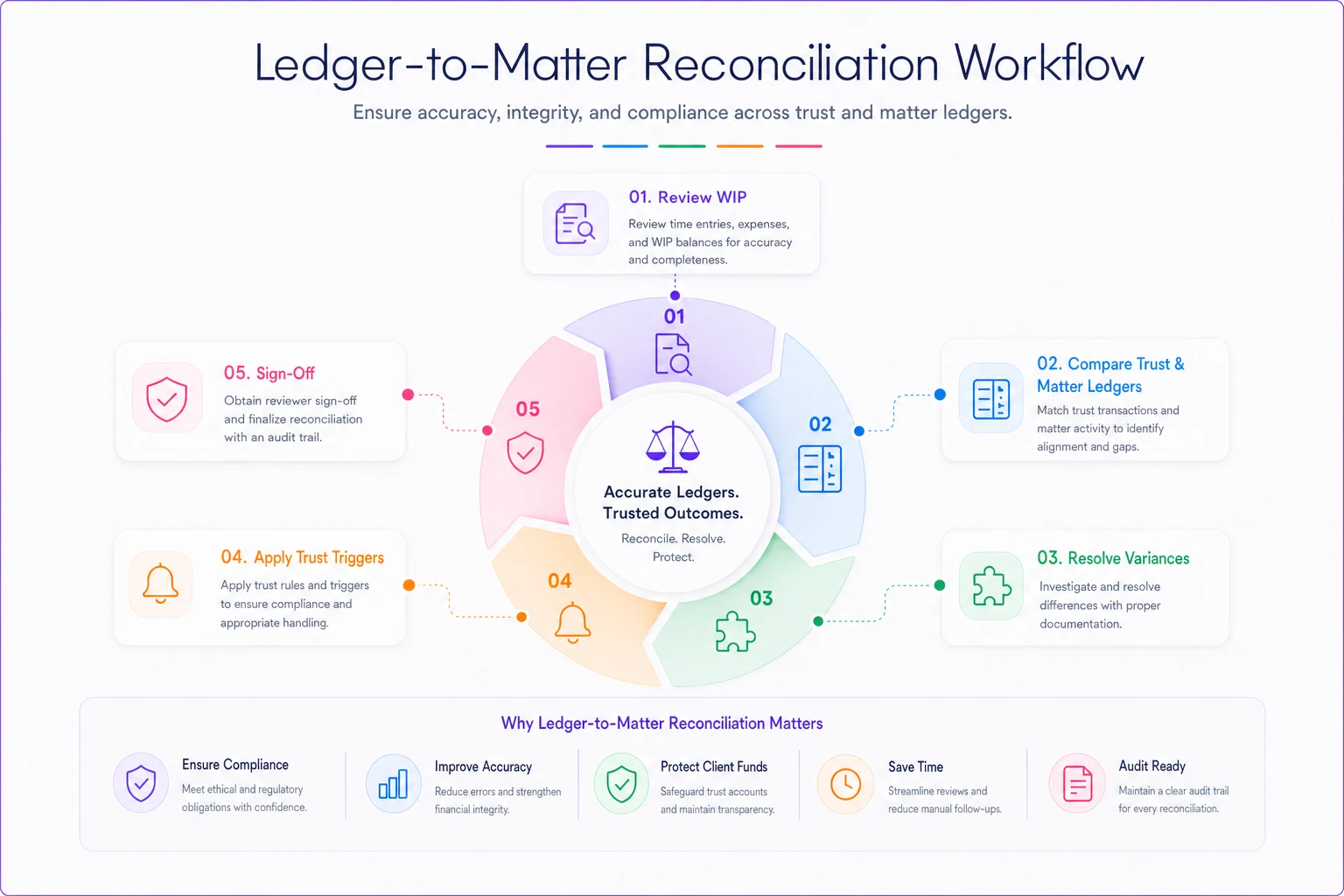
Use this simple workflow when reconciling a matter.
Trust triggers: the closeout step that carries actual regulatory weight
Everything else on a closeout list is operational hygiene. Trust handling is a compliance obligation, and it's where a sloppy closeout turns into a bar complaint. If the matter carried client funds, closing it must fire a specific set of trust actions — and those actions can't live in someone's head.
Never miss a critical deadline again.
Casioly helps legal teams manage cases efficiently and stay on top of critical tasks.
- Centralized case tracking
- Automated deadline reminders
- Secure client communication
No credit card required
The pattern that shows up repeatedly: a matter closes with a small residual trust balance — $85, $250, sometimes just interest-adjacent leftovers — and nobody returns it because it's "too small to bother." Those tiny balances accumulate, and now you've got a trust account holding money for closed matters, which is exactly the thing that surfaces during an audit and looks bad on paper regardless of intent.
Closeout trust triggers should be non-optional and tied to the close action itself:
-
Confirm the current trust balance for the matter against both the trust ledger and the matter ledger — they must agree to the penny.
-
Zero out the balance the right way — apply to the final invoice, refund the client, or transfer per the engagement terms. No default, no "we'll deal with it later."
-
Generate the trust accounting statement for the client showing every deposit and disbursement over the matter's life.
-
Get sign-off from someone other than the person who ran the numbers. Dual-eyes on trust closure isn't bureaucracy; it's what catches the transposed digit.
-
Log the closure date and final balance ($0) in a way that's retrievable during a reconciliation months later.
If you already run a disciplined month-end trust process, closeout should feel like a smaller, matter-specific version of that same discipline — same red-flag logic, narrower scope.
The firms that struggle are usually the ones treating closeout trust as separate from monthly trust, so residuals slip through the gap between the two processes.
Archive steps: closing a matter is also a data decision
This is where closeout quietly overlaps with data governance. When you close a matter, you're not just filing it — you're deciding what to keep, for how long, at what access level, and what to destroy. Skip that decision and you default to "keep everything forever," which is both a storage cost and a discovery liability.
The archive step should force these determinations before the matter drops out of active view. This ties directly to the permissions and structure work covered in Prevent Matter Sprawl: A Matter-Linked Governance and Permissions Playbook — because a closed matter with wide-open access is sprawl that just stopped moving. It doesn't get safer by sitting still.
A workable archive sequence:
-
Set the retention clock. Retention isn't one-size-fits-all — a real estate closing, an estate plan, and a personal injury file have different clocks. The close action is when you assign the destruction-eligible date, not when you guess at it years later.
-
Tighten access. Active matters need broad team access; closed matters usually shouldn't. Drop permissions to a read-only, need-to-know footprint.
-
Purge what shouldn't survive. Drafts, duplicate copies, personal notes that were never part of the official file, and any preservation holds that have been lifted. If a litigation hold is still active, the matter is not eligible to archive — flag it and stop.
-
Confirm the file is complete before it goes cold. Missing signature pages and unfiled correspondence are far harder to chase six months post-closure.
-
Record where it lives. Physical box number, digital location, or both. "Archived" without a location is just "lost, politely."
The mistake that burns firms: purging on instinct instead of policy. Someone deletes what feels like clutter, and it turns out to be the one document a former client requests two years later. Retention decisions belong to a documented schedule, applied at close — not to whoever's cleaning up the drive on a slow Friday.
The post-matter learning review — keep it short or it won't happen
Long retrospectives don't survive contact with a busy practice. The review that actually gets done is one that fits on a single screen and takes ten minutes. The goal isn't a report nobody reads; it's capturing the two or three things worth remembering before the details evaporate.
Post-matter review template
Matter: [name / number] Type: [practice area] Closed: [date] Lead: [name]
-
Budget vs. actual Did we land where we quoted? If not, what drove the gap — scope creep, underquoting, or a specific surprise?
-
What worked One process, template, or decision worth repeating.
-
What didn't One thing that cost time or money we'd do differently.
-
Reusable output Any brief, motion, clause, or checklist worth adding to the precedent library.
-
Client-facing lesson Anything about communication, expectations, or intake we'd flag for similar future clients.
That's the whole thing. Friction-free capture, not a formal debrief. Where this connects to the bigger picture is in your Law Firm Case Lifecycle Framework: Stages, Required Data and SLA Rules — a good review at closeout feeds back into how you scope, quote, and staff the next matter of the same type.
Firms that skip the review don't just lose insight — they re-learn the same painful lesson on the next matter. The associate underquotes the same kind of case twice because nobody wrote down what happened the first time.
A 30/60/90-day timeline so closure actually holds
Closure isn't a single moment. A few things can only be verified once time has passed — did the final payment clear, did anything bounce back, did a straggler invoice arrive. So the smart move is a short post-close timeline that catches the tail.
By day 30:
-
Confirm final invoice payment actually cleared (not just "sent")
-
Verify trust balance is genuinely at $0 and refund checks cleared
-
Confirm no late vendor invoices have landed against the matter
-
Send the client their final trust accounting statement if not already delivered
By day 60:
-
Confirm the file archived correctly and is retrievable from its logged location
-
Verify access permissions dropped to the closed-matter footprint
-
Confirm the retention/destruction date is set in the system
-
Complete the post-matter review if it slipped at closing
By day 90:
-
Final ledger confirmation — matter nets to a defensible number, no surprise reopenings
-
Confirm any reusable work product made it into the precedent library
-
Spot-check that no communications or documents are still being filed against a "closed" matter
-
Formally lock the matter — no further edits without a reopen request
The 90-day lock is the underrated step. Without it, "closed" matters keep accumulating activity — a stray email filed here, a late document there — and you never get a clean baseline. Locking forces a real reopen decision, which keeps your closed set actually closed.
When a lighter version makes sense — and when it doesn't
Not every matter needs the full sequence. A quick, no-trust, flat-fee consultation doesn't warrant a 90-day timeline. Match the rigor to the matter.
The full sequence makes sense when:
-
The matter held trust funds at any point
-
There were advanced costs or a meaningful WIP balance
-
It's litigation or anything with preservation/hold implications
-
The matter is a type you'll see again and can learn from
A lighter touch is fine when:
-
Flat-fee, fully paid, no trust involved
-
Short engagement with no advanced costs
-
One-off matter with no reusable output and no retention complexity
Who should not shortcut it: any firm that's been through a bar audit, a fee dispute, or a discovery request against a closed file. Once you've felt that pain, the closeout discipline pays for itself — because the alternative is reconstructing a matter's financial and document history under pressure, from memory, which never goes well.
A quick real scenario
A four-attorney firm handling a mix of real estate and estate work had roughly 45 matters they thought were closed sitting in their system with no formal closeout. When they ran an actual reconciliation pass, about a third had loose ends — small trust residuals totaling a few hundred dollars across several matters, roughly $6k–$8k in advanced costs never billed back, and a handful of files with no retention date and full team access still enabled.
Working through them took a couple of focused weeks. They recovered a meaningful chunk of the advanced costs, cleared the trust residuals before their next reconciliation, and walked out with a repeatable closeout checklist so it didn't pile up again. The next quarter, matters closed cleanly the first time instead of becoming a cleanup project.
The lesson wasn't that they were careless. It's that without a defined closeout sequence, matters don't close — they just stop getting worked on, which is a very different and much more expensive thing.
Bottom line
A matter closing checklist isn't administrative busywork — it's the step that protects trust compliance, recovers billed-but-forgotten money, controls your storage and discovery exposure, and feeds real lessons into your next case.
Reconcile the ledger, fire the trust triggers, make the retention decision at close, run the ten-minute review, and use the 30/60/90 timeline to make sure closure actually holds instead of quietly drifting back open. Do that consistently and "closed" starts meaning what it's supposed to mean.
A matter closing checklist isn't administrative busywork — it's the step that protects trust compliance, recovers billed-but-forgotten money, controls your storage and discovery exposure, and feeds real lessons into your next case.
Reconcile the ledger, fire the trust triggers, make the retention decision at close, run the ten-minute review, and use the 30/60/90 timeline to make sure closure actually holds instead of quietly drifting back open. Do that consistently and "closed" starts meaning what it's supposed to mean.
Ready to elevate your legal practice management?
Join 500+ law firms using Casioly to optimize case workflows, reduce administrative burden, and improve client satisfaction.