

A mid-size litigation shop I'll describe here had 14 active vendor relationships running at once. Local counsel in three states, a hosted review platform, two court reporters, an expert witness firm, a forensic imaging vendor, and a rotating cast of contract reviewers. Nobody could tell you, on any given Tuesday, which vendor had access to which client's documents, whether the SLA on the review platform was being met, or why the same deposition transcript got billed twice under two different matter numbers.
That's the actual problem. Not "vendor management" as some abstract discipline — it's the daily reality that your vendors are scattered across email threads, shared drives, and someone's memory, and the connection between them and your matters is basically nonexistent.
This playbook is about fixing that one thing: making every external vendor relationship matter-linked, so access, performance, and billing all trace back to a specific matter and matter type instead of floating loose. That's the version of legal vendor management that actually prevents disasters, and it looks very different depending on whether you're onboarding an e-discovery host or a Spanish-language interpreter.
Where vendor chaos actually starts
It almost never starts with a bad vendor. It starts with an urgent matter.
A new case comes in hot. A partner needs local counsel in Ohio by Friday, documents to a review vendor by Monday, and an expert retained before a deadline. So the intake happens through side channels — a quick email, a phone call, a "just send them the Dropbox link." The vendor gets access before anyone has documented what they got access to, why, or when it should be revoked.
Multiply that across a dozen matters and the pattern becomes familiar: over-provisioned vendors sitting on live client data long after their engagement ended, SLAs buried in a contract nobody re-reads, and invoices that don't map cleanly to any matter budget.
Vendor problems are really matter-linkage problems. When a vendor isn't tied to a specific matter with defined scope, access, and billing rules, every downstream control breaks. You can't audit access you never recorded. You can't enforce an SLA you never mapped to a deliverable. And you can't reconcile a bill against a budget that was never allocated per matter.
Different vendors, different playbooks
One of the more consistent mistakes firms make is treating all vendors the same. The onboarding for a court reporter should not look like the onboarding for a forensic vendor who's going to image five custodians' laptops. The risk profile, the data handoff, and the billing model are completely different.
Never miss a critical deadline again.
Casioly helps legal teams manage cases efficiently and stay on top of critical tasks.
- Centralized case tracking
- Automated deadline reminders
- Secure client communication
No credit card required
| Vendor Type | Data Access Level | SLA Focus | Billing Model | Biggest Risk |
|---|---|---|---|---|
| Local / co-counsel | Full matter file | Response time, filing deadlines | Hourly, split fee | Privilege waiver, scope creep |
| E-discovery / hosting | Bulk custodian data | Processing time, uptime, review throughput | Per-GB + per-user | Over-retention after case closes |
| Expert witnesses | Selected exhibits only | Report delivery dates | Hourly, capped retainer | Paying for un-billed prep time |
| Court reporters | Transcript-level only | Turnaround, rough draft timing | Per-page | Duplicate billing across matters |
| Translation / interpretation | Specific documents | Accuracy, delivery window | Per-word or per-hour | Confidentiality gaps |
| Contract reviewers | Scoped doc set | Review rate, QC error rate | Hourly or per-doc | Access lingering after project ends |
The point of a table like this isn't the specific values — your firm will have its own vendor mix. The point is that minimal-privilege access means something different for each row. A court reporter should never have full matter file access. An e-discovery vendor needs bulk access but only for the duration of active review. When you map these distinctions to matter type up front, onboarding stops being improvisation.
The onboarding sequence that actually holds up
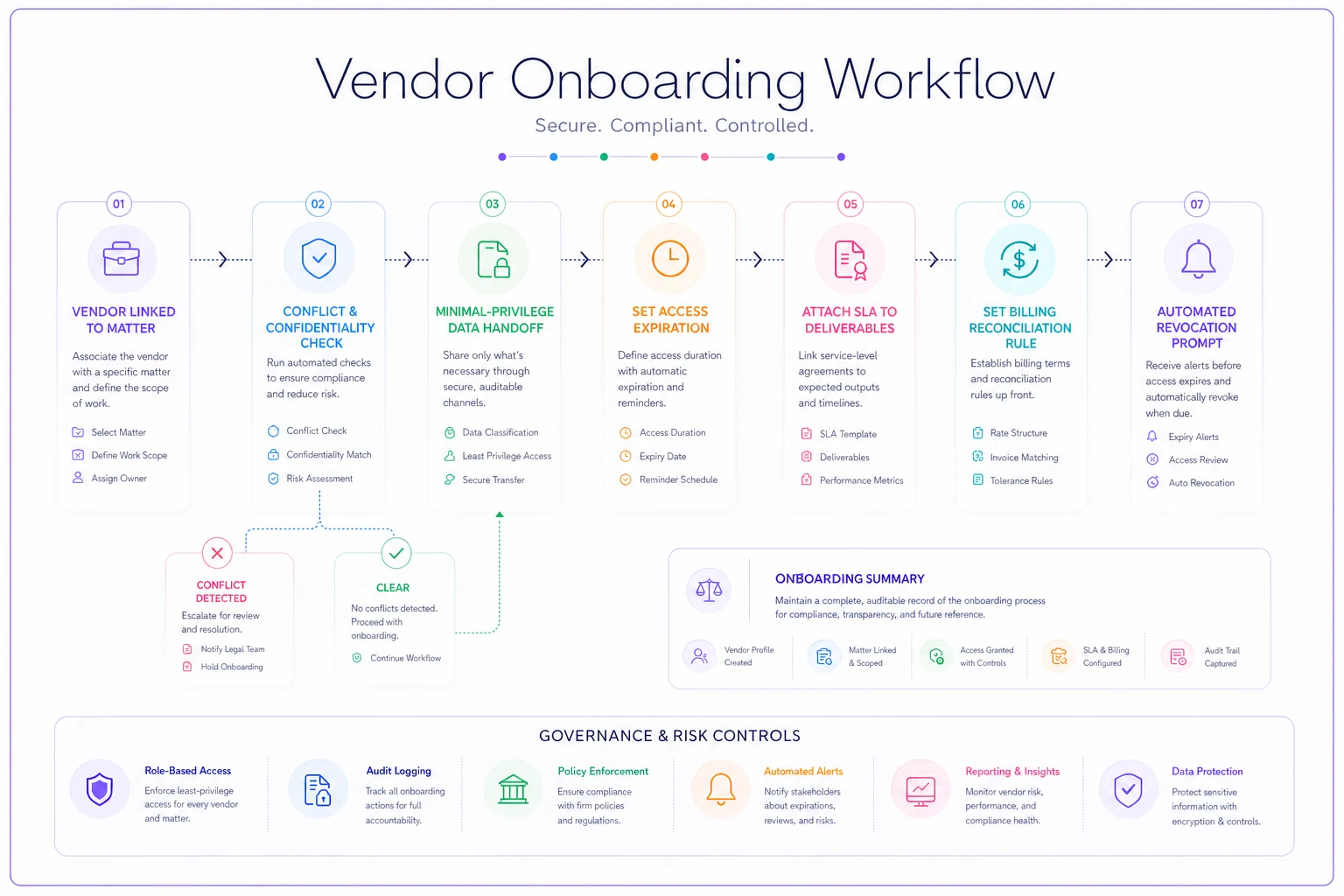
Firms that avoid vendor chaos treat onboarding as a repeatable sequence, not a favor someone does under deadline pressure. Here's the sequence, and it takes about 20 minutes per vendor once the templates exist:
-
Link the vendor to a matter and vendor type before anything else. No matter number, no access. This single rule kills most of the downstream problems.
-
Run the conflict and confidentiality check. For co-counsel and experts especially, confirm no adverse relationships. Get the NDA or engagement letter signed before data moves.
-
Define the minimal-privilege data handoff. Decide exactly what the vendor sees — a specific custodian set, a folder, a document range — and how they get it. Not "here's the whole drive."
-
Set the access expiration date at creation. Every vendor grant gets a review or revocation date tied to the matter's expected phase, not "indefinite."
-
Attach the SLA to concrete deliverables. Turnaround times, uptime, error rates — whatever's relevant to that vendor type, written where the matter team can actually see it.
-
Set the billing reconciliation rule. Define the expected billing model and the matter budget line it hits, so invoices can be checked against something real.
The ordering matters. The matter link comes first, not the paperwork. When the matter link is the entry point, access provisioning, SLA tracking, and billing all inherit the matter context automatically instead of getting bolted on later.
The minimal-privilege handoff, in practice
Most over-provisioning happens because full access is easier than scoped access. Someone shares the entire matter folder because carving out the right subset takes effort. Six months later that vendor still has it.
Bake the access expiration into the share at creation so revocation is automatic rather than manual.
A cleaner workflow: when a vendor is created against a matter, a scoped share gets generated — only the documents or custodian set defined in step 3 — with the expiration date from step 4 baked in. When the date hits, the team gets a prompt to extend or revoke. Nobody has to remember to pull access because the default is that access expires.
A simple visualization of the onboarding workflow follows.
This is the same discipline covered in our piece on integrations governance and ownership matrices — the difference is that vendor access is often harder to audit because it lives outside your walls. If you're already handling e-discovery, the custodian and preservation structure from our e-discovery intake guide plugs directly into what a hosting vendor should and shouldn't be able to see.
SLA scorecards that people actually use
An SLA sitting in a signed contract is not an operational control. It's a document. The gap between the two is where firms get burned — a review vendor is contractually obligated to a 48-hour processing turnaround, but nobody's tracking whether they hit it, so the first time anyone notices a miss is when a deadline slips.
-
Processing turnaround (target vs. actual, per data load)
-
Platform uptime during active review windows
-
Support ticket response time
-
Data errors or re-processing incidents
For local counsel it's different — response time to partner requests, whether filings went out on schedule, whether they flagged issues proactively. Four to six lines, not thirty. The failure mode isn't too few metrics; it's too many, which means nobody maintains them.
One thing worth sitting with: a scorecard only changes behavior if the vendor knows it exists and sees the results. Firms that quietly track SLAs and never share them get no leverage. Firms that send a quarterly one-pager — "here's your turnaround performance across our five active matters" — see vendors tighten up fast, because now there's a visible record tied to renewal.
KPI dashboards mapped per matter type
The scorecard is per-vendor. The dashboard is per-matter, and it's where you see whether vendor spend is actually tracking to the matter budget.
-
Total vendor spend on the matter vs. the vendor line in the matter budget
-
Each vendor's spend against its own allocated cap
-
SLA status per vendor (green/yellow/red)
-
Access status — how many vendors still have live access, and whether any are past their revocation date
That last line is the one most firms miss. A matter winding down should show zero active vendor grants. If it shows four, someone forgot to revoke access, and there's a data-retention exposure hiding in plain sight.
Billing reconciliation, where the money quietly leaks
This is the section most firms underinvest in, and it's where the recoverable dollars actually are.
Vendor billing errors are rarely dramatic. They're small, repetitive, and easy to miss: a court reporter's transcript billed to two matters, an expert's prep time that exceeds the retainer cap, an e-discovery host still charging monthly hosting fees on a matter that closed in the spring. Each one is a few hundred dollars. Across a busy year and a dozen vendors, it adds up — and it wrecks the accuracy of your matter budgets along the way.
-
Does the billing model match what was agreed (per-page, per-GB, hourly)?
-
Does the invoice reference a valid, active matter number?
-
Is the amount within the vendor's allocated cap for that matter?
-
Has this deliverable already been billed under another matter?
That last check catches the duplicate-billing problem that hosting and court-reporting vendors create when work touches related matters. If you're already running month-end financial checks, this slots naturally alongside the discipline in our matter-linked trust reconciliation checklist — same mindset, applied to vendor invoices instead of client funds.
A real scenario
A seven-attorney litigation firm was running about 11 active vendor relationships across roughly 40 open matters. Their whole vendor process lived in email and a shared spreadsheet that hadn't been fully updated in months.
Two things were bleeding them. First, an e-discovery host was still charging around $1,800/month in hosting fees on three matters that had settled — nobody had told the vendor to archive and shut down, and nobody caught it because invoices weren't checked against matter status. That ran for close to five months before anyone noticed. Second, they had at least six vendors with live document access on matters that had closed, including a contract-review firm that had been done for over a year.
They didn't buy anything fancy to fix it. They built a simple matter-linked vendor register: every vendor tied to a matter number, with an access-expiration date, an SLA line, and a billing rule. Onboarding got a short checklist. Once a month, someone spent about an hour reconciling vendor invoices against matter budgets and revoking any access past its date.
Within the first quarter they'd cut the zombie hosting fees, recovered a couple of duplicate transcript charges, and closed out every stale access grant. The rough recovery and avoided spend landed somewhere in the $9k–$12k range for the year — but the bigger win was that a security exposure they didn't even know they had simply stopped existing.
When this level of structure makes sense — and when it doesn't
If you're a solo or two-person shop with one or two vendors you've worked with for years, a full matter-linked vendor register is overkill. A simple shared list and a quarterly invoice check is probably fine. This structure earns its keep when you cross roughly five active vendors or start juggling vendors across several matter types — that's the point where memory and email stop scaling.
Worth being honest about who shouldn't start here either. If your matters themselves aren't cleanly numbered and organized, fixing vendor management first is building on sand. The matter link is the whole foundation. If matters are a mess, get that stable before layering vendor controls on top.
And don't try to do everything at once. Firms that attempt to onboard all existing vendors into a perfect system in one weekend usually give up halfway through. Start with new vendors going forward, then backfill your highest-risk existing relationships — the ones with the most data access — first.
Bringing it together
Vendor chaos isn't a discipline problem or a people problem. It's a linkage problem. When every vendor is tied to a matter and a vendor type from the first minute — with scoped access, an expiration date, an SLA mapped to real deliverables, and a billing rule ready for the invoice — the controls largely take care of themselves. The audit is possible because the record exists. The SLA has teeth because it's visible. The billing reconciles because it was always mapped to a budget.
Firms that stay out of trouble aren't the ones with the strictest vendor policies on paper. They're the ones who made the matter link the front door, so nothing — no access, no invoice, no expert report — enters without a matter number attached to it.
Ready to elevate your legal practice management?
Join 500+ law firms using Casioly to optimize case workflows, reduce administrative burden, and improve client satisfaction.