
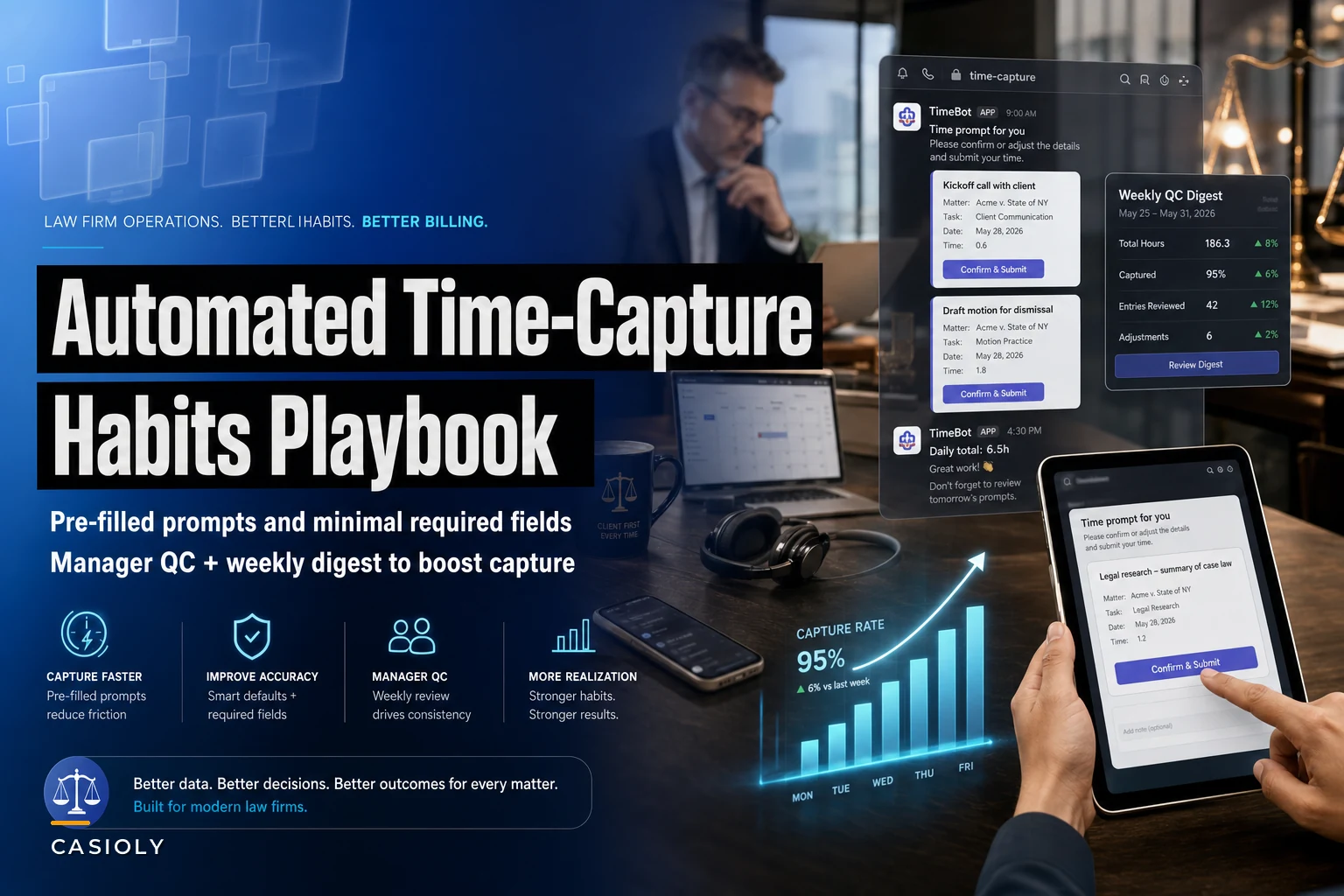

Every firm has that one associate who bills like a machine and another who is objectively working harder but somehow logs three fewer hours a day. The gap almost never comes down to effort. It comes down to when time gets recorded and how much friction sits between doing the work and writing it down.
Most partners try to fix this with pressure. More reminder emails. A stern meeting in January when realization looks bad. Maybe a threat about compensation. It works for about two weeks, then everyone slides back to reconstructing their week on Friday afternoon from memory and calendar guesses.
This post is about the boring, unglamorous stuff that actually moves the needle: shrinking the required fields, timing the prompts right, and giving managers a light QC script they can run without becoming the timesheet police. The goal for time capture habits at a law firm isn't perfect compliance. It's making contemporaneous entry the path of least resistance.
Why reconstruction is the real enemy
The dirty secret of law firm billing is that most lost revenue doesn't come from people forgetting to bill. It comes from people guessing.
When an associate sits down Friday at 4pm to fill in a blank week, they don't invent hours — they do the opposite. They round down, drop the small stuff, and skip anything they can't clearly remember. A 12-minute client call on Tuesday gets forgotten entirely. Three separate 6-minute email exchanges get mentally collapsed into "some emails, call it 0.2." That review of opposing counsel's draft that took 40 minutes gets logged as half an hour because it feels safer.
None of this is fraud. It's memory decay plus a mild fear of over-billing, and it compounds. Reconstructed time tends to run somewhere between 10% and 20% lower than contemporaneous time for the exact same work. The person did the work. The firm just never captured it.
There's also a narrative cost. Entries written three days later are vague — "attention to file," "review documents," "call re: matter." Those are the entries clients slash and billing partners write off. Contemporaneous entries are specific because the detail is still in your head, and specificity is what survives a client's line-item review.
The whole game is closing the gap between the work and the record. Everything below is about that.
Cut the required fields before you do anything else
The single biggest reason people delay time entry is that entering time is annoying. Every mandatory field is a small tax, and small taxes add up until people avoid the whole thing.
Never miss a critical deadline again.
Casioly helps legal teams manage cases efficiently and stay on top of critical tasks.
- Centralized case tracking
- Automated deadline reminders
- Secure client communication
No credit card required
Go look at your actual time-entry screen. Count how many fields are required before someone can save an entry. At a lot of firms the answer is genuinely absurd — matter number, task code, activity code, phase, narrative, billable/non-billable flag, sometimes a "reviewed by" dropdown. Nobody is filling that out cheerfully six times a day.
The fix is separating what's needed to capture from what's needed to bill.
| Field | Required at capture? | Can be added later? |
|---|---|---|
| Matter | Yes | — |
| Duration | Yes | — |
| Short narrative | Yes | — |
| Task/activity code (UTBMS) | No | Yes, at review |
| Phase | No | Yes, at review |
| Billable flag | Default to billable | Fix at review |
Capture should take under 15 seconds and never block on a code the person has to look up. Coding is a review activity — and it's often better done in a batch by a biller or paralegal who actually lives in the code set. If you force lawyers to code every entry at the moment of capture, you'll get bad codes, no entries, or both.
Make capture take under 15 seconds by limiting required fields to matter, duration, and a one-line narrative.
One firm we looked at cut required capture fields from seven down to three and saw daily entry counts climb almost immediately. Not because people worked more, but because the eight-minute call finally felt worth logging.
The timing of prompts matters more than the prompts
Reminders fail when they're generic and badly timed. "Please enter your time" sitting in an inbox at 9am does nothing — the work hasn't happened yet.
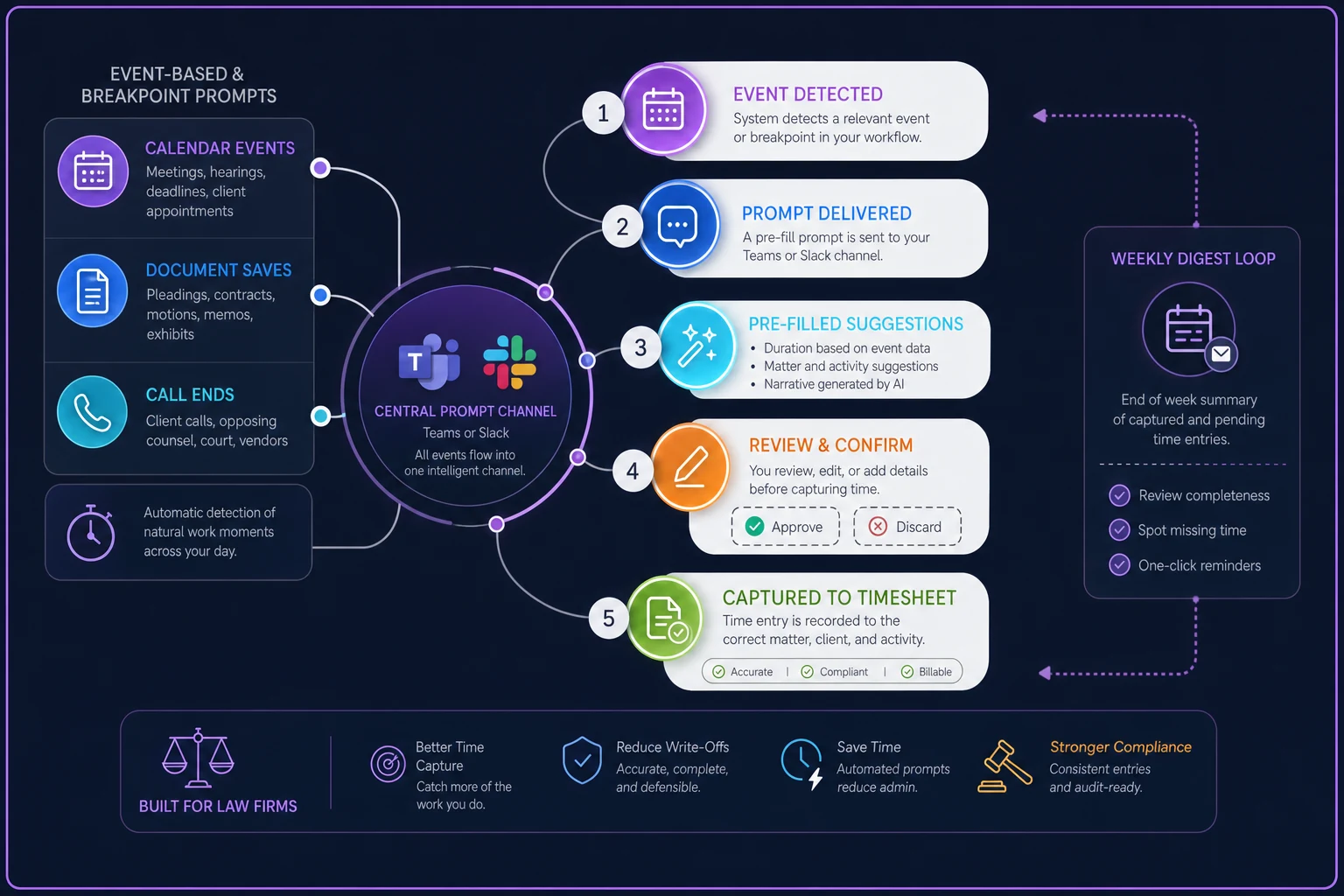
The prompts that actually work are tied to events and natural breakpoints, not arbitrary clock times.
Event-based prompts fire off something that already happened in another system:
-
A calendar meeting ends → prompt
"You just finished a 30-min event on the Henderson matter. Log it?" with duration pre-filled.
-
A document gets saved or a draft goes out → prompt to capture the drafting time.
-
A call ends on the firm phone system → prompt with the number matched to a matter.
The pre-fill is what makes this work. You're not asking someone to remember and reconstruct. You're asking them to confirm or edit something that's already 80% done. Completely different cognitive load.
Breakpoint prompts hit at moments people are already pausing:
-
End of a block of meetings, not the middle
-
A midday nudge around lunch
-
A single end-of-day prompt before someone leaves, not the following morning
Two rules that keep prompts from becoming noise:
-
One channel, consistent. Pick where prompts live — Teams, Slack, email digest, the practice system itself — and stick with it. Prompts scattered across four channels get ignored everywhere.
-
Never nag on entries that are already captured. If someone logs their day contemporaneously, they should get fewer prompts, not the same barrage. Punishing your best loggers with reminders they don't need is a fast way to teach them to tune everything out.
The pre-fill is what makes this work. You're not asking someone to remember and reconstruct. You're asking them to confirm or edit something that's already 80% done. Completely different cognitive load.
Below is a simple workflow showing how event-based and breakpoint prompts feed into a pre-filled capture prompt and then into the timesheet.
The weekly rhythm should be light. A short Monday prompt showing last week's gap days, a mid-week check, and a Friday digest covering what's still uncoded or missing narrative. That's it. If the prompt system feels like a smoke alarm, people pull the battery.
A manager QC script that isn't policing
Most firms get this wrong. QC turns into a partner scrolling through timesheets looking for people to yell at, which poisons the well. People start padding entries to avoid the conversation, or they disengage entirely.
Good QC is a quality check on the entries, not a character check on the person. It runs on patterns, not gut feeling, and it's fast — ten minutes per timekeeper per week, tops.
A manager or supervising associate runs through a short, repeatable script:
-
Gap days. Any full workday with under 4 hours logged. Not an accusation — a question. "Tuesday looks light. Court day? PTO? Or just didn't get logged?"
-
Round-number clustering. A week that's all 0.5s and 1.0s with no odd increments is almost always reconstructed. Real work produces 0.3s and 0.7s.
-
Vague narratives. Anything that could apply to any matter ("review file," "attention to matter") gets flagged for a rewrite while memory is still fresh.
-
Same-day capture rate. What percentage of entries were logged the day the work happened? This is the health metric that predicts everything else.
-
Uncoded backlog. Entries sitting without task codes for more than a few days.
The coaching framing matters as much as the flagging. When you talk to someone about a gap day, it should always be "we don't want you giving away work you actually did" — not "your numbers are low." One protects the person's compensation. The other feels like surveillance. They produce very different behavior.
A simple coaching template for the conversation:
-
Observation, neutral "Your same-day capture was around 40% last week."
-
Impact, personal "Reconstructed time usually runs low, which means you're probably under-billing your own effort."
-
One specific change "Let's try logging right after each meeting for two weeks and see."
-
Follow-up date Not open-ended. Check back on a specific day.
The point isn't to catch anyone. It's to make the invisible visible and give them one small habit change.
Who should NOT be pushed hard on this
Not everyone needs the same treatment, and blanket pressure backfires.
Partners who originate but bill little are a different conversation — pushing daily prompts at a rainmaker who spends most of their time in business development is usually a waste. Their capture problem, if they have one, is about which activities count as billable, not about timing.
People already at 90%+ same-day capture should be left almost entirely alone. The fastest way to break a good habit is to keep managing it. Turn their prompts down, thank them, and move on.
New associates in their first few months need coaching, not QC flagging. They're still learning what's billable and how to describe it. Treating early vagueness as a compliance problem teaches them to fear the timesheet, which is exactly backward.
The heavy attention belongs on the middle group: capable people with a reconstruction habit whose realization is quietly leaking. That's where a light QC script actually pays for itself.
A real scenario
A mid-sized litigation boutique — around 14 timekeepers — had a chronic Friday-reconstruction culture. Same-day capture sat somewhere around 35%, and the billing partner spent most of Friday afternoons chasing people for missing entries and vague narratives.
They didn't add pressure. They did three things. First, they trimmed required capture fields to matter, duration, and a one-line narrative, moving all task coding to a Monday batch handled by a paralegal. Second, they set up calendar-ended and call-ended prompts with pre-filled durations, delivered through one channel. Third, a supervising associate ran the ten-minute QC script per person each week, using the coaching framing rather than the scolding one.
Over roughly a quarter, same-day capture climbed into the 70s. The interesting part wasn't a dramatic revenue jump — it was that billable hours for the same headcount rose a few percent without anyone working longer. They were capturing work they'd already been doing. Narratives got specific enough that client write-downs on vague entries noticeably dropped. Friday afternoons stopped being a scavenger hunt.
Nobody described it as more surveillance. Most people described it as less, because the prompts were doing the remembering for them.
Where this connects to the rest of your operations
Time capture doesn't live in a vacuum. If you're tracking same-day capture rates and gap days, you're building exactly the kind of operational signal that belongs on a proper dashboard — and it's worth being careful about how you display it so it drives behavior instead of gaming. The thinking in how to build matter-level operational dashboards that don't mislead applies directly here: a capture metric that people learn to game is worse than none.
Capture data also feeds staffing reality. When you can see who's logging full days versus who's stretched thin, you make better allocation calls — which ties into matter-level staffing templates and utilization forecasts. Utilization numbers built on reconstructed time are fiction. Fix capture first, and everything downstream gets more honest.
On tooling: the reason event-based prompts and pre-filled durations matter is that they remove the human memory step, which is the part that fails. Practice platforms with AI-assisted capture — pulling durations from calendar and phone events, suggesting narratives from document activity, flagging reconstruction patterns automatically — do the heavy lifting the QC script would otherwise do by hand. But the tool only works if the field requirements and prompt timing are already sane. Software layered on top of a seven-field entry screen just automates the friction.
The habit, not the crackdown
Firms that actually fix time capture don't do it with willpower or fear. They do it by making the right behavior easier than the wrong one — fewer fields, smarter timing, prompts that pre-fill instead of interrogate, and a QC rhythm that protects people's own numbers rather than punishing them.
Contemporaneous entry isn't a discipline problem. It's a friction problem wearing a discipline costume. Strip the friction, time the prompts to when work actually happens, and keep QC focused on quality instead of blame. Do that consistently, and capture rates climb on their own — no policing required.
Contemporaneous entry isn't a discipline problem. It's a friction problem wearing a discipline costume. Strip the friction, time the prompts to when work actually happens, and keep QC focused on quality instead of blame. Do that consistently, and capture rates climb on their own — no policing required.
Ready to elevate your legal practice management?
Join 500+ law firms using Casioly to optimize case workflows, reduce administrative burden, and improve client satisfaction.