

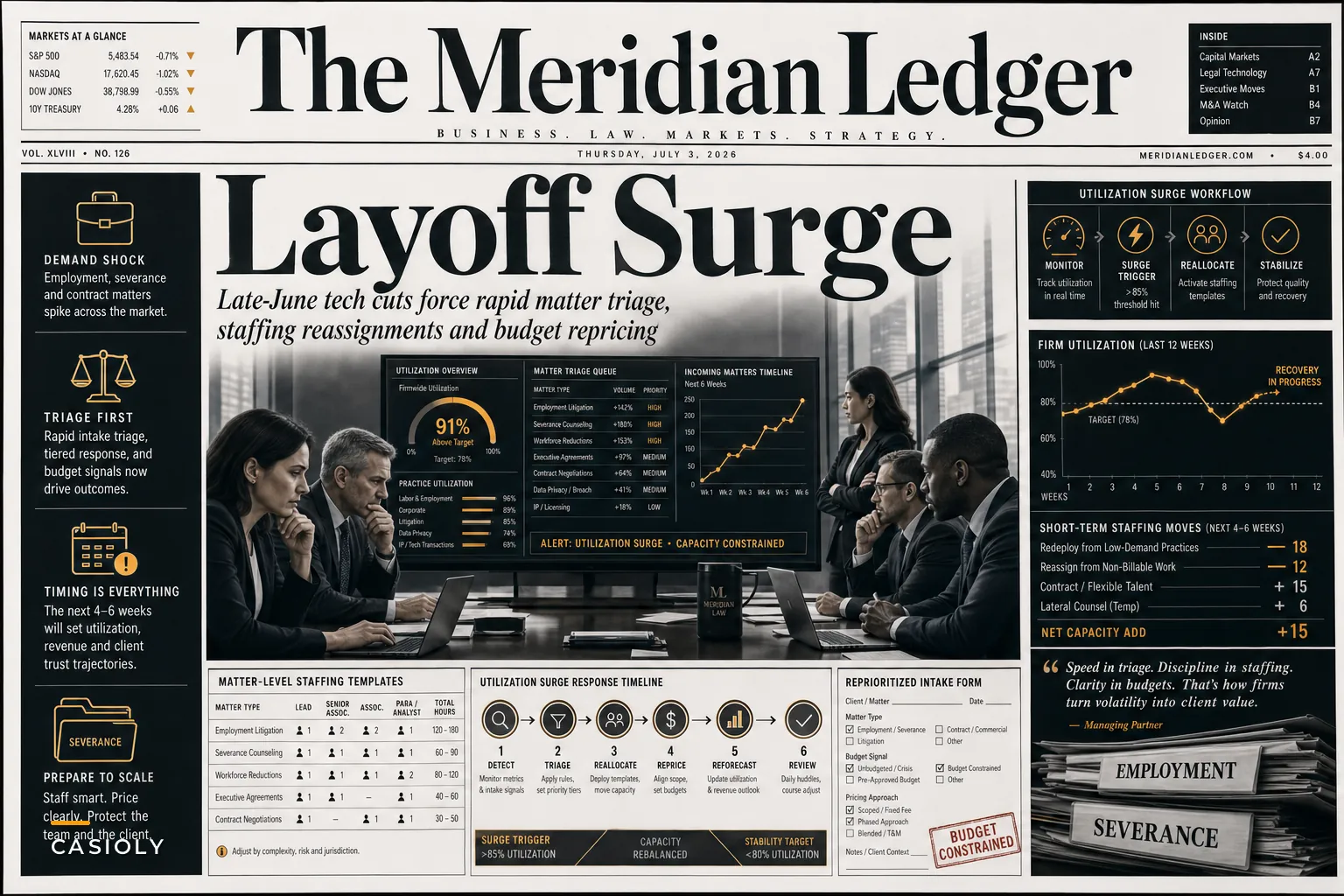

Oracle just cut 21,000 positions. Meta, Amazon, and a handful of other tech giants announced similar reductions within 48 hours of each other. If you're managing a law firm's operations right now, you're probably already seeing the first waves—urgent employment matters from tech clients, budget freeze notifications, partners asking why utilization forecasts suddenly look off.
The running list from TechCrunch makes clear this isn't scattered downsizing. These tech layoffs law firms are dealing with represent a concentrated shift happening across an entire industry at the same time. What separates this from past cycles is the speed—companies are executing workforce changes in days, not months.
The operational challenge isn't just volume. It's that these matters arrive with competing priorities, compressed timelines, and clients who suddenly need to renegotiate everything from retainer agreements to matter scopes mid-stream.
Why standard intake processes break under this pressure
Most firms run intake assuming relatively predictable matter flow. A corporate client might generate 8–12 matters monthly, employment issues trickle in quarterly, litigation follows multi-month cycles. This week blows up that math entirely.
Take a mid-sized firm with four tech clients. Normally they'd see maybe two employment matters per quarter across that portfolio. This week alone, they're fielding:
-
47 individual severance reviews
-
3 class-action exposure assessments
-
11 vendor contract termination reviews
-
2 urgent WARN Act compliance audits
Their intake coordinator, who usually processes around 15 matters weekly, is suddenly facing triple that. The senior associate handling employment work is already at 95% utilization. The litigation partner overseeing potential class actions is traveling.
Traditional triage fails because it assumes you can slot matters into neat priority buckets. But when Oracle's legal team calls about potential WARN Act violations while laid-off executives need severance reviews by Friday and your biggest client just froze all non-critical legal spend—which matter actually gets resources first? There's no clean answer in a standard intake workflow.
The hidden staffing crisis nobody talks about
Resource allocation during these surges reveals a deeper problem most firms won't openly admit: they don't actually know their true capacity. Sure, they track billable hours and monitor utilization. But those metrics assume steady-state operations.
Never miss a critical deadline again.
Casioly helps legal teams manage cases efficiently and stay on top of critical tasks.
- Centralized case tracking
- Automated deadline reminders
- Secure client communication
No credit card required
Your employment team gets slammed with severance reviews. Partners pull associates from corporate matters to help. Those corporate matters slow down. Clients notice. Meanwhile, associates handling urgent employment work can't properly document their time because they're jumping between matters every 30 minutes. Your utilization data becomes essentially meaningless.
One firm found their "available" senior associate capacity was roughly 40% lower than reported—associates were spending 12–15 hours weekly on non-billable crisis coordination. Updating partners, reassigning work, training overflow staff on unfamiliar matter types.
The staffing templates most firms use assume predictable matter types with known complexity. A standard employment matter might look like:
-
Partner
3 hours oversight
-
Senior Associate
12 hours drafting
-
Junior Associate
8 hours research
-
Paralegal
6 hours document prep
Severance negotiations for senior tech executives don't follow that pattern. Equity clawbacks, non-compete jurisdiction issues, deferred compensation structures, IP assignment complications. That "12-hour" senior associate allocation becomes 28 hours. Multiply that by 47 matters arriving simultaneously and the staffing model breaks entirely.
Matter economics that force uncomfortable partner conversations
Budget pressure from the tech layoffs law firms are managing goes beyond employment work alone. These companies are cutting legal budgets while simultaneously generating more urgent matters. It's a resource paradox that breaks traditional matter economics.
Consider what happens when a tech client that typically approves $45k monthly legal spend suddenly institutes a $20k cap—while asking you to handle employment matters, contract exits, data retention for departed employees, and IP assignment verification all at once.
You can't do everything within that budget. You also can't decline matters without risking the relationship. That forces operational decisions firms usually avoid.
| Matter Type | Typical Budget | Compressed Budget | Risk of Deferral |
|---|---|---|---|
| Executive severance review | $8,500 | $3,500 | High liability exposure |
| Vendor contract termination | $6,200 | $2,800 | Immediate penalties |
| WARN Act compliance | $12,000 | $5,500 | Regulatory fines |
| IP assignment audit | $7,800 | Defer | Future litigation risk |
| Non-compete review batch | $15,000 | $6,200 | Talent acquisition delays |
Partners resist these conversations because they expose uncomfortable truths about matter profitability. That prestigious tech client generating $2.8M annually? Once you factor in emergency staffing, weekend work, and constant scope changes, margins can drop below 20%. Most partners know this but prefer not to look directly at the numbers.
Building dynamic utilization models that actually work
Static utilization targets assume predictable workflows. They fall apart during surge events because they can't account for task-switching overhead, knowledge transfer time, or the quality degradation that comes from overload.
Most firms target 85–90% utilization for associates. During surge periods, they'll push toward 95%+ thinking they're maximizing capacity. What actually happens is overall productivity drops. An associate at 95% handling familiar matters might maintain quality. That same associate juggling unfamiliar employment work while training paralegals and updating three partners? Effective output probably drops to around 60% of normal.
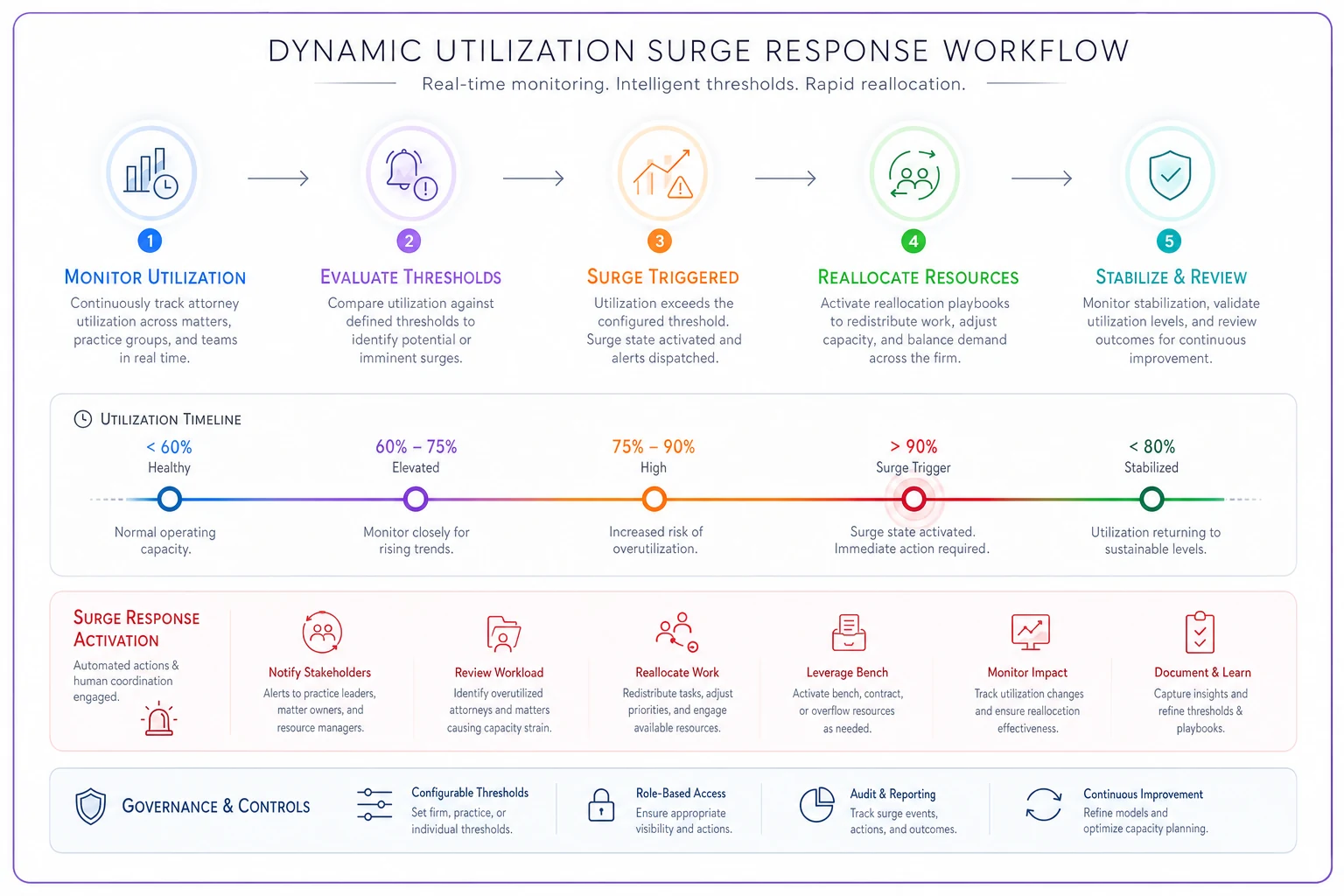
This diagram shows how utilization thresholds trigger reallocation during surges.
-
Surge capacity pools
Keep roughly 15% of associate time unallocated for surge response. This means accepting 85% baseline utilization.
-
Cross-training investment
Every associate spends a few hours monthly working outside their primary practice. Corporate associates review employment agreements. Litigators draft contract terminations.
-
Escalation triggers
When any practice area hits 90% utilization for five consecutive days, automatic reallocation kicks in. No partner approval needed for the first 48 hours.
-
Quality checkpoints
At 93% utilization, all work gets secondary review. The time investment prevents downstream corrections.
These buffers feel expensive during normal operations. During surge weeks, they're what keeps things manageable rather than chaotic.
The delegation matrix everyone needs but nobody builds
When tech layoffs law firms must handle create surge conditions, delegation patterns that work during normal operations fall apart fast. The senior associate who typically reviews junior work is now drafting emergency motions. The partner overseeing matters is in back-to-back client calls.
A functional delegation matrix for surge conditions looks different from the norm:
Normal State Delegation:
-
Partner → Senior Associate (strategy)
-
Senior Associate → Junior Associate (execution)
-
Junior Associate → Paralegal (administration)
Surge State Delegation:
-
Partner → Senior Associate (triage only)
-
Senior Associate → Any available Senior OR Junior (based on matter complexity scoring)
-
Junior Associate → Authorized to self-assign from queue
-
Paralegal → Direct client communication for defined topics
The key difference is that surge delegation removes hierarchical approval chains for defined matter types. A junior associate seeing an urgent severance review in the queue can self-assign if they've completed the relevant cross-training. They don't wait for senior approval.
This terrifies partners. Until they realize the alternative is matters sitting untouched for 72 hours while clients grow frustrated.
Technology automation that prevents bottlenecks rather than creating them
The irony of tech companies laying off workers due to AI advancement while law firms scramble to handle the legal aftermath manually isn't lost on anyone. But the answer isn't wholesale automation—it's targeted operational enhancement.
Document assembly for severance agreements seems obvious until you realize every tech executive negotiation involves unique equity structures, custom vesting schedules, and jurisdiction-specific non-compete language. Pure automation fails there.
What works is AI-assisted operational software handling the routine work while flagging the pieces that actually need human judgment. A platform that can parse incoming severance agreements and surface non-standard terms, track matter status across dozens of simultaneous reviews, alert when utilization thresholds trigger reallocation needs, and generate first drafts while preserving negotiation flexibility.
The firms managing this surge effectively aren't those with the most technology. They're the ones who built operations assuming surges would happen, then enhanced those operations with intelligent automation at the task level. That distinction matters more than it sounds.
Warning signs your firm isn't ready for the next surge
Clear patterns show up between firms that adapt and those that struggle through disruptions like this:
Red flags indicating operational fragility:
-
Utilization regularly exceeds 92% without any surge events
-
Cross-practice collaboration requires partner coordination
-
Matter budgets can't be modified without committee approval
-
Associates work exclusively within single practice areas
-
Staffing decisions require 48+ hours for approval
-
No documented escalation triggers exist
Operational readiness indicators:
-
Maintained surge capacity even during slow periods
-
Junior staff trained across multiple practice areas
-
Matter triage authority distributed below partner level
-
Budget modification protocols that activate automatically
-
Real-time utilization visibility across all timekeepers
The firms struggling this week aren't necessarily smaller or less sophisticated. They're the ones who optimized for efficiency during stable periods without building any surge resilience. Efficiency and resilience are not the same thing, and most firms only discover the difference when it's already too late.
Turning crisis patterns into competitive advantage
Every surge eventually ends. The tech layoffs law firms are managing today will normalize into steady-state employment work within a couple months. But the operational patterns exposed during crisis contain insights most firms ignore once the pressure subsides.
A boutique firm specializing in tech sector work tracked every allocation decision during their surge week and found:
-
Around 65% of "urgent" matters could have been handled with a 24-hour delay without client impact
-
Senior associates were spending roughly 4 hours daily on work paralegals could handle with proper templates
-
Matter scoping conversations averaged 47 minutes but could be cut to 15 with structured intake
-
Client communication consumed about 20% of billable time due to lack of centralized status tracking
They rebuilt operations around those findings. Nothing revolutionary—structured intake questionnaires, paralegal-authorized communications for defined topics, automatic matter status updates pushed to clients daily. Simple changes that only became visible because a surge forced them to actually look.
Six months later, they handled 40% more matters with the same headcount. Not by working harder, but by eliminating the friction their surge week exposed.
The reality of operating through disruption
Tech industry disruptions aren't going to stop. The CNBC report on Oracle's cuts explicitly tied the workforce reductions to AI transformation. This isn't a one-time adjustment—it's an ongoing shift that will keep generating legal work as companies restructure, employees transition, and contracts need renegotiation.
Law firms can't simply staff up for surge capacity they might need twice a year. The economics don't support maintaining idle resources. But they also can't assume traditional operating models will hold up through these disruptions.
That means accepting some uncomfortable realities. The 95% utilization target might need to come down to 85%. Rigid practice area boundaries might need to blur. Hierarchies of delegation might need surge-condition overrides built in.
Smart firms are building what amounts to operational surge protocols—documented, tested, and ready to activate. They're investing in cross-training even when partners question the ROI. They're maintaining capacity buffers even when competitors are touting higher utilization numbers. When the next wave of tech layoffs hits law firms with urgent matters, compressed timelines, and budget constraints, the firms that get through it won't be the ones with perfect efficiency metrics. They'll be the ones who built operations expecting disruption and enhanced those operations with automation where it actually helps.
The question isn't whether your firm will face another surge—it's whether your operations will bend without breaking when it arrives.
Ready to elevate your legal practice management?
Join 500+ law firms using Casioly to optimize case workflows, reduce administrative burden, and improve client satisfaction.