

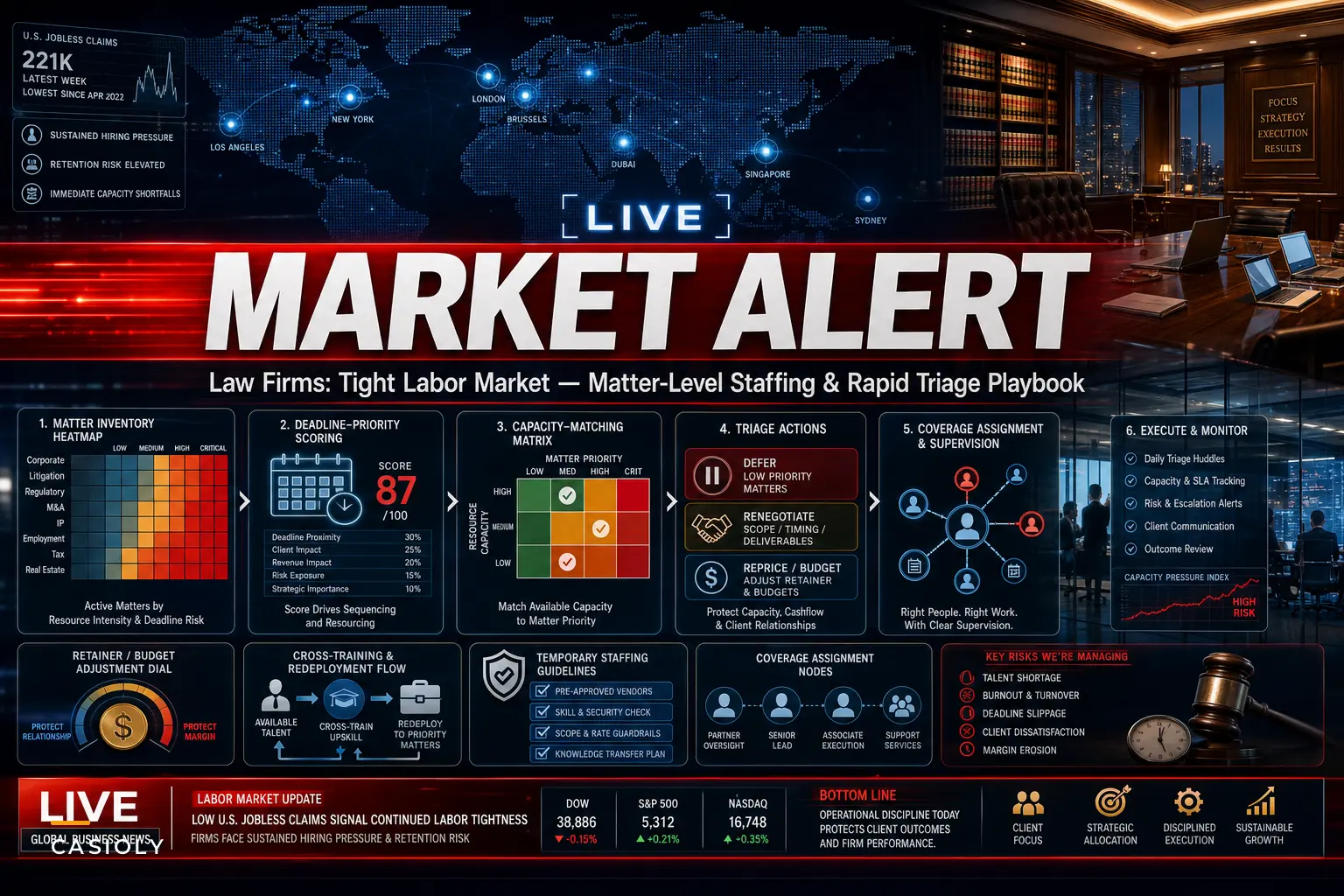

The labor market isn't giving firms a break. As of late October 2026, weekly initial jobless claims were hovering near 57-year lows — roughly 194,000, according to a recent Reuters report. For most industries that's just a headline. For a 25-lawyer firm trying to fill two paralegal seats before year-end closings, it's a very specific operational problem: fewer qualified applicants, longer time-to-hire, and salary expectations that have quietly crept up another notch.
Firms rarely experience a tight labor market as "we can't hire." They feel it downstream — a litigation paralegal quits in November, three matters suddenly have no owner for discovery work, and a partner finds out two days before a filing deadline. The labor market is the weather. The real problem is that most firms have no system for absorbing a staffing shock before it lands directly on a matter.
That's what this piece is about. Not generic retention advice. The actual mechanics of running matter staffing when the talent pool is thin.
The hidden tax of a tight market isn't salary — it's coverage fragility
Everyone fixates on wage inflation, and yes, paralegal and litigation support comp has moved. But the more expensive problem is coverage fragility — how badly a single departure disrupts active matters.
In a loose labor market, a resignation is annoying but manageable. You backfill in six weeks, work gets slightly delayed, nobody notices much. In a tight market, that same seat can sit open for three to four months. And during those months, the work doesn't pause. It gets shoved onto whoever is nearest — usually an associate billing at a rate that makes the reassignment economically absurd, or a partner who stops doing business development to do document review.
The cost of tightness shows up as misallocated work, not empty seats. A firm can look fully staffed on paper while quietly burning partner hours on tasks a $70k paralegal should own.
Consider a mid-size commercial litigation group that loses one of its two senior paralegals in September. Rather than slow down, the remaining paralegal and two associates absorb the gap. By December, those associates are tracking toward 2,400 annualized hours — but roughly 300 of those hours are paralegal-grade work billed at associate rates that clients will push back on. The firm didn't save money by not backfilling. It just moved the loss from the hiring line to the write-down line.
Why firms get blindsided: staffing lives in people's heads
The weakness most firms share is that staffing allocation is informal. Who's working on what, at what capacity, with how much slack — it lives in a practice group leader's memory and a handful of scattered spreadsheets.
Never miss a critical deadline again.
Casioly helps legal teams manage cases efficiently and stay on top of critical tasks.
- Centralized case tracking
- Automated deadline reminders
- Secure client communication
No credit card required
That works fine when turnover is low and hiring is easy. It falls apart the moment you need to answer a hard question quickly:
-
If this person leaves, which matters go uncovered?
-
Who actually has capacity to absorb redistributed work this week — not "seems busy," real capacity?
-
Which active matters can tolerate a two-week delay, and which absolutely cannot?
When those answers aren't written down somewhere reliable, every staffing shock turns into a scramble. In a tight market, those scrambles happen more often and last longer, because you can't just hire your way out in a few weeks.
This connects to a deeper discipline around not letting utilization run blind. We've written separately about building matter-level staffing templates and utilization forecasts, and that foundation becomes far more critical when backfill timelines stretch. The templates stop being a planning exercise and start being your shock absorber.
A triage framework for staffing shocks
When a departure hits — or when you simply can't fill a role before a crunch — you need a repeatable way to decide what gets covered first. Firing off emails asking "who can take this?" is not a system.
Below is a workable triage sequence. The goal isn't elegance; it's making decisions in hours instead of days.
-
Freeze the matter inventory of the departing role. Pull every matter that person touched and the specific tasks they actually owned — not the matters they were nominally "staffed on."
-
Score each affected matter on two axes
deadline proximity and client sensitivity. A filing due in ten days for your second-largest client is a different animal than a dormant matter with no near-term action.
-
Separate true deadlines from soft ones. Court dates and statutory deadlines are immovable. Internal "we told the client Friday" dates often have slack you can negotiate. Firms routinely treat both as equally rigid and panic unnecessarily.
-
Match high-priority tasks to real capacity, not seniority. The instinct is to hand urgent work to the most senior available person. The better move is often finding genuine slack lower in the org and supervising it closely.
-
Defer or renegotiate the low-priority tail. For low-sensitivity, no-near-deadline matters, a deliberate pause is a legitimate decision. The mistake is letting those matters quietly rot instead of consciously parking them.
The step most firms skip is number three. Treating every date as sacred forces over-allocation of scarce people to work that could have waited. In a tight market, the ability to distinguish a real deadline from a self-imposed one is worth a full-time hire.
The diagram below maps the triage sequence.
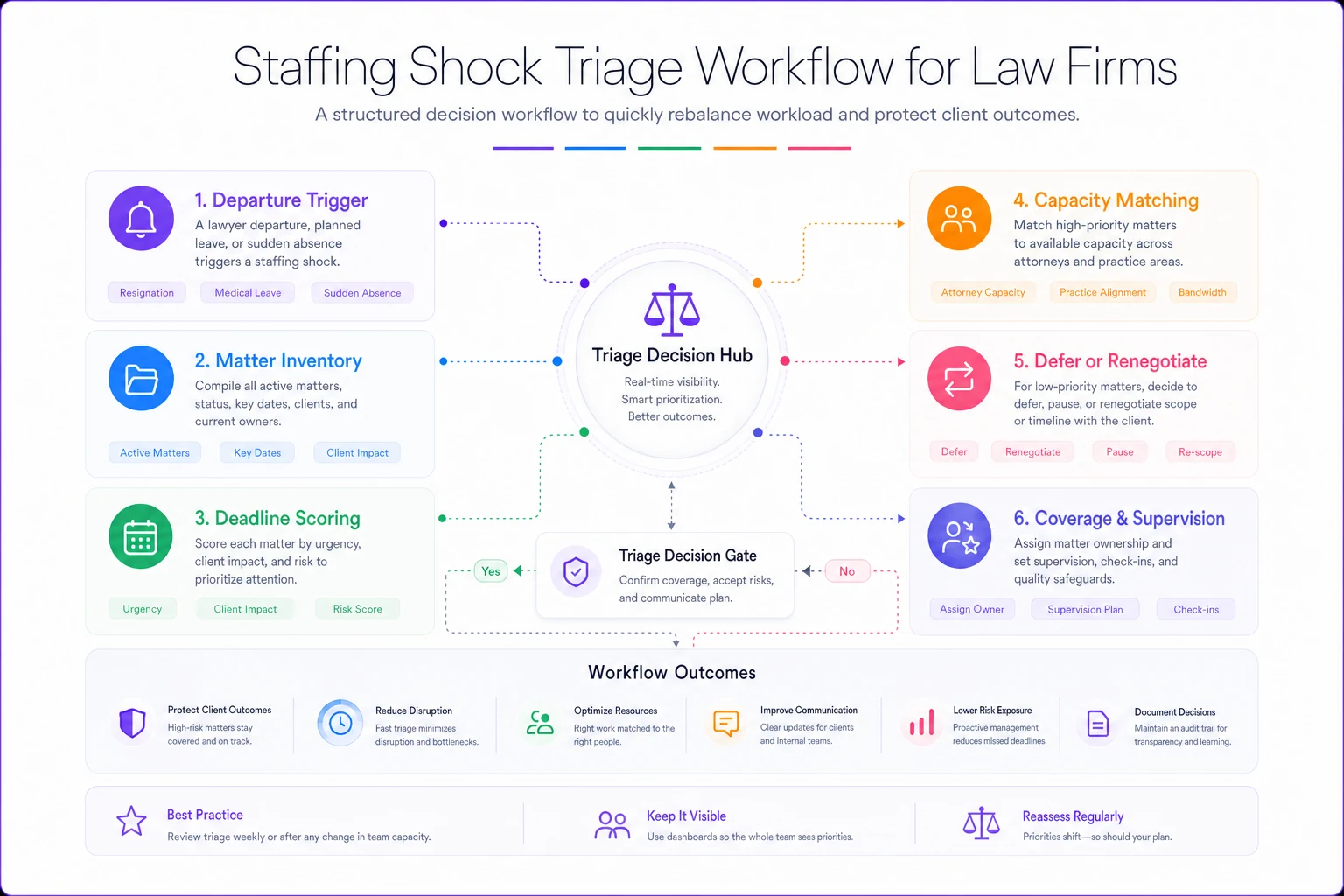
Once the triage sequence runs, the output should be a short written list — not a mental map. Who owns what, which matters are parked and why, and who's supervising the redistributed work. That document becomes the reference point for the next three to four months while the seat is open.
Redeployment beats hiring when the clock is short
When time-to-fill is long, internal redeployment is usually faster and cheaper than external hiring — if you can see capacity clearly. The problem is that "capacity" is one of the most misleading numbers in a law firm. Everyone is "slammed." Few are actually at capacity in a way that holds up when you look at the real workload.
| Situation | Hire externally | Redeploy internally |
|---|---|---|
| Permanent, structural workload increase | ✅ Best fit | ❌ Only a stopgap |
| Short-term spike (year-end closings, trial prep) | ❌ Too slow | ✅ Faster, cheaper |
| Specialized skill gap (e-discovery, niche practice) | ✅ Often necessary | ⚠️ Only if skill exists internally |
| Sudden departure mid-matter | ⚠️ Backfill in parallel | ✅ Immediate coverage |
| Uncertain demand, cautious growth | ⚠️ Risky commitment | ✅ Lower-risk first move |
Firms that handle tight markets well lean on the right column harder than their peers — not because they love reshuffling people, but because they have enough visibility into actual utilization to redeploy with confidence instead of guesswork.
When redeployment is the wrong call
-
The workload increase is clearly permanent, and you're just delaying an inevitable hire while burning out your best people.
-
The gap requires a genuine specialty nobody internal has. Shuffling a corporate paralegal onto a complex e-discovery matter creates risk, not coverage.
-
You've already redeployed the same handful of reliable people three times this quarter. That's not flexibility — that's the early stage of their resignation.
If you're reaching for redeployment every month, the real signal is that baseline staffing is too thin for your matter load, and the tight market is simply exposing it.
Retention math changes when replacement cost rises
In a loose market, losing a good paralegal is a setback. In this market, it's expensive in ways that are easy to underestimate. Factor in the recruiting spend, three to four months of open-seat drag, ramp time for whoever you eventually hire, plus the realization you lose when associates and partners cover the gap at the wrong rates. For a strong senior paralegal, that total can quietly run well past a year of their salary.
That math should reshape retention priorities. A targeted counteroffer, a workload adjustment, or a mid-year comp correction that would have felt extravagant a few years ago is often cheaper now than the departure it prevents. The firms that get burned are the ones still running on pre-tightness replacement-cost assumptions.
-
Predictable workload. Support staff don't always leave over pay — often it's the fourth consecutive weekend spent on someone else's poorly planned matter. Visible, balanced allocation is itself a retention tool.
-
Clear ownership. People burn out faster when accountability is murky and they absorb everyone's loose ends by default.
-
Not being the permanent redeployment target. Your most capable people get pulled into every fire. If they never get a stable run on their own matters, they'll eventually leave for somewhere that offers one.
If you're reaching for redeployment every month, the real signal is that baseline staffing is too thin for your matter load, and the tight market is simply exposing it.
A short real scenario
A regional firm — around 40 attorneys, mixed litigation and transactional — lost a senior litigation paralegal in early fall, right before a stretch of year-end deal closings and a trial-prep crunch. Hiring stalled; two solid candidates took competing offers before the firm could move fast enough.
Instead of letting the gap land wherever it fell, the practice group leader ran a basic triage. They listed every matter the departing paralegal had been doing hands-on work on, flagged the three with hard near-term dates, and identified which deadlines on the rest were internal and movable. Two matters got consciously parked for six weeks with client sign-off. The urgent discovery work went to a junior paralegal from the transactional side — someone with real slack — supervised closely, rather than defaulting to an associate.
The outcome: associate overflow hours that quarter came in noticeably lower than the prior year's comparable crunch, write-downs on the affected matters stayed modest, and the backfill hire — who landed about ten weeks later — walked into matters that were organized rather than on fire. Nothing dramatic. Just the difference between a managed shock and a chaotic one.
The point isn't the specific numbers. It's that the firm had a way to see who did what and where real capacity actually sat. That visibility is what turned a potential deadline crisis into a routine reshuffle.
What to put in place before the next departure
You can't control the labor market, but you can make your firm far less fragile to it. A short checklist to pressure-test your current state:
-
- [ ] For every active matter, is it clear who owns which tasks — not just who's "on the matter"?
-
- [ ] Could you produce, within an hour, a list of matters that lose coverage if any single support person leaves?
-
- [ ] Do you track real utilization, or do you rely on people self-reporting that they're "slammed"?
-
- [ ] Have you separated hard statutory/court deadlines from soft internal ones across your active matters?
-
- [ ] Do you know your true fully-loaded cost of a vacancy for key roles — including lost realization?
-
- [ ] Is there a documented triage sequence, or does each departure trigger a fresh scramble?
-
- [ ] Are your most-redeployed people getting any stability, or are they quietly becoming flight risks?
If you can't confidently check most of these, the next resignation will cost more than it should — and in this market, the next resignation is never far off.
Where this leaves firm leaders
Tight labor markets don't reward firms that hire fastest. They reward firms that are hardest to knock off balance.
The difference is almost entirely about visibility: knowing who's actually doing what, which matters can bend and which can't, and where real capacity lives before you need it. That's unglamorous operational work. It won't show up in a pitch deck or a ranking. But when a key paralegal gives notice in the middle of your busiest quarter, the firms that treated staffing as a real system — not a memory exercise — are the ones that absorb the hit and keep their deadlines, their margins, and their remaining people intact. In a market this tight, that resilience is the whole game.
The difference is almost entirely about visibility: knowing who's actually doing what, which matters can bend and which can't, and where real capacity lives before you need it. That's unglamorous operational work. It won't show up in a pitch deck or a ranking. But when a key paralegal gives notice in the middle of your busiest quarter, the firms that treated staffing as a real system — not a memory exercise — are the ones that absorb the hit and keep their deadlines, their margins, and their remaining people intact. In a market this tight, that resilience is the whole game.
Ready to elevate your legal practice management?
Join 500+ law firms using Casioly to optimize case workflows, reduce administrative burden, and improve client satisfaction.