

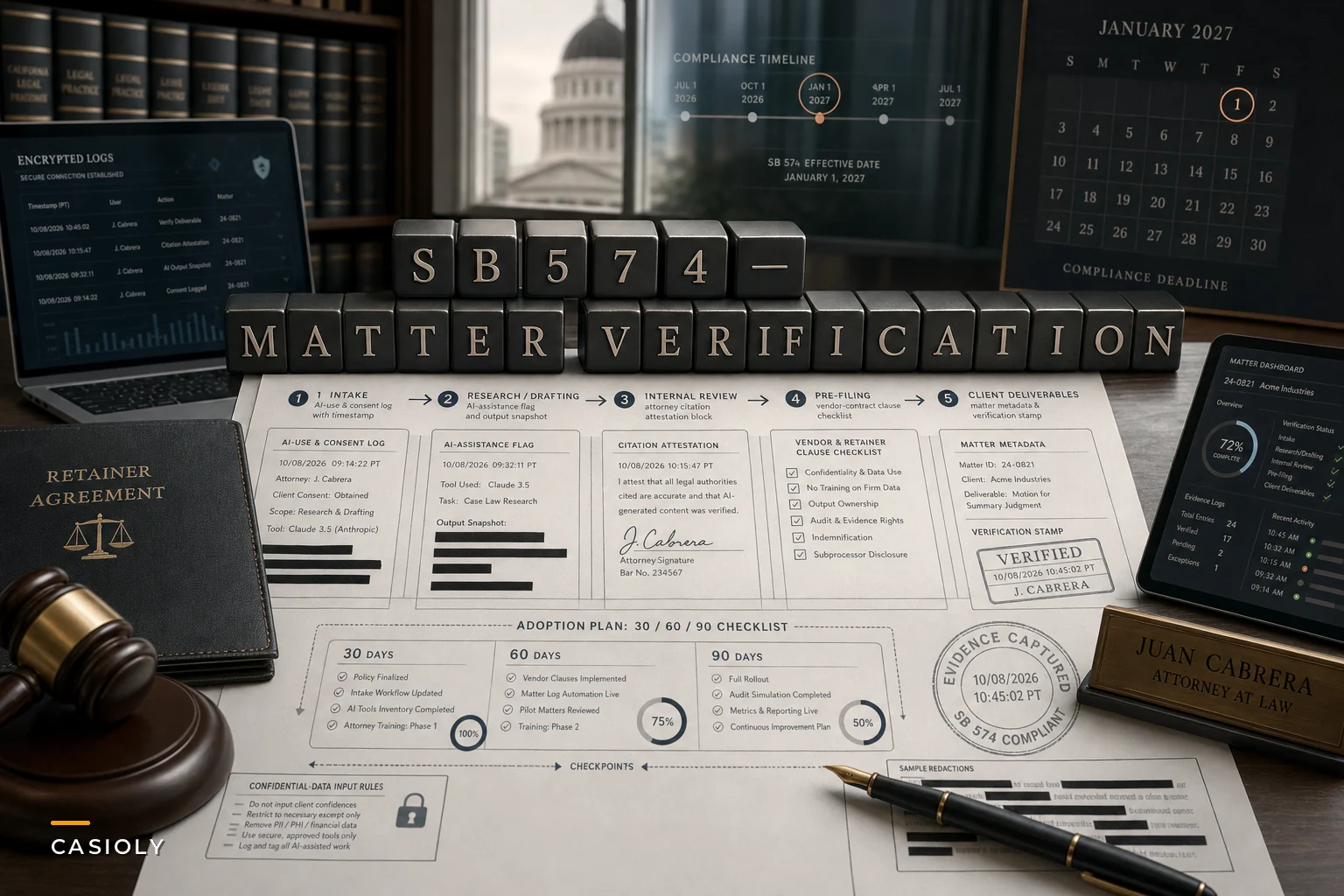

When Governor Newsom signed SB 574 at the end of September, a lot of firms treated it as a press-release moment — forward the article to the risk committee, nod seriously, move on. That's a mistake. The parts of this law that actually hurt aren't the headline principles ("you can't delegate the practice of law to a machine"). The parts that hurt are the quiet operational requirements buried underneath: you now need evidence that a human verified AI output before it went into a filing, you need controls that stop confidential client data from being pasted into tools that haven't been vetted, and you need all of it tied to specific matters and specific attorneys.
If your firm has a California footprint — or you're multi-state and California is the strictest jurisdiction you touch — the clock runs to January 1, 2027. That's not a lot of runway for workflow changes that need partner buy-in.
What the law actually forces you to change
The Reuters coverage of SB 574 does a clean job summarizing the four pillars: no delegating legal work to AI, restrict confidential/nonpublic client data going into AI systems unless access is properly limited, take reasonable steps to verify AI output including citations, and no citations in California court filings that the responsible attorney hasn't personally verified.
Read those as four principles and they sound obvious. Read them as an auditor would — "show me how you know this happened" — and they turn into concrete process requirements. The practical summary from Holland & Knight is worth circulating internally because it flags the effective date and the supervisory angle, which is where most firms are underprepared.
The real problem this exposes: your workflow has no memory
Most matter workflows were never built to prove what didn't happen or who checked what. They track deadlines, documents, billing, maybe status. They don't capture the moment a brief was drafted with AI assistance, or whether the associate ran the cites through a verification step, or what data went into the tool.
Never miss a critical deadline again.
Casioly helps legal teams manage cases efficiently and stay on top of critical tasks.
- Centralized case tracking
- Automated deadline reminders
- Secure client communication
No credit card required
That gap is the actual compliance risk. SB 574 doesn't just ask you to behave well — it effectively asks you to reconstruct good behavior after the fact if a client, a court, or the bar comes asking. And reconstruction is where firms fall apart.
A few patterns that tend to cause problems:
-
The "trusted associate" blind spot. Senior people assume their juniors verify output. Juniors assume senior review will catch problems. Nobody owns the verification checkpoint, so it lives nowhere.
-
Shadow tools. The intake paralegal uses a free summarizer. The litigation associate has a personal Claude account. The firm's vetted tool is one of five actually in use, and only one of them appears in any policy.
-
Confidential data leaking through convenience. Someone pastes a deposition excerpt to "clean up the formatting." Technically that's nonpublic client data going into a system with unclear access limits. No one logged it. No one even thought of it as an event.
The underlying issue is that verification and AI-use are events in a matter's life, and your system probably has no place to record them.
Where verification checkpoints actually belong in the matter lifecycle
Don't bolt a generic "AI policy" onto the firm and call it done. Tie the controls to the stages where exposure is real. Here's how the checkpoints map against matter stages for a litigation-heavy practice:
| Matter Stage | AI Exposure Risk | Required Checkpoint | Evidence to Capture |
|---|---|---|---|
| Intake / conflicts | Pasting client narrative into unvetted tools | Pre-approval of tool + data-scope confirmation | Tool used, data category, approver |
| Research / drafting | Hallucinated authority, fabricated cites | Citation verification before internal review | Who verified, source confirmed, timestamp |
| Internal review | Assuming prior stage verified | Second-pass attestation by responsible attorney | Attorney attestation tied to document version |
| Pre-filing | Unverified cites reaching the court | Hard-stop verification gate before filing | Signed verification log per filing |
| Client deliverables | Confidential data in output | Confidentiality/data-input check | Confirmation no restricted data was exposed |
Here's a visual of how those checkpoints fit into a matter flow.
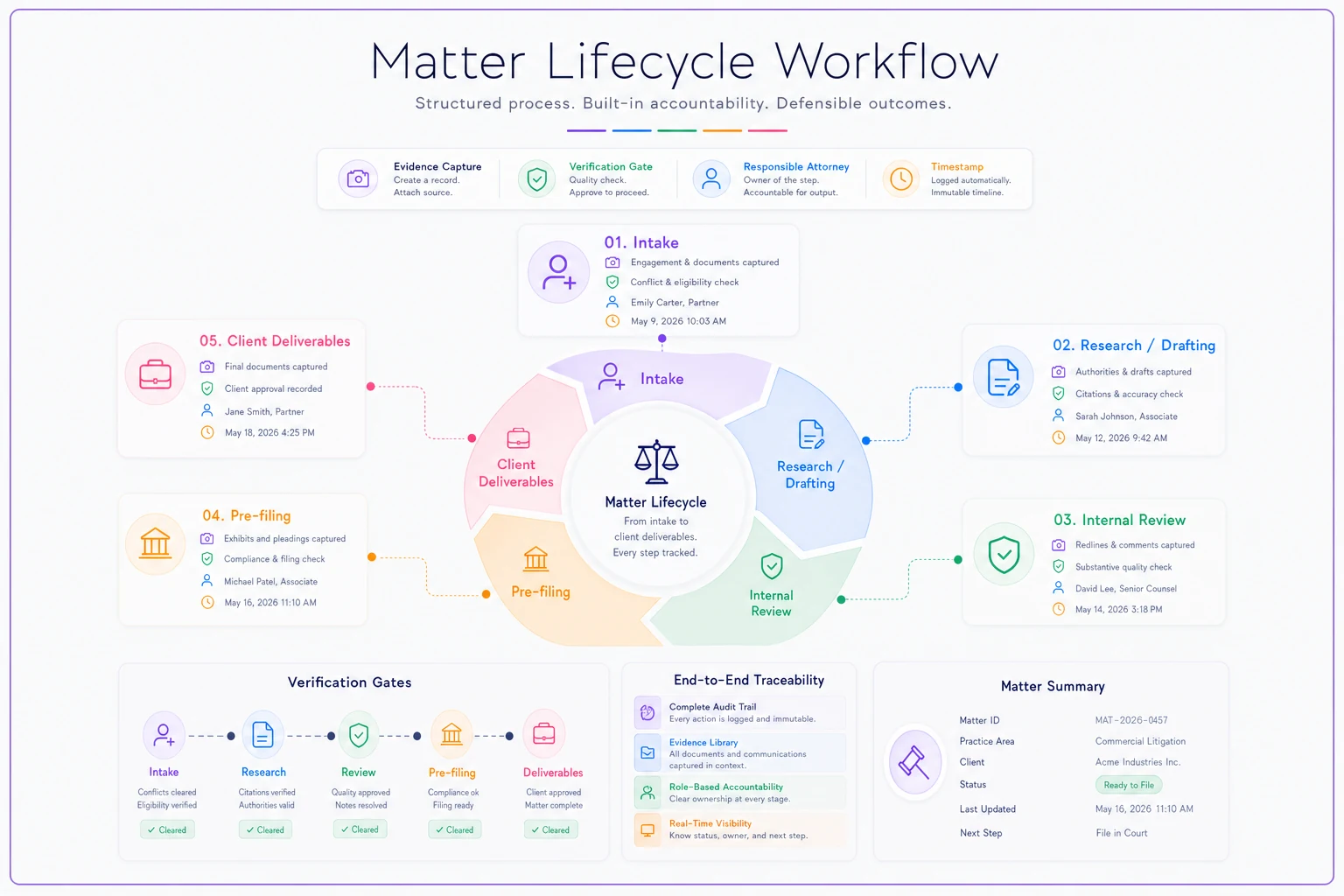
The pre-filing gate is the one worth obsessing over. California's rule about court filings is the sharpest edge in the whole statute — a single fabricated citation in a brief is the kind of thing that ends up in an opinion with your firm's name attached. That checkpoint should be a hard stop, not a reminder.
Building the AI-use log without drowning your attorneys
The instinct is to create a massive compliance form. Don't. If logging takes more than a few seconds, attorneys route around it, and you're worse off than before because now you have a policy you're violating instead of a gap you're managing.
A workable AI-use log captures the minimum that proves the story:
-
Matter number — ties the event to a specific client engagement.
-
Tool used — from the firm's approved list, or flagged as "other" (which should trigger review).
-
Data category entered — public/general, client-nonpublic-with-limits, or restricted (restricted should be a near-impossible path).
-
Output type — research, drafting, summarization, correspondence.
-
Verification status — verified / not-yet-verified / N/A.
-
Responsible attorney — the name that answers for it.
-
Timestamp — automatic, not manual.
Keep the log to the minimum fields listed so attorneys actually use it.
Notice what's not on there: the full prompt, the entire output, pages of narrative. You don't need a transcript. You need a defensible record that a human owned the output and verified what the law requires. Over-collecting creates its own privilege and discovery headaches.
This also connects to good evidence-capture habits more broadly. The discipline of logging advice and decisions as they happen — the same discipline covered in our breakdown of malpractice-ready evidence capture — is exactly the muscle SB 574 is now forcing firms to build for AI specifically. Firms that already keep clean advice logs will find this far less painful than firms starting from zero.
Intake safeguards: stop the leak before it starts
Verification protects the output end. Intake protects the input end, and it's the part most firms forget.
The confidential-data restriction means your intake process needs to decide, early, what data about a matter can touch which tools. A typical failure looks like this: a new matter comes in, the intake team summarizes the client's situation using whatever's handy, and nobody classified the data first. Now you've got nonpublic facts sitting in a system you never vetted, before the engagement letter is even signed.
-
Classify at intake, not later. Flag matters involving sealed records, trade secrets, health data, or anything where client confidentiality is heightened. These get tighter AI-tool restrictions by default.
-
Approved-tool allowlist, enforced technically where possible. A policy document nobody reads is not a control. Blocking consumer AI endpoints on firm devices is.
-
Engagement-letter and retainer language updates. Clients increasingly want to know your AI posture. Say it plainly — what you use, what you don't, how you protect their data. Some clients will have their own restrictions you need to honor.
-
A "when in doubt, don't" default. If the data category is unclear, the tool is off-limits until someone classifies it.
The mistake worth warning against most: treating intake AI rules as separate from your existing conflicts and data-classification steps. They're the same decision point. Bolt them together so staff make one classification, not three.
Vendor due diligence: the part that takes longest
If there's one thing to start this week, it's vendor review. SB 574's data-restriction requirement depends on your AI tools actually limiting access appropriately — and you can't attest to that without diligence you may not have done.
For each tool in actual use, you need to know:
-
Where does the data go, and is it used for training?
-
What are the access and retention controls?
-
Does the contract include confidentiality terms that match your client obligations?
-
Can you get audit logs out of it if you ever need to prove verification happened?
That last point gets overlooked more than the others. A tool that does great work but gives you no exportable trail of who used it, when, and on what is a tool that can't support your compliance story. Prioritize vendors that produce auditable records.
Vendor contracts are slow. Redlines take weeks, security reviews take longer, and you're competing with every other firm doing the same scramble before year-end. Start now.
A short real-world scenario
Picture a mid-size firm — 40 or so attorneys, mixed litigation and transactional, offices in LA and one out of state. Before any of this, their "AI policy" was a two-paragraph email from the managing partner saying "be careful with ChatGPT." No logging, no allowlist, no intake classification tied to AI.
When they actually mapped tool usage, they found something like nine different AI tools in use across the firm, only two of which anyone in management knew about. Two associates admitted to pasting client document excerpts into consumer tools for summarization — not maliciously, just efficiency.
The fix wasn't dramatic. They consolidated to three vetted tools, added a lightweight verification checkbox at the pre-filing stage, and folded AI-data classification into the conflicts check they were already running. The whole thing took about a quarter to roll out. The meaningful change wasn't technological — it was that verification finally had an owner and a record. When their malpractice carrier asked about AI controls at renewal, they had an actual answer instead of a shrug.
Shadow tools dropped from nine to effectively zero on firm devices, and every filing after the rollout carried a verification log entry. That's the kind of before/after that actually protects a firm.
Who should move fastest — and who can breathe a little
Move now if you:
-
File in California courts regularly
-
Have associates who draft research-heavy briefs
-
Already know AI tools are in use but can't name them all
-
Handle matters with heightened confidentiality obligations
You have slightly more room if you:
-
Have a small, fully transactional practice with minimal court filings
-
Already run disciplined advice logs and data classification (you're extending an existing system, not building one)
-
Have already blocked consumer AI tools technically
But "more room" is relative. The effective date applies to everyone touching California practice. Even a firm that bans AI entirely needs to document that policy and prove enforcement — because "we don't use it" is also a claim you may have to back up.
Bringing it together without over-engineering
The firms that handle SB 574 well won't be the ones with the thickest policy binder. They'll be the ones who made verification and logging part of how matters already move — not a separate compliance tax attorneys resent and avoid.
Tie the checkpoints to the stages where risk is real. Keep the log short enough that people actually use it. Classify data once, at intake, alongside work you already do. Vet your tools for exportable audit trails, not just performance. And make sure every AI-touched output has a human name attached to the verification.
The law is really just formalizing something good firms were supposed to be doing anyway: knowing what went into client work, confirming it's right, and being able to prove it. Firms that already treat evidence capture as a habit will find January 1 mostly a matter of extending what they've got. The ones who've been coasting on "our attorneys know better" have about a quarter to build the muscle. Start with vendor review and the pre-filing gate — those are the two that bite hardest if you get them wrong.
The law is really just formalizing something good firms were supposed to be doing anyway: knowing what went into client work, confirming it's right, and being able to prove it. Firms that already treat evidence capture as a habit will find January 1 mostly a matter of extending what they've got. The ones who've been coasting on "our attorneys know better" have about a quarter to build the muscle. Start with vendor review and the pre-filing gate — those are the two that bite hardest if you get them wrong.
Ready to elevate your legal practice management?
Join 500+ law firms using Casioly to optimize case workflows, reduce administrative burden, and improve client satisfaction.