



Most firms don't lose money because their automations don't work. They lose money because their automations work sometimes, in ways nobody can predict. A new matter opens, but the conflict check fires twice. A calendar deadline gets created, then the source system updates the date and nothing downstream notices. A billing event drops silently because the intake record was still in "draft" when the trigger ran. None of these show up as errors. They show up three weeks later as a missed statute, a duplicate invoice, or a matter that closed on paper but never got archived.
Orchestration is the part of firm operations almost nobody names out loud, but everyone feels. It's the connective tissue between systems that each work fine on their own. And when firms start stitching intake to calendaring to billing to archive, the failures stop being about any single tool and start being about how events move between them.
This is a catalog of the patterns that hold up, the schemas worth standardizing on, and the retry and error-handling rules that keep automation from turning into a slow-motion malpractice generator.
Why matter automation breaks differently than other business automation
A retail order that fails can usually be retried with no harm. Worst case, a customer gets two shipping emails. Legal matters don't work that way. The same event replayed twice can mean two calendar entries for one deadline, two trust ledger postings, or two conflict checks that return contradictory results because the client record changed in between.
The core issue is that legal events are stateful and consequential. Each step depends on the exact state of the matter at the moment it ran, and each step often has side effects that are hard or embarrassing to undo. You can't just "run it again" the way you can with a marketing webhook.
What tends to happen across a lot of firm stacks is that the automation gets built optimistically — someone wires intake to auto-create a matter in the practice management system, wires that to auto-populate the calendar, then stacks billing on top. It works in the demo. It works for the first fifty clean matters. Then a paralegal edits an intake form after submission, or two staff open the same referral within minutes of each other, and the whole chain does something nobody designed.
The firms that survive this don't have fancier tools. They have explicit contracts between steps — a clear definition of what event means what, what happens if it fires twice, and what happens if a downstream system is briefly unavailable.
The four-stage backbone and where each handoff leaks
Think of matter orchestration as four stages connected by three handoffs. The stages are relatively safe. The handoffs are where everything goes wrong.
Never miss a critical deadline again.
Casioly helps legal teams manage cases efficiently and stay on top of critical tasks.
- Centralized case tracking
- Automated deadline reminders
- Secure client communication
No credit card required
| Handoff | What's supposed to happen | Common failure | Blast radius |
|---|---|---|---|
| Intake → Calendar | Matter opens, key dates get calculated and scheduled | Deadline computed from a field that later changes; no recompute | Missed statute / court date |
| Calendar → Billing | Time and events become billable activity | Billing starts before engagement letter is countersigned | Unbillable WIP, ethics exposure |
| Billing → Archive | Closed matter gets reconciled and retained | Matter marked closed but trust balance nonzero; archive skipped | Trust violation, records gap |
| (cross-cutting) Any → Any | State stays consistent everywhere | One system updated, others silently stale | Data drift, wrong-source decisions |
That last row is the sneaky one, and it's why integration ownership matters so much. When systems disagree about the truth of a matter, automation confidently acts on the wrong version. We've written more about that specific failure mode in Don't Let Data Drift: Integrations Governance, Ownership Matrices and Reconciliation Rules for Law-Firm Stacks — worth reading alongside this because orchestration and drift are two sides of the same coin. One is how events move, the other is how state stays honest.
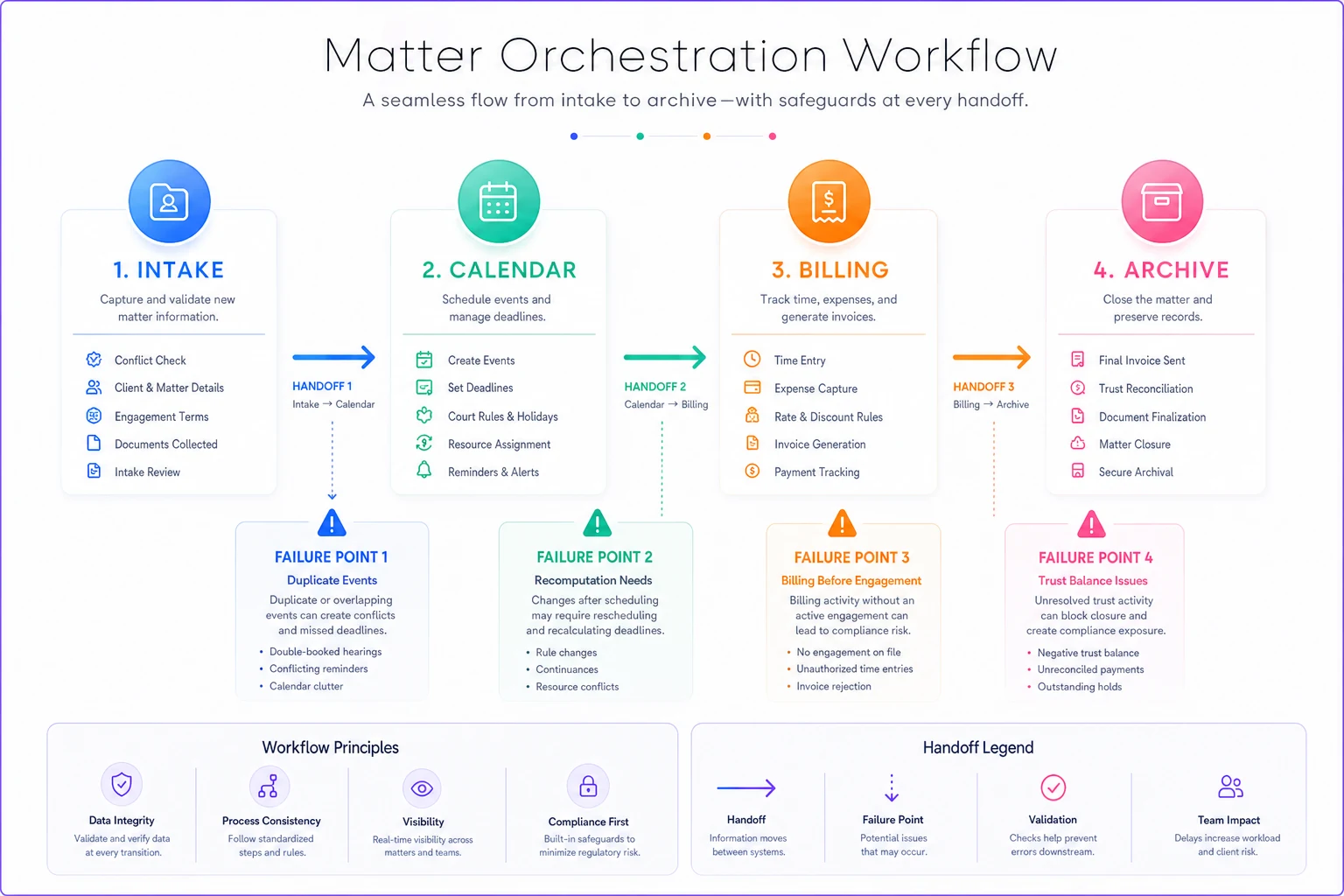
A simple diagram like this helps teams map ownership and failure modes.
Event schemas: the contract nobody writes down
The single biggest upgrade most firms can make isn't a new platform. It's writing down what an event actually contains and treating that as a contract.
Below is a workable shape for a matter-lifecycle event. Keep it boring and stable:
``json
{
"eventid": "evt9f2c1a7b",
"eventtype": "matter.opened",
"occurredat": "2024-05-14T09:12:33Z",
"idempotencykey": "matter-open-2024-0417",
"matterid": "MTR-2024-0417",
"actor": {
"userid": "u338",
"role": "intakeparalegal"
},
"sourcesystem": "intakeform",
"schemaversion": "1.2",
"payload": {
"clientid": "CLI-5521",
"practicearea": "estatelitigation",
"responsibleattorney": "u12",
"conflictcheckstatus": "cleared",
"engagementletter_status": "sent"
}
}
``
A few things in there do real work.
The idempotency_key is deterministic — built from the matter and the action, not from a random ID or a timestamp. That means if intake fires the same "matter.opened" event twice (network retry, double-click, whatever), every downstream system can recognize it's already processed that exact event and skip it. This one field prevents the duplicate-calendar-entry problem better than any amount of manual checking.
Make idempotency keys deterministic and derived from the matter/action so all consumers can detect duplicates without extra coordination.
The schema_version matters more than people expect. When you eventually change what "matter.opened" contains, older consumers shouldn't crash or silently misread fields. Versioning lets you evolve without a coordinated big-bang upgrade.
And source_system plus actor give you an audit trail without any extra work. When something posts twice, you want to know immediately whether it came from the intake form, a manual override, or a retry.
A calendar-critical event should carry the inputs the deadline was derived from, not just the deadline itself:
``json
{
"eventtype": "deadline.scheduled",
"matterid": "MTR-2024-0417",
"idempotencykey": "deadline-answer-MTR-2024-0417",
"payload": {
"deadlinetype": "answerdue",
"computedfrom": {
"triggerevent": "serviceofcomplaint",
"triggerdate": "2024-05-10",
"ruleset": "statecivil30d",
"days": 30
},
"duedate": "2024-06-09",
"dualowner": ["u12", "u_338"]
}
}
``
Carrying computed_from is what makes recomputation possible. If the service date later changes, the system can detect that the input to a scheduled deadline moved and flag or recompute — instead of leaving a now-wrong date sitting on someone's calendar. Deadlines computed from hidden inputs are the ones that kill firms.
Idempotency and retry rules that won't hurt you
The general principle: reads and recomputations can be aggressive; writes with side effects must be idempotent and cautious.
-
Is the operation idempotent? If yes (guarded by an idempotency key), safe to retry freely with exponential backoff.
-
Does it create a financial or calendar side effect? If yes, retry only if the idempotency key confirms no prior success. Never blind-retry a trust posting.
-
Is the failure transient or permanent? Timeouts, 5xx, rate limits → retry. Validation errors, 4xx, "matter not found" → do not retry; route to a human.
-
Have we exceeded the retry ceiling? Cap at a small number (3–5 attempts over a few minutes). After that, stop and escalate. Silent infinite retries are how a small outage becomes a flood of duplicate events when the system comes back.
-
Did it finally fail? Move to a dead-letter queue with the full event payload, and alert a named owner — not a shared inbox.
The mistake worth calling out: firms often set retries to "keep trying until it works." That feels safe and is actively dangerous. If a billing endpoint is down for twenty minutes and you retried a hundred queued events without idempotency guards, you get a hundred duplicate charges the moment it recovers. Bounded retries plus idempotency keys is the only combination that's actually safe.
Error handling: the difference between a hiccup and an incident
Every automated step needs to answer one question before it runs: what happens if I fail halfway?
-
Retryable technical failures — network, timeout, brief unavailability. Retry per the policy above, then dead-letter.
-
Business-rule failures — engagement letter not countersigned, trust balance nonzero at close, conflict not cleared. These should never auto-retry. They mean "a human decision is required." Route them to the responsible attorney or ops lead with the specific reason attached.
-
Data-integrity failures — matter ID doesn't exist, client record mismatch, schema version unsupported. These signal something upstream is broken. Halt that workflow branch and alert, because retrying will only propagate bad state.
The pattern that separates mature firms: they treat business-rule failures as expected outcomes, not errors. A matter that can't close because trust isn't zeroed isn't a bug — it's the control doing its job. If your automation logs that as a failure and buries it in a queue, you've turned a working safeguard into noise.
One more thing worth building early: a compensating action for anything that has partial side effects. If a workflow opens a matter, creates three calendar entries, then fails before finishing, you need a defined way to roll back or quarantine that half-created matter. Otherwise you accumulate ghost matters — half-real records that show up in reports and nowhere else.
A monitoring checklist you can actually run
Automation you can't observe is automation you can't trust. The checklist below catches the failures described above before they reach a client:
-
- [ ] Dead-letter queue depth — alert if anything sits unprocessed longer than an hour. A growing DLQ is your earliest warning.
-
- [ ] Duplicate detection rate — track how often idempotency keys catch a repeat. A sudden spike means something upstream is misfiring.
-
- [ ] Event lag — time between
occurred_atand downstream processing. Growing lag means a bottleneck forming, usually before anything visibly breaks. -
- [ ] Business-rule rejection log — matters blocked at a handoff (unsigned engagement, nonzero trust). Review daily; these are decisions waiting on someone.
-
- [ ] Recompute triggers — how often a deadline input changed after scheduling. Frequent recomputes point to sloppy intake data.
-
- [ ] Orphaned matters — records that opened but never reached a terminal state (closed or archived) after an expected window.
-
- [ ] Schema-version mismatches — any consumer receiving a version it doesn't support. This should be near zero; anything above it means a coordination gap.
-
- [ ] Archive completion rate — closed matters that actually completed reconciliation and retention. The gap between "marked closed" and "fully archived" is where records obligations quietly rot.
The firms that get burned almost always monitor uptime and ignore the DLQ. Uptime tells you the system is running. The DLQ tells you whether it's running correctly.
A real scenario: the double-billed retainer
A mid-sized litigation boutique — around 14 attorneys, somewhere near 600 active matters a year — wired their intake tool to auto-create matters and kick off retainer invoicing. Clean idea. For months it worked.
Then their billing provider had a slow afternoon. Requests timed out. Their integration was set to retry until success, with no idempotency key. When the provider recovered, the queued retries all flushed at once. Around 30 matters got duplicate retainer invoices, and about a dozen went out to clients before anyone noticed. Two clients disputed. One relationship got frosty enough that they nearly lost the matter.
The cleanup — reversing invoices, apologizing, reconciling trust, re-explaining charges — ate somewhere in the range of 40–50 hours of admin and attorney time over two weeks. Not catastrophic, but entirely self-inflicted.
The fix wasn't a new platform. They added deterministic idempotency keys on billing events, capped retries at four attempts, and routed anything past that to a dead-letter queue with an alert to the billing manager. Since then, when the provider hiccups, events wait and process once. The duplicate rate dropped to effectively zero. Total engineering effort: about two days.
The lesson that stuck with them wasn't "automation is risky." It was that they'd automated the action without ever defining the contract.
When aggressive orchestration makes sense — and when it doesn't
Not every firm should chain everything together, and knowing where to stop is part of doing this well.
When it makes sense:
-
You have consistent, high-volume matter types where the same steps repeat predictably (personal injury, real estate closings, standardized estate work).
-
Your intake data is already clean and validated at entry.
-
You have someone who owns the orchestration — not just the individual tools.
When it's a bad idea:
-
Your intake is still messy or heavily freeform. Automating on top of dirty data just moves the errors downstream faster.
-
Your matter types are highly bespoke, where each requires attorney judgment at nearly every step. You'll spend more time handling exceptions than the automation saves.
-
Nobody can name the owner of the end-to-end flow. Un-owned automation drifts.
Who should genuinely wait: firms mid-migration between practice management systems, or firms whose staff don't yet trust the current tools. Orchestrating across systems people are still learning creates failures that get blamed on the automation and poison adoption. Sequencing matters — get the systems stable and adopted first, then wire them together. That ordering problem is exactly what we cover in Roll Out Matter Systems With Minimal Disruption: Pilot Design, Training Sprints and Adoption KPIs.
Building it so it stays safe as you scale
The patterns that survive growth share a few traits. Events are self-describing and versioned. Every side-effecting operation is idempotent by default, not as an afterthought. Retries are bounded. Business-rule blocks are treated as normal, not as errors to suppress. And someone — a real named person — owns the dead-letter queue and reviews it like they'd review a bank statement.
When firms are small, all of this can live in a few well-configured integrations and a shared understanding. At 50 matters a month, informal works. At 500, informal collapses, because the failures stop being rare enough for humans to catch by hand. Writing down schemas and retry rules early means you're building the guardrails while the stakes are low — so when volume increases, every edge case doesn't turn into a client-facing incident.
The firms that do this well don't talk about their automation much. It just quietly does the right thing, fails loudly when it should, and never bills a client twice. That's the whole goal — not automation that's impressive, but automation you can stop thinking about because you trust exactly how it behaves when things go wrong.
The firms that do this well don't talk about their automation much. It just quietly does the right thing, fails loudly when it should, and never bills a client twice. That's the whole goal — not automation that's impressive, but automation you can stop thinking about because you trust exactly how it behaves when things go wrong.
Ready to elevate your legal practice management?
Join 500+ law firms using Casioly to optimize case workflows, reduce administrative burden, and improve client satisfaction.