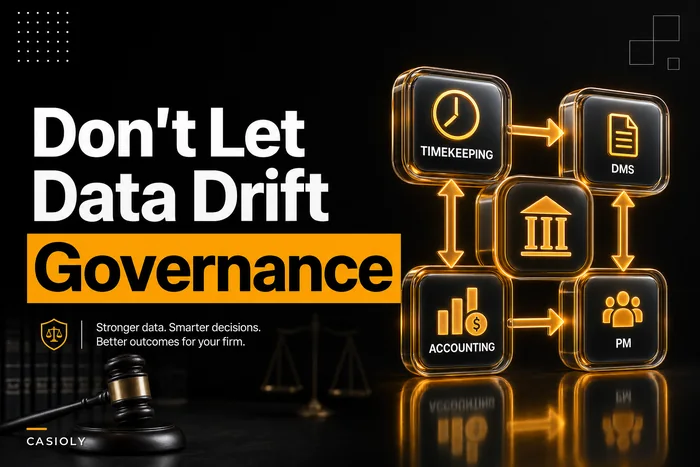



Most firms don't have an architecture problem in the way a CTO would describe it. They have a source-of-truth problem that disguises itself as a dozen smaller ones: the billing system thinks a matter closed in March, the document management system still shows it active, the calendar still has deadlines attached, and nobody can say with confidence which record is correct. By the time someone notices, three people have made decisions based on three different versions of reality.
That's what breaks law-firm stacks at scale. Not the lack of integrations — the excess of them, wired together without a clear rule about who gets to declare something true. A matter-centric architecture fixes this by starting from a simple, slightly uncomfortable question: for every important fact about a matter, which system is allowed to assert it, and what happens downstream when it changes?
This piece walks through how to build that blueprint — authoritative sources, event schemas, idempotency rules, and the enforcement checkpoints that keep the whole thing honest as matter volume grows.
Start from the matter, not the tools
The common failure is organizing architecture around applications. You get a "practice management layer," a "document layer," a "finance layer," and a tangle of sync jobs connecting them. Each vendor assumes it's the center of the universe, and each one happily overwrites fields it doesn't actually own.
A matter-centric model inverts that. The matter is the organizing entity, and every system is defined by what it's authoritative for relative to the matter lifecycle. Practice management owns matter status and responsible attorney. The finance system owns billed and collected amounts. The conflicts system owns the conflict clearance state. Document management owns the canonical document set — but not the matter's open/closed status, even though it stores a field called "status" that tempts everyone into treating it as truth.
What comes up repeatedly across firms is that nobody ever wrote this down. Everyone assumes a mapping exists, and in practice it lives in the heads of two or three long-tenured ops people. When they're on vacation and a sync breaks, the firm discovers its architecture was tribal knowledge all along.
So the first artifact is boring and essential: an authoritative-source map. One row per meaningful fact.
| Matter fact | Authoritative source | Consumers (read-only) | Change triggers an event? |
|---|---|---|---|
| Matter status (open/closed/on-hold) | Practice management | DMS, finance, calendaring | Yes |
| Responsible attorney | Practice management | Finance, routing, reporting | Yes |
| Conflict clearance state | Conflicts system | Intake, practice management | Yes |
| Trust balance | Accounting/trust ledger | Billing, dashboards | Yes |
| Billed / collected amounts | Finance system | Dashboards, forecasting | Yes (batched) |
| Canonical document set | DMS | Review tools, portals | Yes |
| Key deadlines | Calendaring system | Practice management, alerts | Yes |
| Client contact / billing info | CRM/intake | Everything | Yes |
If two systems both claim to own a field, you've found a future incident. Resolve it on paper before it resolves itself at 6pm on a filing deadline.
Events are the contract between systems
Once you know who owns what, the next question is how change travels. Direct database syncs and nightly batch jobs are where data drift breeds — worth a deep read in our piece on integrations governance and reconciliation rules. The cleaner pattern is event-driven: when an authoritative source changes a fact, it emits an event describing what changed, and consumers react.
Never miss a critical deadline again.
Casioly helps legal teams manage cases efficiently and stay on top of critical tasks.
- Centralized case tracking
- Automated deadline reminders
- Secure client communication
No credit card required
The value isn't technical elegance. It's accountability. An event is a timestamped, replayable record of a decision. When someone asks "why did this matter get flagged for collections," you can trace the exact event chain instead of reverse-engineering it from a dozen tables.
A reasonable event schema for a matter status change looks like this:
{ "eventid": "evt9f2a7c41", "eventtype": "matter.status.changed", "schemaversion": "1.2", "occurredat": "2024-11-03T15:42:11Z", "matterid": "MAT-2024-00831", "sourcesystem": "practicemanagement", "actor": { "type": "user", "id": "atty118", "role": "responsibleattorney" }, "payload": { "previousstatus": "open", "newstatus": "onhold", "reasoncode": "clientpaymentpending" }, "idempotencykey": "MAT-2024-00831:status:onhold:2024-11-03T15:42:11Z", "correlationid": "intakebatch_4471" }
Three fields on that schema do most of the heavy lifting and get skipped by teams who treat events as "just notifications."
-
schema_version— the single most-regretted omission. The day you need to change a payload shape, versioning is what lets old and new consumers coexist instead of forcing a big-bang migration. -
idempotency_key— more on this below, but it's the thing that stops the same event from being processed twice. -
actor— who or what made the change. A surprising number of firms can't distinguish between a human closing a matter and an automation doing it, which matters enormously for audit purposes and for trust in the system overall.
Here's a trust-ledger event for contrast, because financial facts need stricter handling:
{ "eventid": "evt3b81d209", "eventtype": "trust.balance.updated", "schemaversion": "2.0", "occurredat": "2024-11-03T09:05:00Z", "matterid": "MAT-2024-00614", "sourcesystem": "trustledger", "actor": { "type": "system", "id": "nightlyrecon" }, "payload": { "previousbalancecents": 1250000, "newbalancecents": 940000, "transactionref": "TRX-55820", "movementtype": "disbursement" }, "idempotencykey": "TRX-55820", "correlationid": "recon20241103" }
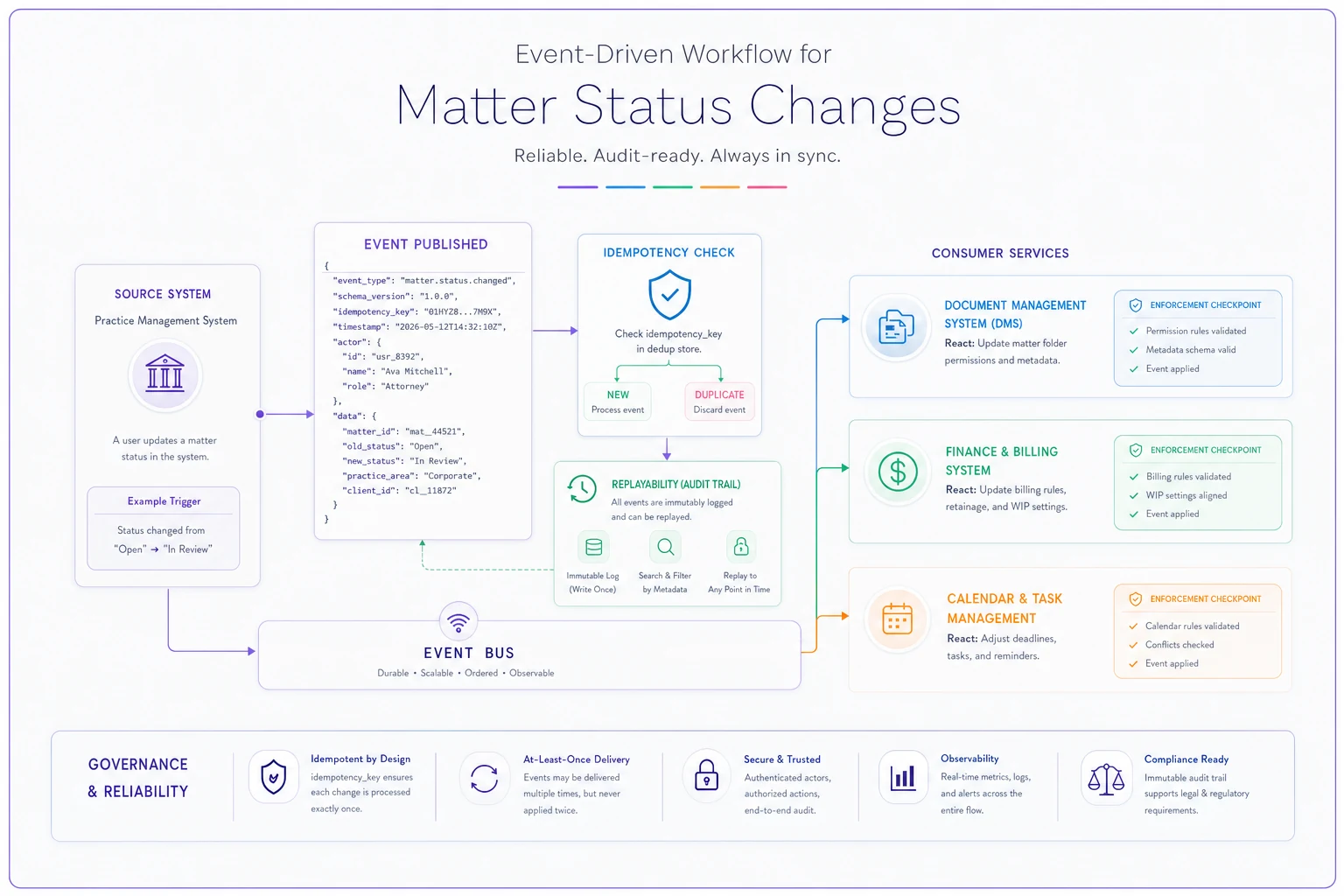
A simple workflow visualization of the event flow.
Idempotency is not optional for money or deadlines
Idempotency sounds like a backend concern until you watch what happens without it. A retry storm during a network hiccup replays the same "deadline created" event four times. Now the matter has four copies of the same court deadline, three attorneys get paged, and someone eventually deletes "the duplicates" — including the real one.
The rule is simple to state and annoying to enforce: every consumer must be able to process the same event twice and reach the same state as processing it once. The idempotency key is how a consumer recognizes it's already seen this.
-
Derive keys from business facts, not timestamps alone. For a transaction, use the transaction reference. For a status change, use
matterid + field + newvalue + occurred_at. Pure UUIDs don't help if the same logical change can be emitted twice. -
Store processed keys for a sane retention window. Thirty to ninety days covers most realistic retry or replay scenarios.
-
Make side effects conditional on the key check. Send the email, create the deadline, post the ledger entry only if the key hasn't been seen. That's the whole game.
-
Treat idempotency failures as alerts, not silent swallows. If you're rejecting duplicates constantly, something upstream is misbehaving and you want to know about it.
For monetary events, use the transaction reference as the idempotency key so retries can't apply a disbursement twice.
Deadlines and trust transactions are where a missing idempotency rule turns into a malpractice exposure or a bar complaint, not just a messy table. That's the priority order for rolling this out.
Enforcement checkpoints: where the architecture earns its keep
A blueprint nobody enforces is just a diagram. The real work is placing checkpoints at the points where matters transition between lifecycle stages, because those transitions are where bad data causes the most damage.
Think of a checkpoint as a gate: before a matter can move to the next state, certain facts must be present, consistent across authoritative sources, and valid. The canonical matter metadata model defines what those required fields are; checkpoints are when and where you verify them.
A workflow example makes this concrete. Consider the transition from intake to active matter:
The intake system emits a matter.intake.completed event. Before practice management flips the matter to "open," an enforcement checkpoint runs. It confirms the conflicts system has emitted a conflict.cleared event for this matter, that a responsible attorney is assigned, that an engagement letter document exists in the DMS, and that a billing arrangement is set in finance. If any of those are missing, the matter doesn't open — it lands in a "pending enforcement" queue with a specific reason code, and the right person gets a task. No silent half-open matters floating around.
-
Intake → Open conflict clearance present, responsible attorney assigned, engagement letter on file, billing terms set.
-
Open → Billing-active valid rate card linked, LEDES codes mapped if the client requires them, trust funded if the engagement demands a retainer.
-
Active → On-hold reason code required, collections flag synced, calendaring notified so deadlines aren't silently abandoned.
-
Active → Closing all time entries posted, trust balance at zero or disposition recorded, final invoice state reconciled, retention schedule assigned.
-
Any state → Closed no open deadlines in calendaring, no unreconciled trust movement, document set marked canonical and locked.
The "Active → Closing" checkpoint is the one firms most often skip and most regret. A matter that closes with a non-zero trust balance and nobody noticing is exactly the kind of thing that surfaces two years later in an audit.
Governance playbook: keeping the blueprint alive
Architecture decays. New vendor, new integration, someone adds a field "temporarily," and six months later the authoritative-source map is fiction. The governance layer is what prevents that slow rot.
A workable playbook doesn't need a committee of twelve. It needs clear ownership and a short, enforced change process.
-
Name an owner for the authoritative-source map. One person — usually in legal ops — who signs off on any change to who-owns-what. If a new tool wants to write to "matter status," that's a decision, not a default.
-
Require event-schema review before any new integration ships. New event type or changed payload? It gets a version bump and a quick review against existing consumers. This is a fifteen-minute conversation that prevents week-long outages.
-
Run reconciliation on a fixed cadence. Nightly for financial facts, weekly for matter metadata. Reconciliation compares authoritative sources against consumer copies and flags divergence. When drift appears, you want it surfaced in a report, not discovered by a client.
-
Keep a schema registry. Even a shared document listing every event type, its current version, its owning system, and its consumers beats institutional memory. It's the map people actually check before making changes.
-
Review checkpoint exceptions monthly. Items stuck in "pending enforcement" queues tell you where either your data entry or your rules are broken. A growing queue is an early-warning signal worth watching.
Firms that get this right treat governance as lightweight but non-negotiable. Skipping the schema review "just this once" is how you end up back in the tribal-knowledge architecture you were trying to escape.
A realistic scenario
A mid-sized litigation and transactional firm — somewhere around 40 attorneys, several thousand open and historical matters — kept hitting the same wall. Their practice management and finance systems disagreed on matter status often enough that month-end close dragged on for the better part of a week. Someone would find matters marked closed in billing but active everywhere else, chase down the discrepancy, correct it manually, and repeat.
They weren't tracking a precise failure rate, but ops estimated a few dozen matters per month had conflicting status across systems. Each one took maybe fifteen to thirty minutes to untangle — call it ten to fifteen hours a month of pure reconciliation work, plus the invisible cost of decisions made on wrong data.
They didn't rip anything out. They did three things: wrote the authoritative-source map (practice management owns status, full stop), moved status changes to an event with an idempotency key, and added two enforcement checkpoints — one at matter opening and one at closing. The closing checkpoint refused to let a matter close with unreconciled trust or open deadlines.
Within a couple of billing cycles, month-end close dropped from roughly a week to about two days. The reconciliation queue shrank to a handful of genuine edge cases instead of dozens of avoidable ones. Nothing dramatic happened on any single day — the drift just stopped accumulating, because the system no longer allowed two sources to quietly disagree.
When this makes sense — and when it doesn't
This blueprint is overkill for a two-attorney firm running a single integrated platform and a shared calendar. If one tool genuinely holds everything and nobody's syncing across systems, you don't have a source-of-truth problem yet.
It becomes worth it the moment you have three or more systems that each believe they own matter facts, and especially once trust accounting and court deadlines are in the mix. Those two domains don't tolerate drift — the cost of a mistake is measured in bar complaints, not cleanup hours.
Who should probably not start here: firms in the middle of a platform migration. Lock down your canonical metadata and get the migration stable first; layering event-driven enforcement on top of a moving target just creates two sources of chaos instead of one. Sequence it: metadata model, then authoritative-source map, then events and checkpoints.
One caution for the ambitious — don't automate enforcement actions faster than you can trust them. A checkpoint that blocks a matter transition is high-stakes; get it wrong and you've halted real work. The safer rollout runs checkpoints in "observe" mode first, logging what would have been blocked before you let them actually gate anything. The broader principles around what to automate and what to keep human-in-the-loop are worth reviewing in our write-up on matter orchestration patterns and safe automation rules.
The point of all this
A matter-centric architecture isn't about diagrams or vendor selection. It's about making one decision — who's allowed to declare each fact true — and then building the plumbing that respects it: events as the contract, idempotency so retries don't corrupt state, and checkpoints so matters can't slip between stages with missing or contradictory data.
Do that, and the dozen small symptoms firms usually chase — close delays, duplicate deadlines, trust surprises, dashboards nobody trusts — mostly stop being individual fires. They were never separate problems. They were all the same architecture gap, showing up in different rooms.
A matter-centric architecture isn't about diagrams or vendor selection. It's about making one decision — who's allowed to declare each fact true — and then building the plumbing that respects it: events as the contract, idempotency so retries don't corrupt state, and checkpoints so matters can't slip between stages with missing or contradictory data.
Do that, and the dozen small symptoms firms usually chase — close delays, duplicate deadlines, trust surprises, dashboards nobody trusts — mostly stop being individual fires. They were never separate problems. They were all the same architecture gap, showing up in different rooms.
Ready to elevate your legal practice management?
Join 500+ law firms using Casioly to optimize case workflows, reduce administrative burden, and improve client satisfaction.