



The Fed's latest signals about potential rate increases feel different this time. After Fed Governor Hammack's comments this week about tighter policy, partners at mid-size firms started checking their credit line rates again. One managing partner texted me yesterday: "Our operating line just jumped another 75 basis points. That's $42k more annually we weren't planning for."
What's happening on the ground: firms that were comfortable floating $800k–$1.2M in work-in-progress suddenly face an extra $4,000–$7,000 monthly in carrying costs. Litigation finance that looked reasonable at 12% now pencils out at 14-15%. Client payment cycles that stretched from 45 to 62 days now cost real money to carry.
The bigger problem isn't the rate itself—it's that most firms have no idea which matters are actually profitable when you factor in these new carrying costs.
The Hidden Math Most Firms Miss
A personal injury matter that takes 18 months to resolve looks great on paper with a $120,000 contingency fee. But run the actual numbers with current rates: you're carrying roughly $85,000 in time and expenses for those 18 months. At today's rates, that's costing you around $11,000 just in financing. Your effective return drops from 41% to 28%.
Compare that to a corporate transaction that closes in 45 days with a $35,000 flat fee. Lower headline number, sure. But you're only carrying $28,000 for six weeks. Financing cost? Maybe $350. Your actual return stays north of 20%, and you get the cash to redeploy immediately.
This gets more complex when you layer in associate salaries tied to utilization targets, office overhead allocated by matter, technology costs per timekeeper, and collection risk variations by practice area.
Most firms track these numbers annually or quarterly at best. In a rising rate environment, that's like steering a ship by looking at last month's weather report.
Why Standard Firm Metrics Break Down
Traditional law firm metrics weren't built for rapid rate changes. Realization rates, utilization percentages, and revenue per lawyer all assume stable underlying costs. They tell you what happened, not what's happening.
Never miss a critical deadline again.
Casioly helps legal teams manage cases efficiently and stay on top of critical tasks.
- Centralized case tracking
- Automated deadline reminders
- Secure client communication
No credit card required
Take realization rates. A 92% realization looks healthy until you realize it's taking 73 days to collect instead of 45. At current rates, that extra month costs you 1.2% of the invoice value. Your real realization is closer to 91%. Across a $4M book of business, that's $48,000 annually disappearing into financing costs.
Collection velocity matters more than collection rate now. A client who pays 85% of invoices within 20 days is worth more than one who pays 95% at 60 days. Standard dashboards don't show this distinction.
The problem compounds with matter complexity. A multi-year litigation matter with irregular billing creates cashflow valleys that require bridge financing. A subscription legal service with predictable monthly payments doesn't. Yet most firms treat them identically in their financial planning.
Building a Rate-Sensitive Operations Framework
The firms adapting fastest are rebuilding their operations around three core metrics that actually respond to rate changes:
| Metric | Definition |
|---|---|
| Matter Carrying Cost | Total unbilled time + expenses + overhead allocation × current financing rate × expected days to collection |
| Effective Matter Margin | (Expected fees - direct costs - carrying costs) ÷ expected fees |
| Cashflow Coverage Ratio | Next 30 days expected collections ÷ next 30 days fixed costs |
These aren't numbers you calculate quarterly. They need weekly updates, especially for matters over $50,000 or lasting beyond 90 days.
One employment law firm restructured their entire intake process around these metrics. New matters get scored on expected margin after carrying costs. Anything below 35% requires partner approval. Matters below 25% get rejected or restructured as partial retainer engagements.
The shift changed their entire book of business. They dropped 18% of their matters by count but only 7% of revenue. Average matter margin increased from 42% to 51%. More importantly, they reduced their credit line usage by $340,000, saving roughly $4,500 monthly in interest.
Here's a quick workflow to operationalize these metrics:
Prioritize automating matters over $50,000 first to capture the biggest impact.
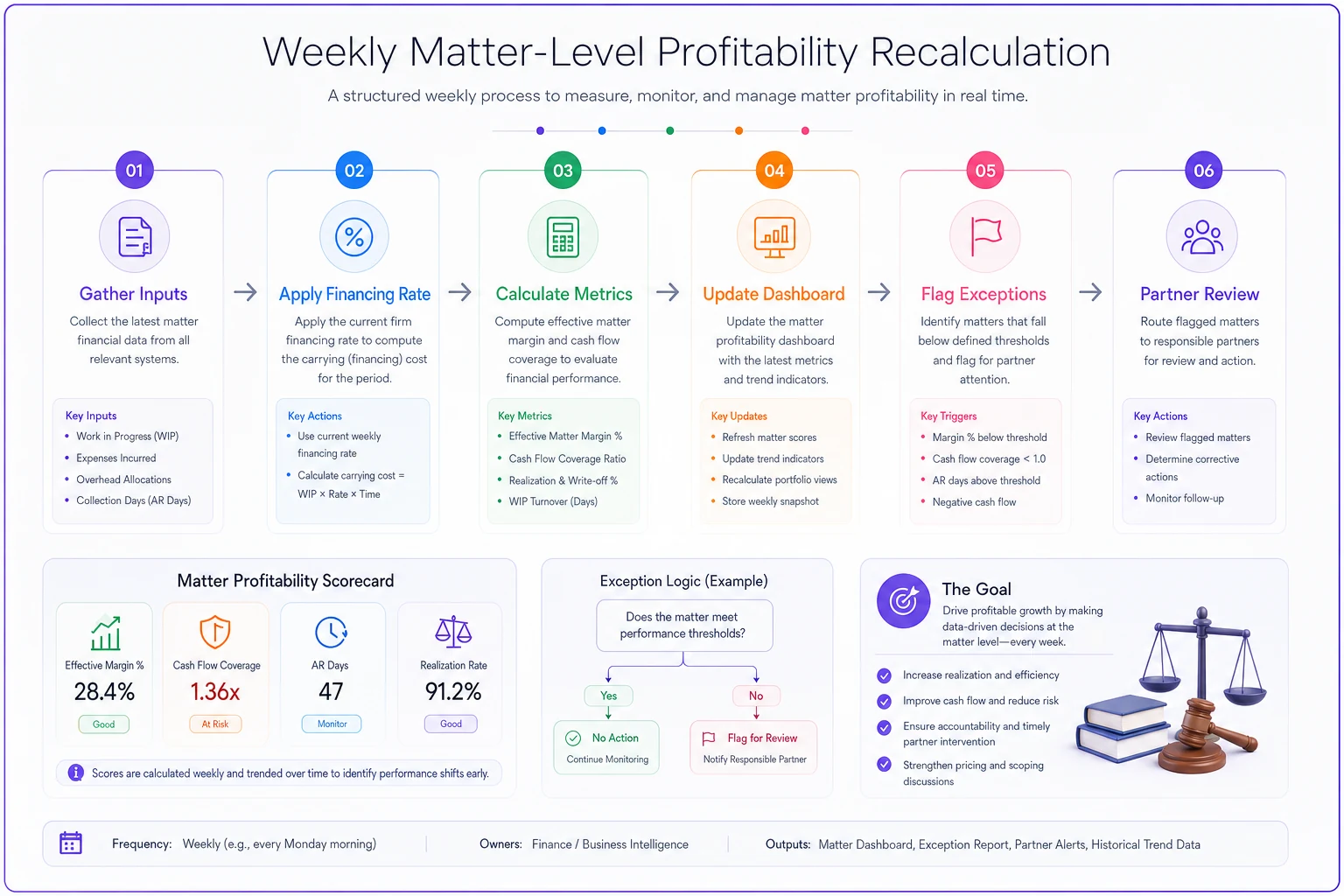
Use this flow to automate weekly recalculations and matter scoring.
The Triage System That Actually Works
When cashflow tightens, you need clear rules about what gets attention first. The instinct is to chase the biggest receivables, but that's often wrong.
Priority 1: Fast-closing matters under 30 days These become your cashflow bridge. Even smaller fees matter when they arrive quickly. A $15,000 real estate closing next week beats a $60,000 litigation settlement in three months.
Priority 2: Matters with contractual payment terms Corporate clients with net-30 agreements, insurance defense with regular payment cycles, subscription services with monthly billing. These are predictable even if not immediate.
Priority 3: High-margin matters regardless of timeline The matters where your effective margin exceeds 50% after carrying costs. These justify the wait.
Priority 4: Everything else The dangerous middle—decent fees, unclear timelines, moderate margins. These kill cashflow in rising rate environments.
The discipline comes in actually following the framework. Partners hate turning away work, especially from existing clients. But taking a 20% margin matter means you can't take a 45% margin matter next month when your credit line is maxed.
Pricing Adjustments Beyond Rate Increases
Raising hourly rates is obvious but usually wrong in this environment. Clients facing their own financing pressures resist rate increases more than structural changes.
Retainer requirements on all matters over $25,000 Not huge retainers—even 15-20% changes the carrying cost math dramatically. A $100,000 matter with a $20,000 retainer only requires you to finance $80,000. That's $1,200 less in annual carrying costs at current rates.
Escalation clauses for extended matters Build in 3% fee increases for matters extending beyond six months, another 3% at twelve months. Frame it as complexity pricing, not interest, but it covers your carrying costs.
Unbundled services with faster payment terms Instead of one $50,000 matter over four months, break it into four $12,500 phases with payment due at completion. You're financing each phase for 30 days instead of the full amount for 120 days.
Success fee restructuring Move from pure contingency to hybrid models. Even a small monthly retainer during litigation changes the financing math. A PI firm shifted to $1,500 monthly retainers plus 25% contingency (down from 33% pure contingency). Client costs stayed similar, but the firm's carrying costs dropped 40%.
Technology Infrastructure for Rate-Responsive Operations
The spreadsheet-and-quarterly-review approach breaks down completely when rates shift monthly. You need systems that automatically recalculate carrying costs as rates change.
This is where matter-level operational dashboards become essential. But they need specific modifications for rate sensitivity:
-
Daily WIP aging reports with carrying cost calculations
-
Automatic alerts when matter carrying costs exceed thresholds
-
Rolling 30-day cashflow projections updated with each time entry
-
Dynamic matter scoring based on current financing rates
The automation layer matters because manual updates can't keep pace. When rates shift, you need every matter's profitability recalculated immediately, not at month-end. AI-powered platforms can continuously monitor these metrics and flag matters that flip from profitable to marginal as rates rise.
One litigation boutique built a system that tracks every matter's "breakeven date"—the point where carrying costs exceed projected margin. When rates rose last month, seventeen matters crossed their breakeven threshold. The firm immediately renegotiated payment terms on twelve of them and dropped five entirely.
Collection Strategies for Tighter Credit
When your clients face their own credit crunches, standard collection practices fail. Sending demand letters to a client whose credit line is maxed just damages the relationship without improving payment odds.
Week 1 after invoice: Confirmation call, not collection call. "Did you receive the invoice? Any questions about the work performed?" This catches processing delays before they become collection issues.
Week 3: Payment plan offer if not paid. "Would splitting this into two payments help with your cashflow?" Better to get half now than all in 60 days.
Week 4: Discount for immediate payment. 5% off for payment within 48 hours often unlocks frozen payments. You lose 5% but save 3-4% in carrying costs.
Week 6: Work stoppage notice. Clear but not aggressive. "We'll need to pause work on your matter until we can resolve the outstanding balance."
Week 8: External collection or withdrawal from representation.
The difference from standard collection is the compressed timeline and graduated flexibility. You can't afford 90-day payment cycles when financing costs 12-15% annually.
Staffing Decisions in Variable Rate Environments
Rising rates fundamentally change the economics of staffing. That additional associate who might have been marginally profitable at 6% rates becomes a cashflow drain at 9%.
The calculation isn't just salary and benefits anymore. It's:
-
Base compensation
-
Benefits and overhead (usually 25-35% of base)
-
Financing cost of their uncollected billings
-
Opportunity cost of matters you can't take with existing staff
A $120,000 associate costs roughly $156,000 fully loaded. If they maintain 1,800 billable hours at $200/hour with 85% realization and 60-day collection cycles, you're carrying about $51,000 in their uncollected work constantly. At current rates, that's another $6,000-7,000 annually.
Their true cost isn't $156,000—it's closer to $163,000. They need to generate $180,000+ in collected revenue just to break even, not the $156,000 you might have calculated.
This math pushes firms toward senior associates and counsel-level hires over junior associates. Someone billing $400/hour with 50-day collection cycles generates better cashflow than someone at $200/hour with 65-day cycles, even at lower utilization.
The Scenario Planning Nobody Wants to Do
Most firms avoid modeling truly bad scenarios, but that's exactly what you need when rates spike. What happens if:
-
Rates rise another 200 basis points?
-
Collection cycles stretch another 20 days?
-
Two major clients delay payment simultaneously?
-
Your credit line gets reduced by 20%?
Run these scenarios monthly, not annually. The answers tell you which operational changes are optional versus mandatory.
A mid-size firm ran these scenarios last month and discovered they were three months from a cashflow crisis if rates rose another percent and collections slowed by just ten days. They immediately instituted retainer requirements on all new matters, offered 8% discounts for immediate payment on all outstanding invoices, froze hiring despite being "understaffed," and shifted two partners from litigation to transaction work.
Painful decisions, but they avoided the credit line crisis that would have forced much worse choices.
Making Rate Changes Work For You
Rising rates can actually improve your firm's operations if you respond correctly. They force discipline that profitable times let you avoid.
Firms that adapt quickly often emerge stronger because they've eliminated marginal matters they shouldn't have taken anyway, built better cashflow management systems, strengthened client payment discipline, improved matter-level profitability tracking, and reduced dependency on external financing.
The employment law firm mentioned earlier? They're more profitable now at 11% rates than they were at 7% because they completely restructured their operations around cashflow efficiency. Their credit line usage dropped 60%, their average matter margin increased 9%, and partner draws actually increased despite lower top-line revenue.
Practical Next Steps
The path forward isn't complicated, but it requires immediate action:
This week: Calculate your current carrying costs on top 20 matters. You'll likely find 3-4 that are actually unprofitable at current rates.
Next two weeks: Implement retainer requirements on all new matters. Start at 20% and adjust based on client pushback.
This month: Build or buy matter-level profitability tracking that includes financing costs. Spreadsheets work initially but won't scale.
Next month: Renegotiate payment terms with your slowest-paying clients. Offer discounts for faster payment if necessary.
Next quarter: Restructure practice areas based on cashflow efficiency, not just revenue. Some practices that look profitable aren't in high-rate environments.
Rising rates expose operational weaknesses that good times concealed. The firms that acknowledge this reality and adapt their operations accordingly won't just survive—they'll build sustainable competitive advantages while others struggle with cashflow crunches they should have seen coming.
The question isn't whether rates will impact your firm. They already are. The question is whether you'll adapt your operations before cashflow problems force much harder decisions. Based on what I'm seeing across firms right now, you have maybe 60-90 days to get ahead of this. After that, you're playing defense instead of offense.
Ready to elevate your legal practice management?
Join 500+ law firms using Casioly to optimize case workflows, reduce administrative burden, and improve client satisfaction.