

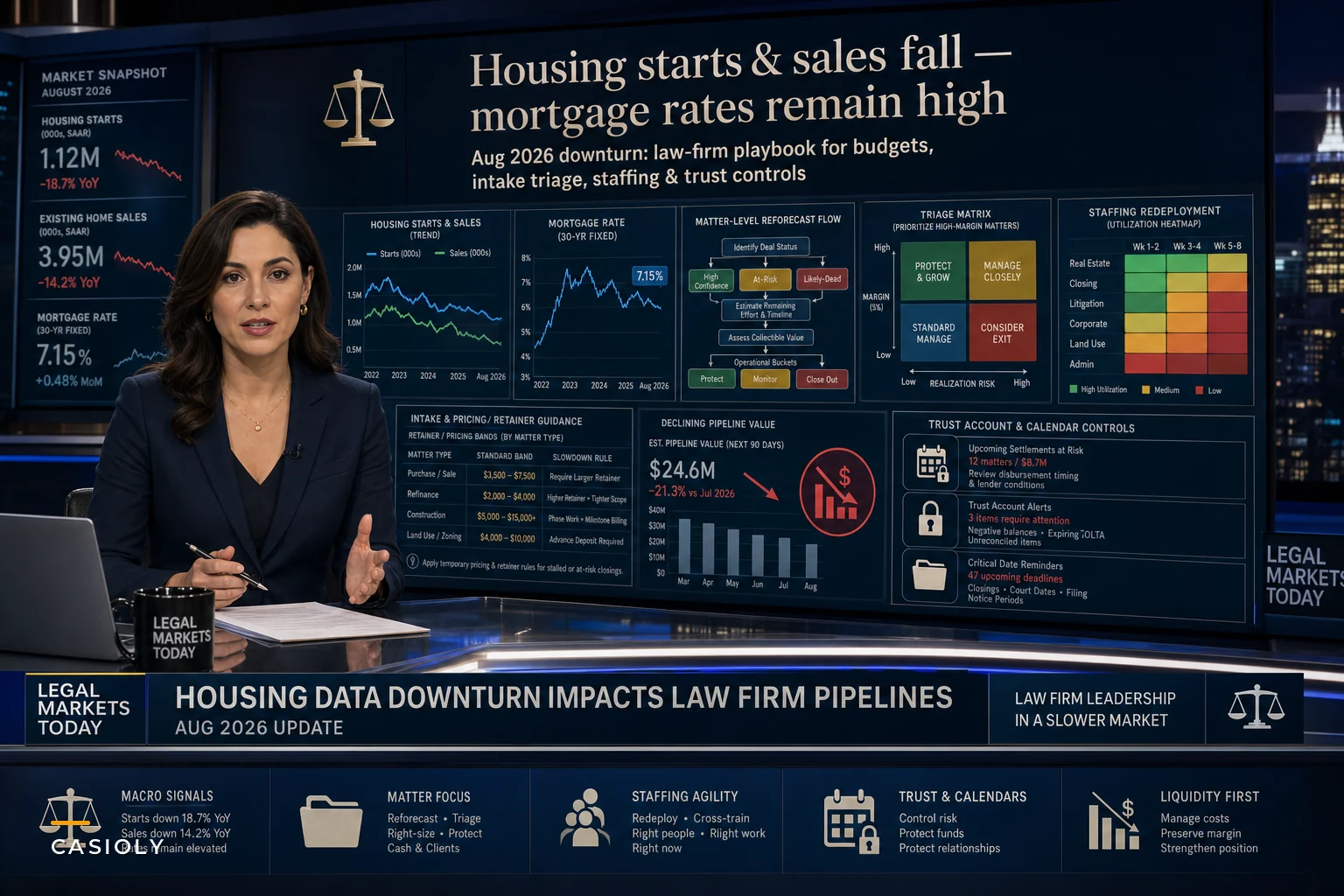

The mid-August 2026 numbers were not subtle. Single-family starts dropped hard in July, existing-home sales fell for a second straight month, and mortgage rates stubbornly parked around 6.7%. Reuters reported that existing-home sales posted their second consecutive monthly decline, which for most residential practices means the pipeline you were counting on for Q4 is thinner than your last forecast assumed. CNBC added a small note of relief, noting that rates finally stopped climbing and demand started trickling back — but "trickling" is the operative word. Nobody's pipeline refills overnight.
If your firm handles closings, title work, purchase-and-sale, refinances, or high-volume residential transactional work, you already feel this. Fewer new files. Existing deals stretching out because financing keeps falling through or repricing. And the uncomfortable realization that your staffing was built for a busier market than the one you're in right now.
This isn't market commentary. The interesting question isn't why housing slowed — it's what a slowdown exposes about how your firm actually operates, and what you do in the next 30–60 days so the revenue dip doesn't become a cash crisis.
What the slowdown actually breaks first
The mistake most firms make is treating a housing slowdown as purely a revenue problem. It shows up that way, but it breaks operations somewhere upstream — usually in three places at once.
Utilization gets lumpy, not just lower. When deal flow drops 20–30%, the work doesn't distribute evenly across your team. Your senior closing attorney might still be buried finishing deals that survived, while two paralegals who used to carry four files each are suddenly carrying one and a half. Firm-wide utilization looks down. Individual utilization looks like famine and feast sitting three desks apart.
Matter budgets quietly stop meaning anything. A real-estate matter budgeted at six hours across four weeks now stretches to nine weeks because the buyer's lender keeps re-underwriting. The hours might not blow up, but the carrying cost does — the file stays open, WIP ages, and the matter you expected to close in July is still sitting in your trust reconciliation in September.
Intake loses its filter. This one's counterintuitive. In a busy market, firms are naturally selective because they're full. When it slows, everyone gets hungrier and starts saying yes to marginal matters — the fee-sensitive FSBO, the messy title with three heirs, the refi that'll probably die at rate lock. Those low-margin, high-friction files are exactly the ones that eat whatever capacity you thought you'd freed up.
A slowdown doesn't just reduce work. It scrambles which work you have, stretches how long it takes, and erodes the discipline that kept your margins intact. Cutting costs without fixing those three things just makes you a smaller version of the same problem.
Reforecast at the matter level before you touch headcount
The instinct in a slow month is to look at the firm P&L and start thinking about who's expendable. That's backwards. You can't make a sound staffing decision until you know what your open matters actually look like right now — not what they looked like when they were opened.
Never miss a critical deadline again.
Casioly helps legal teams manage cases efficiently and stay on top of critical tasks.
- Centralized case tracking
- Automated deadline reminders
- Secure client communication
No credit card required
Start with a fast reforecast of every open matter using three questions:
-
Is this deal still real? Rate the probability it closes
high, at-risk, or likely-dead. In this market, be honest — a purchase contract with a financing contingency and a shaky pre-approval is at-risk, not high.
-
What's the realistic remaining effort and timeline? Not the original budget. The remaining budget given what's actually happened since opening.
-
What's the collectible value left in it? Fixed-fee closings that stall still cost you labor with no upside. Flag them.
This is where a standard cost-driver approach pays off. If you've already built matter budgets around consistent drivers — stage, document volume, party count, contingency complexity — you can reforecast in an afternoon instead of a week. If you haven't, this slowdown is the forcing function to finally build that foundation. The matter budgeting framework built on a standard cost-driver taxonomy and stage-tied budgets is what makes rapid re-estimation possible, because you're adjusting known variables instead of guessing from scratch.
Here's a simple visual of that reforecast workflow.
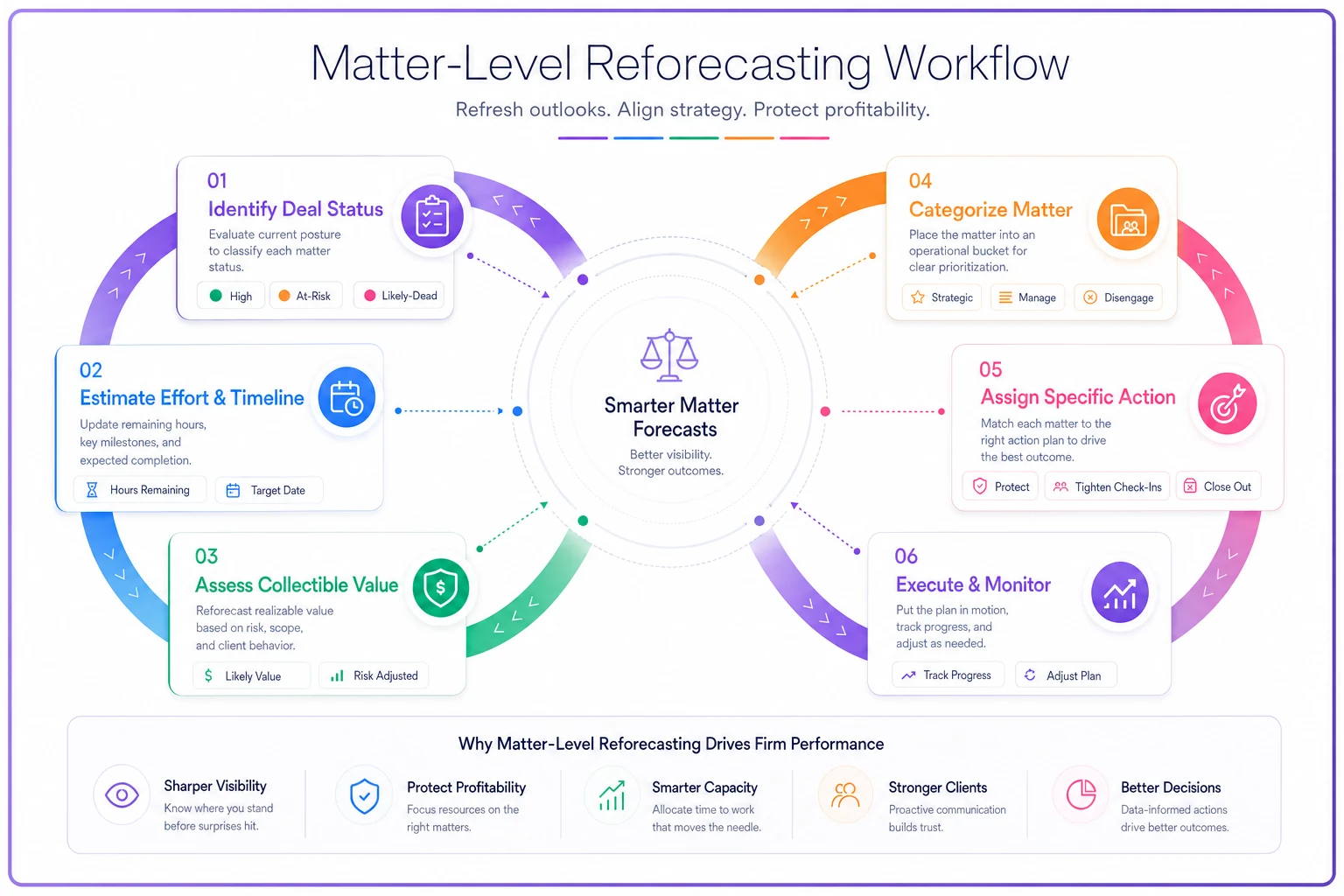
Use it to run through open matters quickly.
A quick way to sort the reforecast output:
| Matter category | Signal | Operational action |
|---|---|---|
| High-probability, on-budget | Financing solid, timeline holding | Protect it. Don't reassign the team mid-deal. |
| At-risk, stretching | Contingency risk, timeline slipping | Tighten check-ins, confirm client commitment, hold billing discipline |
| Likely-dead, aging WIP | No lender movement in 2–3 weeks | Have the close-out conversation now, bill what's owed, release capacity |
| Low-margin new intake | Marginal fee, high friction | Reprice or decline — don't backfill a slow month with money-losing work |
Firms that handle a slowdown well spend their first week here. The ones that struggle skip straight to layoffs and then discover they cut the wrong people because they never separated the busy-looking work from the actually profitable work.
Intake triage: get pickier, not less picky
There's a strong pull to loosen intake standards when the phone rings less. Resist it. A slow market is exactly when a sharper triage filter pays off most, because every marginal file you take now occupies capacity you'll want back the moment rates ease and volume returns.
Centralize intake data — probability, fee type, referral source, and financing status — so you can see pipeline quality, not just counts.
Rework your intake triage around margin and closeability, not just conflicts and capacity. A residential file that would've been an automatic yes in a hot market deserves a harder look now:
-
Financing reality. Is there a real pre-approval, or a Zillow-adjacent hope? Financing-contingent deals in a 6.7% rate environment fall apart more often than they used to. That's not pessimism — it's just the current close rate.
-
Fee structure vs. friction. A flat-fee closing on a clean deal is fine. The same flat fee on a probate-tangled title with out-of-state heirs is a slow bleed. Price for the friction or pass.
-
Client responsiveness signals. Slow-responding clients stretch already-stretched timelines. A file that drags 90 days ties up WIP you can't afford to age right now.
-
Strategic value. Sometimes you take a break-even matter because the referral source sends ten deals a year. Fine — but make that call on purpose, not by default.
The underlying discipline isn't complicated. It's making intake a decision again instead of a reflex. Firms that centralize intake data — probability, fee type, referral source, financing status — can actually see their pipeline instead of just a raw count of open files. A pipeline of 40 matters where 15 are likely-dead and 8 are money-losing is a completely different situation than "40 open matters." The firms that get burned are the ones still counting the raw 40.
Staff reallocation without wrecking morale (or losing your best people)
When work slows, firms either freeze and hope, or they cut fast and cut clumsily. Both are expensive.
The better move is redeployment before reduction. Your residential closing team has transferable skills — title review, document assembly, coordination, client communication. A slowdown in purchase transactions rarely hits every practice line equally. Refinances behave differently than purchases. Commercial and leasing work runs on its own cycle. Estate and probate work often increases when people are staying put in homes they can't afford to sell.
A realistic redeployment sequence:
-
Map transferable capacity. Identify who's underutilized and what adjacent work they can credibly handle with light supervision.
-
Find the receiving demand. Which practice areas or partners are still busy or backlogged? Probate, landlord-tenant, deferred contract review, refinance volume when rates dip.
-
Set a temporary allocation, not a permanent transfer. Frame it as "we're moving you to help estate work through October" so nobody assumes their role is gone.
-
Cross-train deliberately during the gap. Slow weeks are the cheapest training weeks you'll ever get. A paralegal who learns probate intake now is worth more when purchase volume returns.
-
Only then consider structural reductions — and if you do, use reforecast data, not gut feel about who seems busy.
The insight a lot of managing partners miss: your slowest weeks are your only real free time to build capacity for the recovery. Every slowdown ends. The firms that come out ahead used the quiet to cross-train and clean up their systems while competitors just shrank.
Tighten the boring stuff: trust, calendaring, collections
When volume is high, sloppy back-office process gets hidden by revenue. When volume drops, the sloppiness becomes the whole story.
Trust accounting. Stalled and dead deals leave money sitting in trust — earnest money, unused closing funds, retainers on files going nowhere. Aging trust balances on dead matters are a compliance risk and a sign of files nobody's properly closing out. A slowdown is the time to reconcile aggressively and clear stale balances.
Calendaring. Deals stretching out means more moving closing dates, more rate-lock expirations, more shifting contingency deadlines. The volume of date changes actually goes up in a slow market even as deal count goes down. That's precisely when calendaring errors spike — everyone assumes fewer deals means fewer deadlines and gets careless.
Collections. This needs a hard reset. When clients are financially stressed by the same market conditions you are, receivables age faster. Move to more front-loaded retainers, shorter billing cycles, and earlier follow-up on aging invoices. Waiting 60 days to chase a bill in a soft market is how a revenue dip becomes a cash crisis.
A real scenario: what the first 45 days can look like
Consider a small firm — four attorneys, six support staff — doing mostly residential closings and title work in a mid-size metro. Coming into the slowdown they were running around 30–35 closings a month. By July that dropped to roughly 22, with several more deals stuck in limbo waiting on financing decisions.
Their first instinct was a hiring freeze and a vague sense they'd "need to let someone go soon." Instead they ran a matter-level reforecast first. It surfaced something useful: about a third of their open files were at-risk or effectively dead, and four flat-fee closings had stretched past 60 days and were now costing more in labor than they'd ever collect. They'd been mentally filing those as "almost done" for weeks.
They closed out the dead files, had honest conversations with two stalled clients, and cleared roughly $9k–$12k in aged trust balances that had been sitting untouched. Two paralegals got temporarily redeployed to a probate attorney who'd been quietly buried for months. They tightened intake — declined three marginal refi files that almost certainly would've died at rate lock — and moved new residential clients to a larger upfront retainer.
None of that reversed the market. Revenue was still down for the quarter. But they avoided a panic layoff, stopped the WIP aging problem, and freed capacity they used for cross-training in probate and landlord-tenant work. When purchase volume started trickling back a couple months later, they had trained people ready instead of scrambling to hire. The dip stayed a dip instead of becoming a spiral.
When to hold steady vs. when to cut
Not every firm should react the same way, and the wrong reaction costs more than doing nothing.
When redeployment and tightening is enough: You have adjacent practice lines with real backlog, your cash runway is measured in months not weeks, and your reforecast shows a soft pipeline rather than an empty one. Most firms are actually here. Shrinking prematurely just hands recovered market share to competitors.
When structural cuts genuinely make sense: You're a pure-play residential closing shop with no adjacent work to absorb capacity, receivables are aging past your ability to make payroll, and the reforecast shows the pipeline isn't just soft but structurally thin. Even then — cut using data, protect your closers and your most cross-trainable people, and keep the reduction proportional to the forecast, not the panic.
Who should not overreact: Firms with diversified transactional and non-transactional work. If probate, commercial leasing, or dispute work is holding steady, a residential dip is a reallocation exercise, not an existential one. Firms that cut deepest in these moments are usually the ones that never had matter-level visibility, so a normal cyclical slowdown looked like a collapse.
The real lesson underneath the numbers
A housing market slowdown is a stress test for how well your firm actually runs. Firms with clean matter budgets, real pipeline visibility, disciplined intake, and cross-trainable staff treat it as a manageable cycle. Firms running on gut feel and raw file counts experience the same slowdown as a scramble — cutting the wrong people, letting WIP rot, and clearing trust balances only when an audit forces them to.
The market will move again. Rates will ease, purchase demand will come back, and the firms that spent the quiet stretch reforecasting, retriaging, and cross-training will be ready to catch the rebound while everyone else is rehiring. The slowdown itself isn't the real threat. Running your firm without visibility into your own matters — that's what turns a soft quarter into a bad year.
A housing market slowdown is a stress test for how well your firm actually runs. Firms with clean matter budgets, real pipeline visibility, disciplined intake, and cross-trainable staff treat it as a manageable cycle. Firms running on gut feel and raw file counts experience the same slowdown as a scramble — cutting the wrong people, letting WIP rot, and clearing trust balances only when an audit forces them to.
The market will move again. Rates will ease, purchase demand will come back, and the firms that spent the quiet stretch reforecasting, retriaging, and cross-training will be ready to catch the rebound while everyone else is rehiring. The slowdown itself isn't the real threat. Running your firm without visibility into your own matters — that's what turns a soft quarter into a bad year.
Ready to elevate your legal practice management?
Join 500+ law firms using Casioly to optimize case workflows, reduce administrative burden, and improve client satisfaction.