



Most firms don't have a data problem. They have a trust problem. The numbers exist — sitting in the practice management system, the billing platform, the document store, the conflicts database. The trouble is that when the CFO pulls realization by practice group and the BD lead pulls the same metric from a different report, the numbers don't match. And once that happens twice, nobody trusts either dashboard. Everyone quietly goes back to their own spreadsheet.
That's the real failure mode. A trusted data platform law firm leaders can rely on isn't about having better charts. It's about having a defensible chain from the source system to the dashboard cell, so when someone asks "where does this number come from?" there's an answer that survives scrutiny.
This is a systems article. We're going to cover how the pieces connect — source mappings, ETL conventions, lineage, SLAs, acceptance tests, and governance — and more importantly, where the whole thing tends to crack as a firm grows.
Why matter data breaks down before anyone notices
Data trust doesn't fail loudly. It erodes.
A firm at 30 lawyers can run reporting off exports and institutional memory. Someone in finance knows that "status = closed" in the old billing system doesn't mean the matter is actually done — it means the last invoice went out. They mentally adjust. The reporting works because a human is quietly patching the gaps.
Then the firm grows to 120 lawyers across four offices. The person who knew all the quirks moved to a different role. A second billing system got bolted on after an acquisition. Now "closed" means three different things depending on which system a matter originated in, and nobody documented it. The dashboards still render. They're just wrong, and the wrongness stays invisible until a partner challenges a write-off number in a comp meeting.
The breakdown usually isn't technical. It's that the semantic agreements — what a field actually means — were never written down. The ETL ran fine. It was moving garbage faithfully.
This is why any serious platform starts upstream, with a canonical matter metadata model. If the definitions aren't fixed before you build pipelines on top of them, you're automating confusion.
Source mappings: the layer everyone underestimates
Source mapping is the unglamorous work of documenting, for every field in your canonical model, exactly which system supplies it, how it's transformed, and who owns the definition.
Never miss a critical deadline again.
Casioly helps legal teams manage cases efficiently and stay on top of critical tasks.
- Centralized case tracking
- Automated deadline reminders
- Secure client communication
No credit card required
The mistake firms make is treating this as a one-time spreadsheet. A typical example: a firm maps its billing system to the canonical model, signs off, and six months later the billing vendor pushes an update that renames a status code. Nothing breaks visibly. The pipeline keeps running. But "WIP" is now flowing into a bucket that used to mean "written off," and realization reports slowly drift until someone notices the practice group suddenly looks 4% more profitable than it should.
A workable source mapping layer treats each mapping as a living contract with four parts:
-
The source field and system (e.g.,
matterstatusin Elite,stagecodein the intake tool) -
The transformation rule (how raw values collapse into canonical values)
-
The business owner who gets to approve changes to the definition
-
The reconciliation rule that checks the mapping is still true
That last point is where firms separate real platforms from reporting theater. If your mapping isn't continuously tested against the source, it's a historical document, not a control. The same discipline that prevents silent integration failures across your stack applies here — this is the same category of problem covered in integrations governance and reconciliation rules, just applied to the analytics layer specifically.
A compact source-mapping table
Here's the minimum structure worth maintaining per canonical field:
| Canonical field | Primary source | Transformation | Owner | Reconciliation check |
|---|---|---|---|---|
| Matter stage | Practice mgmt system | Map 9 raw codes → 5 canonical stages | Legal Ops | Daily row count + value distribution |
| Responsible attorney | HR system (not billing) | Join on employee ID | Finance | Null rate must be <1% |
| Realized fees | Billing warehouse | Sum net of write-offs | Finance | Reconcile to GL monthly |
| Client ID | CRM/conflicts DB | Dedupe against master | BD / Risk | Orphan check vs. matter table |
| Close date | Post-matter review flag | Latest of two dates | Legal Ops | Compare to billing final-invoice date |
Worth flagging: "responsible attorney" is sourced from HR, not billing. In practice, billing systems carry stale attribution — the billing attorney and the actual responsible attorney drift apart constantly after reorganizations. Sourcing from the wrong place is one of the most common quiet errors in BD dashboards.
ETL conventions that hold up under audit
ETL in a law firm context isn't about volume. The data is small. It's about discipline and repeatability, because the output feeds decisions that have ethical and financial consequences.
Idempotent loads. Running the same load twice should produce the same result. Sounds obvious. In practice, firms end up with pipelines that append instead of replace, and matters get double-counted after a reload. When your realization number jumps 11% overnight and nothing changed in the business, this is usually why.
Immutable raw staging. Keep a copy of the source data exactly as it arrived, before any transformation. When finance disputes a number, you need to replay what the source actually said on the day the dashboard was generated. Without a raw layer, you can't reconstruct history, and an auditor's first question is always "show me the original."
Keep the raw staging immutable so you can replay source data when disputes arise.
Transformation logic lives in version control, not in the BI tool. The single biggest cause of untrustworthy dashboards is business logic buried inside individual report definitions. Three analysts each build "realization" slightly differently in the dashboard layer, and now you have three truths. Logic should be computed once, in the pipeline, and consumed everywhere identically.
Explicit handling of nulls and unknowns. A matter with no recorded practice group shouldn't silently vanish from a practice-group report — it should land in an "unassigned" bucket that's visibly tracked. Disappearing rows are how totals stop tying out.
Lineage checks: answering "where did this number come from?"
Lineage is the ability to trace any figure on a dashboard back through every transformation to its source records. It's the difference between a platform you can defend and one you just hope is right.
The practical test: pick a single cell — say, Q3 write-offs for the real estate group — and trace it. Can you get from that number back to the specific matters, then to the specific billing transactions, then to the raw source rows? If you can do that in minutes, you have lineage. If it takes a half-day of detective work, you don't, and you're one challenged number away from losing credibility with the partners who matter most.
-
Row-count reconciliation at each pipeline stage — if 4,200 matters enter the transform and 4,180 come out, something is silently dropping records.
-
Aggregate tie-outs — total realized fees in the warehouse must reconcile to the general ledger within a defined tolerance, checked on a schedule, not on request.
-
Distribution drift alerts — if the proportion of matters in a given stage shifts more than a set threshold week over week, flag it, because that's usually a mapping break rather than a real business change.
The firms that get burned skip the drift alerts. Slow, quiet failures are the dangerous ones. A pipeline that breaks completely gets fixed by Tuesday. A pipeline that's 6% wrong runs for a year.
SLAs and ownership: turning "the data team" into accountable roles
A platform without SLAs is a hobby. Finance, BD, and risk each need different freshness and reliability guarantees, and pretending one standard fits all is how you end up over-engineering some pipelines and under-serving others.
A realistic SLA structure looks something like this:
-
Finance (realization, WIP, collections) refreshed daily by 7am, must tie to GL within 0.5% at month-end, corrections acknowledged within one business day.
-
Risk (conflicts, ethical walls, matter exposure) near-real-time for new matters, because a stale conflicts view is a genuine liability, not an inconvenience.
-
BD (client revenue, origination, cross-sell) weekly refresh is usually fine; accuracy of client hierarchy matters more than freshness.
Each SLA needs a named owner — not "the data team," an actual person who gets paged when the daily load fails. Diffusing ownership across a team reliably produces the outcome where everyone assumes someone else is watching the 7am load, and nobody is.
Who should NOT build this yet
Blunt assessment: if your firm hasn't locked down a canonical metadata model, building an analytics platform on top is premature. You'll automate inconsistency at scale and make it harder to fix, because now there are dashboards people depend on built on shaky foundations.
Similarly, a firm under roughly 25 lawyers with a single billing system and one reporting person probably doesn't need this full apparatus. The overhead outweighs the benefit. Spreadsheets with documented assumptions are fine until coordination across multiple people and systems becomes the actual bottleneck.
Acceptance tests: the gate before anyone sees a dashboard
Acceptance testing is where most firms are weakest, because it feels like extra work for something that "looks right." But a dashboard that looks right and is quietly wrong is worse than no dashboard at all — it drives confident bad decisions.
A minimum acceptance checklist before a new or changed dashboard goes live:
-
[ ] Every metric has a written definition signed off by its business owner
-
[ ] Totals reconcile to the authoritative source (GL for financials, conflicts DB for risk)
-
[ ] Known edge-case matters (pro bono, contingency, inter-office transfers) are tested explicitly
-
[ ] Null and "unassigned" buckets are visible, not hidden
-
[ ] A lineage trace works end-to-end for at least one sampled figure
-
[ ] Prior-period numbers didn't change unexpectedly after the new logic deployed
-
[ ] Access controls match the sensitivity of the data shown
That last point connects to the broader problem of dashboards that technically function but mislead through bad metric design — worth reading alongside this, since reliable plumbing and honest KPI construction are two halves of the same goal. A perfectly engineered pipeline feeding a misleading ratio still produces a dashboard nobody should trust.
A real scenario: when two "truths" collided
A roughly 140-lawyer firm with two offices and a bolted-on acquisition had a recurring fight in every quarterly partner meeting. Finance reported firm-wide realization around 88%. The practice group leaders, pulling their own numbers, consistently showed figures 3–5 points higher. Both sides assumed the other was wrong, and the meetings devolved into arguments about whose spreadsheet to believe instead of what to do about the business.
The root cause was unremarkable and typical: the acquired office's billing system coded write-downs differently, and the practice group reports were pulling pre-write-off figures while finance pulled post. Neither was lying. Nobody had written down which definition was canonical.
The fix wasn't a new BI tool. It was establishing a single source-mapped definition of "realization," computing it once in the pipeline, running a monthly GL tie-out, and killing the side spreadsheets. Build time was a few weeks — mostly spent arguing about definitions rather than writing code. Within two quarters the partner meetings stopped being about the numbers and started being about decisions. Hard to price exactly what that's worth, but anyone who's sat in those meetings knows.
The lesson that generalizes: the hard part is almost never the engineering. It's getting people to agree on what a word means, then enforcing that agreement in the pipeline so it can't drift back.
Governance: the part that keeps it trustworthy after launch
A platform that's accurate on day one and ungoverned is accurate for about six months. Governance is what prevents the slow erosion we started with.
A change-control process for definitions. No one gets to redefine "active matter" in isolation. Changes to canonical definitions go through a review that includes the affected teams, because a change that helps finance can quietly break BD's client-revenue rollups.
A data owner per domain. Finance owns financial definitions, risk owns exposure and conflicts definitions, legal ops owns lifecycle and stage definitions. Owners approve changes and answer the "why does this number look like this?" questions. Ownership without decision rights is just a name on a chart.
A periodic reconciliation and audit cadence. Monthly tie-outs, quarterly reviews of mapping accuracy, and a standing check that the raw staging layer still matches the sources. This is boring and it's exactly what auditors want to see — evidence the controls run on a schedule, not only when something breaks.
How the pieces actually connect
Step back and the system is a chain where each link protects the next.
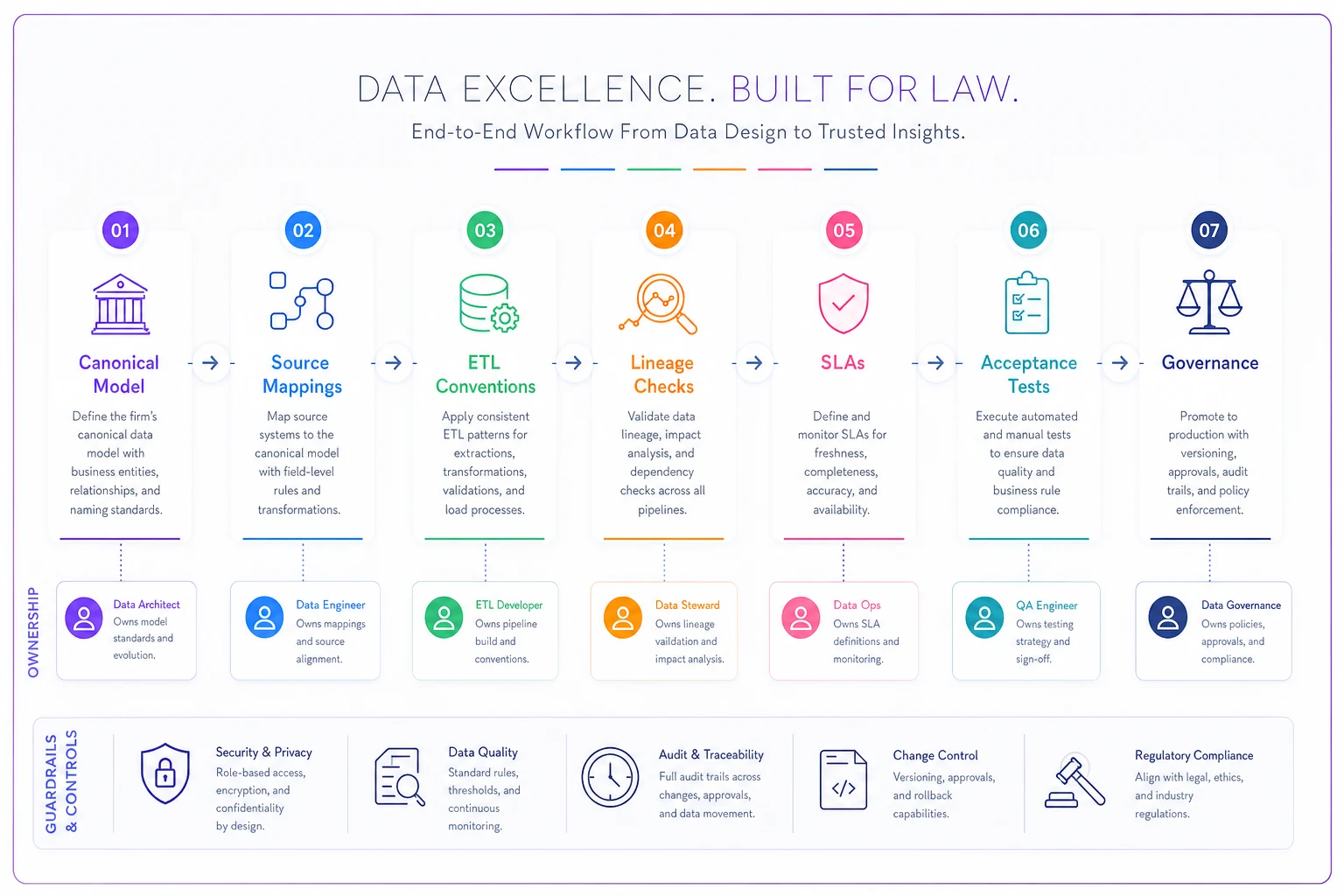
The canonical model fixes what fields mean. Source mappings bind those meanings to real systems with owners. ETL conventions move the data faithfully and repeatably. Lineage checks prove the movement didn't corrupt anything. SLAs set expectations each team can plan around. Acceptance tests gate new work before it reaches a decision-maker. And governance keeps every earlier link from drifting over time.
Break any one link and the whole chain loses its claim to being trustworthy. A firm with perfect ETL but no governance drifts. A firm with great governance but no lineage can't defend its numbers in an audit. This is a systems problem, not a tooling problem, because the links fail in combination — usually quietly, and usually at the exact moment the firm has grown enough that no single person can hold the whole picture in their head anymore.
Here's a quick diagram of how the components chain together.
The firms that build something genuinely trusted aren't the ones with the fanciest dashboards. They're the ones who can answer, calmly and in minutes, "where does this number come from?" — every time, for every number, no matter who's asking.
The firms that build something genuinely trusted aren't the ones with the fanciest dashboards. They're the ones who can answer, calmly and in minutes, "where does this number come from?" — every time, for every number, no matter who's asking.
Ready to elevate your legal practice management?
Join 500+ law firms using Casioly to optimize case workflows, reduce administrative burden, and improve client satisfaction.