



The August 2026 print landed harder than most desks expected. U.S. employers added 162,000 jobs and unemployment held at 4.1% — a firmer number that, as Fox Business reported, pushed up the odds of a near-term Fed move. For most people that's a headline they scroll past. For a managing partner staring at a partial trust ledger and three matters that haven't replenished in six weeks, it's a timing problem that just got harder to ignore.
What nobody puts in the memo: your firm's cost of carry moves before your realization does. If you're running on a line of credit to cover payroll between big collections, a rate shift hits your interest expense in the next statement cycle. The fees that would offset it? Still buried in WIP, waiting on client approvals, sitting in matters where the client is now also feeling the same borrowing pinch and getting slower to pay.
That gap — faster costs, slower cash — is the whole problem. And it doesn't show up cleanly at the firm level. It hides inside individual matters.
Why the firm-level view lies to you right now
Most firms watch cash in aggregate. Total AR, total WIP, this month versus last. That view is comforting and mostly useless in a moment like this, because it averages out the exact matters that are about to hurt you.
A rate shift doesn't transmit uniformly into a law firm. A recent CNBC preview of the report framed the summer as unusually soft for hiring, which makes a strong August print more of a jolt to expectations. Your clients read the same signals. The corporate real estate developer with floating-rate exposure gets cautious immediately. The insurance defense book barely notices. Estate planning clients don't care at all.
So your collections risk isn't spread evenly — it's concentrated in a handful of matters tied to rate-sensitive clients. If you're only watching the firm total, you'll see a number that looks "fine" right up until two large matters slip their payment 45 days and your line draw spikes.
Firms that handle rate shocks well aren't smarter about macro. They just look at cash one layer down, at the matter level, so they can see which specific engagements are about to change behavior before the AR aging report tells them a quarter later.
The three things that actually move in the next 60 days
When rate odds jump, three operational levers shift almost immediately, and they move in a specific order.
Never miss a critical deadline again.
Casioly helps legal teams manage cases efficiently and stay on top of critical tasks.
- Centralized case tracking
- Automated deadline reminders
- Secure client communication
No credit card required
-
Client spending intent shifts before their invoices do. Clients don't email you to say they're tightening. They start approving smaller scopes, delaying discretionary work, and taking longer to release payments. You feel it in slower replenishment first, then in AR aging.
-
Your carry cost rises on a fixed schedule. Interest on your operating line doesn't wait. If your credit is priced off a short-term benchmark, your next cycle already reflects the repricing.
-
Staffing utilization gets lumpy. A firmer labor market means associates and paralegals are marginally harder to replace and more expensive to keep. At the same time, if rate-sensitive matters slow, you get pockets of underutilization sitting right next to overloaded teams.
The mistake is treating these as three separate fires. They're one connected system. Slower client cash raises your line draw, which raises your interest cost, which shrinks the buffer you'd normally use to smooth over uneven staffing. Miss that connection and you make three individually reasonable decisions that still add up to a bad quarter.
A matter-level cashflow triage you can run this week
You don't need a finance overhaul. You need a short, honest pass through your open matters ranked by cash risk.
-
Pull every open matter with unbilled WIP over a threshold you care about — anything above $15k in WIP or $10k in aging AR. Ignore the small stuff for now.
-
Tag each by client rate-sensitivity. Three buckets
high (floating-rate debt, real estate, capital-intensive), medium (deal-flow dependent), low (regulatory, insurance-funded, personal). This is a judgment call, not a model. Your partners already know the answer.
-
Estimate a realistic pay-timing for each — not the optimistic one. When will cash actually land, given how this specific client has actually behaved?
-
Flag the retainer and replenishment status. Which matters are running on fumes? Which are past their drawdown trigger but nobody's sent the replenishment request?
-
Layer in near-term staffing cost per matter so you can see which engagements are burning payroll without a clear cash-in date.
-
Sort by the ugliest combination high rate-sensitivity, depleted retainer, slow historical payment, high active staffing cost. That short list is your entire problem. Usually it's somewhere between five and nine matters, not fifty.
This exercise tends to surprise people. A firm convinced it had a collections problem "across the board" often finds the real exposure sitting in four matters — same industry, same slow-pay pattern, same missed replenishment trigger.
⚡ Pro tip: This triage works best when matter-stage data is already tracked somewhere centralized. If you're pulling numbers from three different systems, the process drags and partners get fatigued before you finish. That's where operational software with matter-level dashboards earns its keep — the data is already there, you're just filtering it differently.
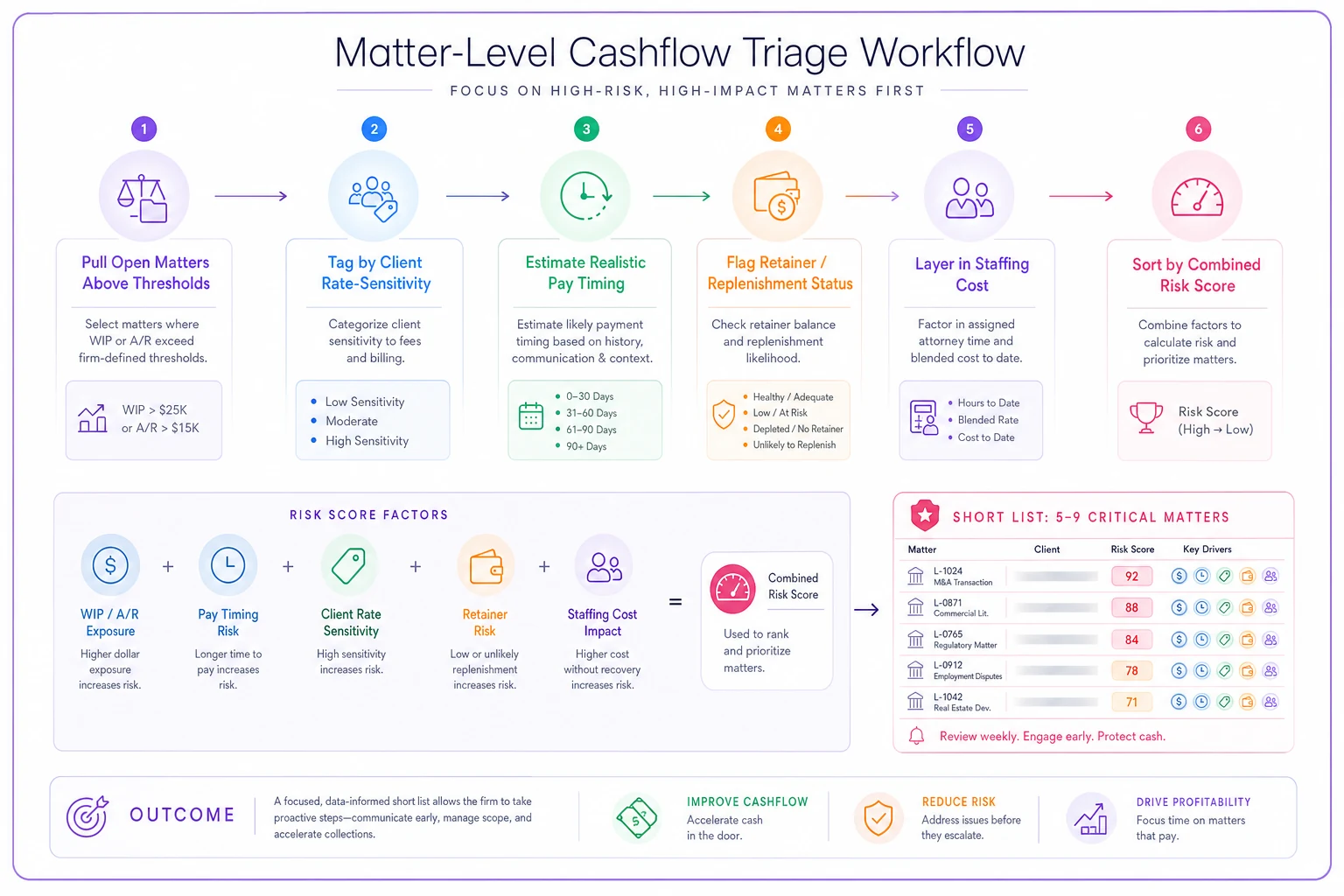
Quick workflow to run the triage:
The retainer moves that matter more than repricing
The first instinct in a tightening cycle is to talk about raising rates. Repricing is real, but slow — it applies to new matters and renewals, and it does almost nothing for the liquidity gap you're facing in the next two months.
| Lever | Speed of cash impact | Client friction | Best used for |
|---|---|---|---|
| Enforce existing replenishment triggers | Fast (days) | Low | Matters already past drawdown threshold |
| Increase evergreen retainer minimums | Medium (weeks) | Medium | Ongoing, high-burn matters |
| Shift to milestone/upfront billing | Medium | Medium-high | New matters, scoped projects |
| Rate increases | Slow (quarters) | High | Renewals and new engagements |
| Interim/progress billing on WIP | Fast | Low-medium | Matters with large unbilled balances |
The overlooked winner here is interim billing on matters carrying heavy WIP. If you've got $40k of unbilled time sitting on a matter because you traditionally bill at a phase boundary, moving to monthly interim billing pulls cash forward without a single awkward conversation about rates. Clients rarely object to being billed for work already done. They object to surprises.
The second overlooked lever is simply enforcing the triggers you already wrote into your engagement letters. Most firms have retainer replenishment terms in place. Almost none of them fire consistently, because it depends on someone noticing the balance dropped below the floor. In a normal quarter, a missed replenishment costs you a little float. In a tightening quarter, it's the difference between covering payroll from cash versus drawing on your line.
Where this connects to something you already know
None of this works if your cash-timing estimates are fiction. The whole triage above depends on being honest about when money actually arrives per matter — and that's a discipline worth building before you need it. If you haven't already mapped how your matter stages translate into realization and cash timing, that groundwork is exactly what we covered in mapping matter-stage probabilities to realization curves and cash-timing forecasts. A rate shock just makes that kind of forecasting the difference between a controlled response and a scramble.
Firms that already have stage-to-cash mapping in place aren't panicking this week. They're re-running numbers they already trust, with a slightly grimmer set of assumptions.
The staffing side people get wrong
The reflex when cash tightens is to freeze hiring and maybe trim. In a firmer labor market, that's often the worst move at the worst time — the people you'd lose are harder to get back.
The smarter play is reallocation, not reduction. When rate-sensitive matters slow, you get underused capacity: associates staffed heavy on a deal that just went quiet. That capacity is expensive to sit idle and cheap to redeploy. The problem is visibility — partners tend to hold onto their people, and nobody has a firm-wide view of who actually has slack this week.
-
Identify matters that slowed in the last two weeks and who's staffed on them
-
Cross-reference against matters that are behind on deadlines or running hot
-
Reassign at the task level, not the whole-person level — shift 30% of someone's week, not their entire book
-
Protect billing continuity — make sure reassigned hours land on matters that actually collect
-
Frame it as coverage, not reassignment, so nobody reads a slow deal as a performance signal
The goal is keeping good people busy on collectible work while rate-sensitive matters figure out their next move.
A real scenario
A mid-sized commercial firm — roughly 22 attorneys, heavy in real estate and finance — went into a similar tightening stretch running around 40% of collections on a floating-rate line. Their firm-level dashboard looked fine: WIP up, AR in a normal range.
When they finally looked one layer down, six engagements tied to rate-sensitive developers accounted for most of their aging risk, and four of those had blown past retainer replenishment floors that nobody had flagged. Their line draw had crept up by around $180k over two months, almost entirely to cover the timing gap those matters created.
They didn't reprice anything. They enforced existing replenishment terms on the four flagged matters, moved two heavy-WIP matters to monthly interim billing, and reassigned two associates off a stalled development deal onto a litigation matter that was behind and — importantly — paying on time. Within about six weeks the line draw came back down close to where it started. Nothing exotic. Just seeing the exposure in time to act on the specific matters causing it.
When to actually pull these levers — and when not to
Run the full triage when: you carry a meaningful floating-rate operating line, a chunk of your book is rate-sensitive, or your replenishment terms exist mostly on paper. That's most commercial and real-estate-heavy firms right now.
Go lighter when: your clients are insulated from rate moves — insurance-funded defense, regulatory work, most personal legal matters — and you're not carrying much credit. Forcing aggressive retainer changes on clients who feel no pinch just creates friction for cash you didn't actually need to accelerate.
Don't cut staff on a single print. One strong payroll number changes rate odds, not certainty. Reduction decisions built on two months of noise tend to cost more than they save, especially when the labor market is firm and rehiring is slow.
The honest read on August isn't panic. It's that the timing gap between your costs and your cash just got more expensive to ignore. Firms that look one layer down — at the matter level, tied to real client behavior and honest pay-timing — can make deliberate moves in the next 60 days. Firms watching only the firm-level total will get the same information a quarter too late, from their line-of-credit statement instead of their own dashboard.
Ready to elevate your legal practice management?
Join 500+ law firms using Casioly to optimize case workflows, reduce administrative burden, and improve client satisfaction.